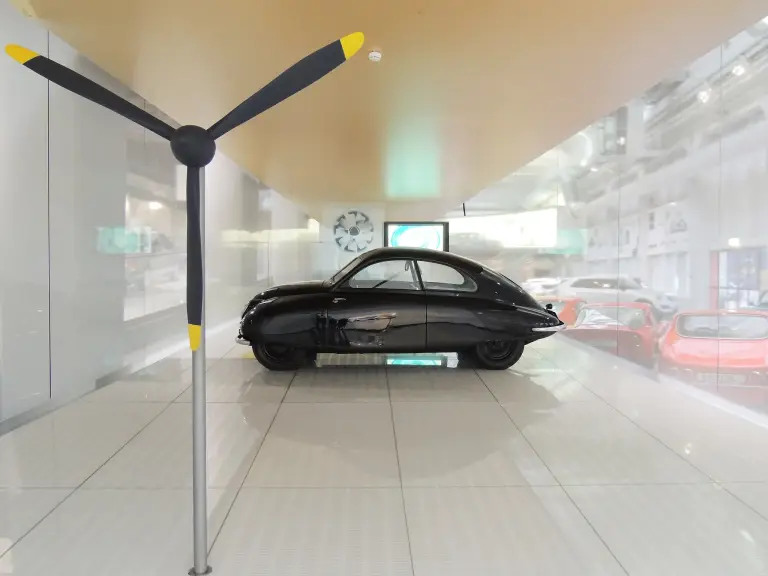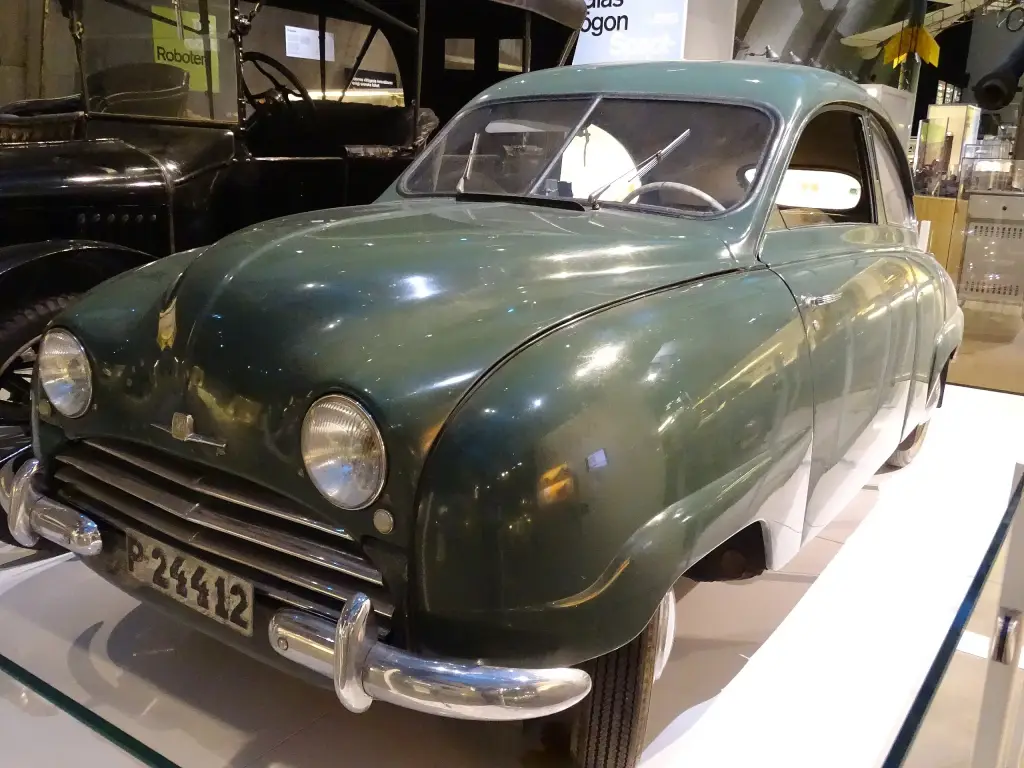
The Saab 92 was the first production car made by Saab, then an aircraft manufacturer. Series production began on 12 December 1949, the body was remarkably aerodynamic for its time, and early cars were painted bottle green because Saab had bought a surplus batch of wartime paint.
Saab 92 at a glance
| Production | 1949–1956 |
|---|---|
| Type | Saab’s first production car |
| Basis | the Ursaab prototype |
| Drag coefficient | 0.30 |
| Body | stamped from one piece of sheet metal, then cut for doors and windows |
| Engine | 764 cc water-cooled two-cylinder two-stroke, 25 hp |
| Top speed | 105 km/h |
| Gearbox | three-speed, first unsynchronised, with a freewheel |
| Suspension | torsion bars |
| Colour | bottle green at first |
| Built | 20,128 |
Based on one source, the English Wikipedia article on the 92.
History of the Saab 92
The 92 was developed from the Ursaab prototype and put into production on 12 December 1949. Its body was aerodynamic for the period, with a drag coefficient of 0.30, and the whole shell was stamped from a single piece of sheet metal and then cut open for the doors and windows. Every car was the Deluxe version: a standard model was advertised, but no one wanted to buy it, so none were built.
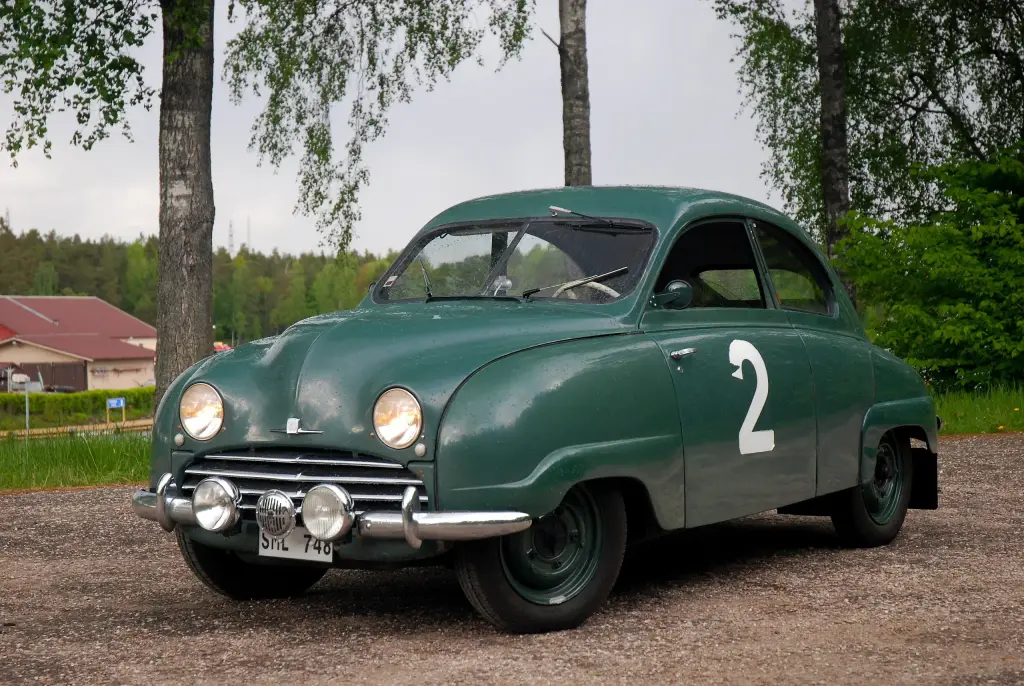
The engine was a transversely mounted, water-cooled two-cylinder two-stroke of 764 cc, based on a DKW design, producing 25 hp and giving a top speed of 105 km/h. The three-speed gearbox had an unsynchronised first gear, and a freewheel device was fitted to prevent oil starvation when the engine was used for braking. Suspension was by torsion bars.
All early Saab 92s were painted dark green, close to British racing green. According to one account, Saab had bought a large consignment of green cellulose paint originally ordered by the armed forces for camouflage; the colour did not suit the terrain, the whole batch was sold off, and Saab bought it, which is why both its aircraft and its first cars were green. The paint became something of a trademark.
A total of 700 cars of the 1950 model were made. In 1951 German VDO instruments replaced the original American Stewart-Warner components. The 92B arrived in 1953 with a much larger rear window and a larger luggage space with an opening lid, and it was now available in grey, blue-grey, black and green. In 1954 a new Solex 32BI carburettor and ignition coil raised output to 28 hp, the American headlights were replaced with Hella units, and a textile roof was offered as an option; maroon was added to the colours. In 1955 came an electric fuel pump and square tail lights in the rear wings.
The Saab 93 was introduced in December 1955, but the 92B and the 93 were built alongside each other for a while, and the last 92 was assembled in late 1956 or early 1957. In total 20,128 Saab 92s were made. The car’s competition history began two weeks after its launch, when Saab’s chief engineer Rolf Mellde finished second in his class on the Swedish Rally; in 1952 Greta Molander won the Coupe des Dames on the Monte Carlo Rally in a 92 tuned to 35 hp.
Design and features
- Aircraft thinking: a one-piece pressed body and a drag coefficient of 0.30.
- Two-stroke engine: 764 cc, 25 hp and a freewheel to protect it on overrun.
- Torsion-bar suspension: unusual for a small car of 1949.
- Bottle green: the surplus paint that became Saab’s first trademark colour.
Saab 92 versions
- 92 (1949–1953): the original car, all in green, with Stewart-Warner instruments at first.
- 92B (1953–1956): larger rear window, opening boot lid and a wider choice of colours.
- 1954 and 1955 updates: 28 hp, Hella headlights, optional textile roof, electric fuel pump.
The 92 was replaced by the Saab 93 and developed from the Ursaab prototype, which was disguised during testing as the Paddan. More cars are in the Saab collection.
Video: Saab 92 1953
Video by the uploader on YouTube.
Sources
- Saab 92, English Wikipedia: design, engine, colours, production