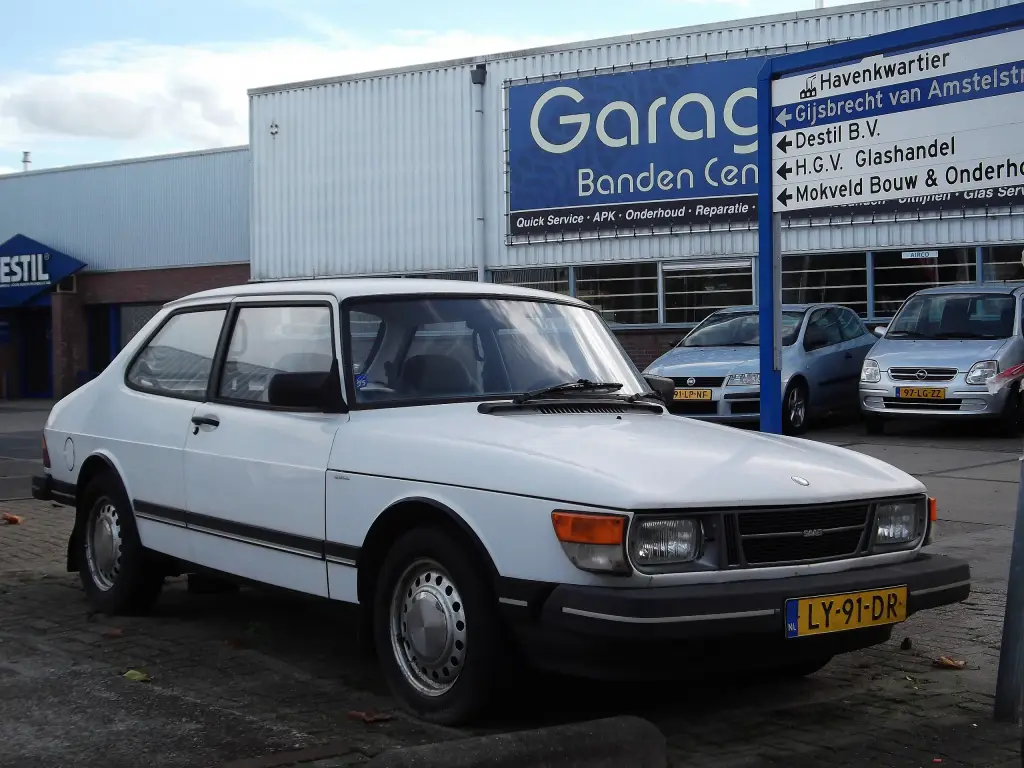
The Saab 90 was a family car built from September 1984 to 1987 in Uusikaupunki, Finland. It was created by welding the front half of a Saab 99 to the rear half of a Saab 900 sedan, a solution proposed by the Finnish engineers at Saab-Valmet.
Saab 90 at a glance
| Production | September 1984–1987 |
|---|---|
| Assembly | Uusikaupunki, Finland, by Saab-Valmet |
| Body | two-door sedan |
| Layout | Saab 99 front, Saab 900 sedan rear |
| Engine | 2.0-litre Saab H, 100 PS |
| Gearbox | four- or five-speed manual |
| Fuel | unleaded, thanks to hardened valve seats |
| Luggage space | 377 litres, up from 320 |
| Built | 25,378 |
| Special edition | Saab 90 Lumikko, ten cars for Finland |
Based on one source, the English Wikipedia article on the Saab 90.
History of the Saab 90
When the Saab 96 went out of production in 1980, Saab needed a new base model for Europe. At the same time the people at Saab-Valmet in Finland were worried about the future of the Saab 99, which was built entirely in their factory. Their first attempt in 1983 welded the front of a Saab 900 to the rear of a 99; the head of Saab’s car division, Sten Wennlo, said the idea was good but the result looked too much like a 900.
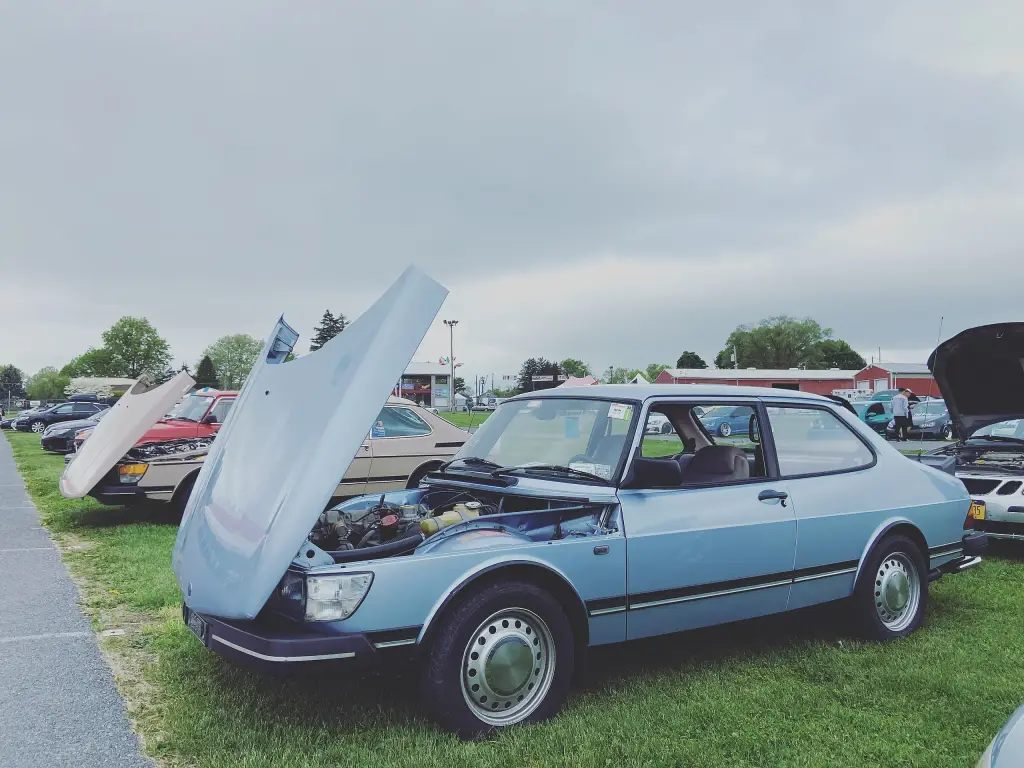
Wennlo wanted the opposite combination. In March 1984 he asked the Saab illustrator Rony Lutz to cut together two press photographs, the front of a 99 and the rear of a 900 sedan, and the sheet metal workers at Uusikaupunki then built the real thing. The design manager Björn Envall saw the car only after the two bodies had been welded together. The name changed from 99 to 90 so that it would fit better with the 900 and the new 9000.
The 90 was sold as a two-door sedan only. Its 2.0-litre Saab H engine produced 100 PS, and the car came with a four- or five-speed manual gearbox, the five-speed version having closer ratios, spoilers and lower-profile tyres. The new rear end brought a larger fuel tank and increased luggage space from 320 to 377 litres. The valve seats were hardened so the engine could run on unleaded fuel, and the car received a new starter motor and a more upright steering wheel. Small changes followed in 1986 and 1987.
For the Finnish market a limited edition called the Lumikko was built in 1985: ten white cars by Scan-Auto with the Saab Airflow kit, a spoiler, Saab 900 Aero wheels, a sunroof, extra instruments and a leather steering wheel. All ten took part in Scan-Auto’s 20th anniversary parade in Tampere, and three are said to survive with the Finnish Saab club.
In total 25,378 Saab 90s were built, sold in a limited number of European countries. About 10,000 went to Sweden, 1,154 to the Netherlands and about 600 to Germany. Falling sales made it uneconomical to fit a catalytic converter, so 1987 was the last year. The final car was built on 1 July 1987 and went straight to the Saab museum in Trollhättan.
Design and features
- Two Saabs in one: the front of a 99 and the rear of a 900 sedan in a single body.
- Finnish production: built only at Uusikaupunki by Saab-Valmet.
- Unleaded fuel: hardened valve seats allowed the engine to run without leaded petrol.
- Bigger boot: the 900 rear end raised luggage space to 377 litres.
Saab 90 versions
- Standard 90: 2.0-litre engine with a four-speed manual gearbox.
- Five-speed 90: closer gearing, spoilers and lower-profile tyres.
- Lumikko (1985): ten white cars for Finland with the Airflow kit and 900 Aero wheels.
The 90 was a continuation of the Saab 99 and shared its rear with the Saab 900. It was replaced in the range by the smaller Saab 9000 line. More cars are in the Saab collection.
Video: Saab 90 Test Drive & Overview (2003)
Video by the uploader on YouTube.
Sources
- Saab 90, English Wikipedia: history, engines, sales, Lumikko