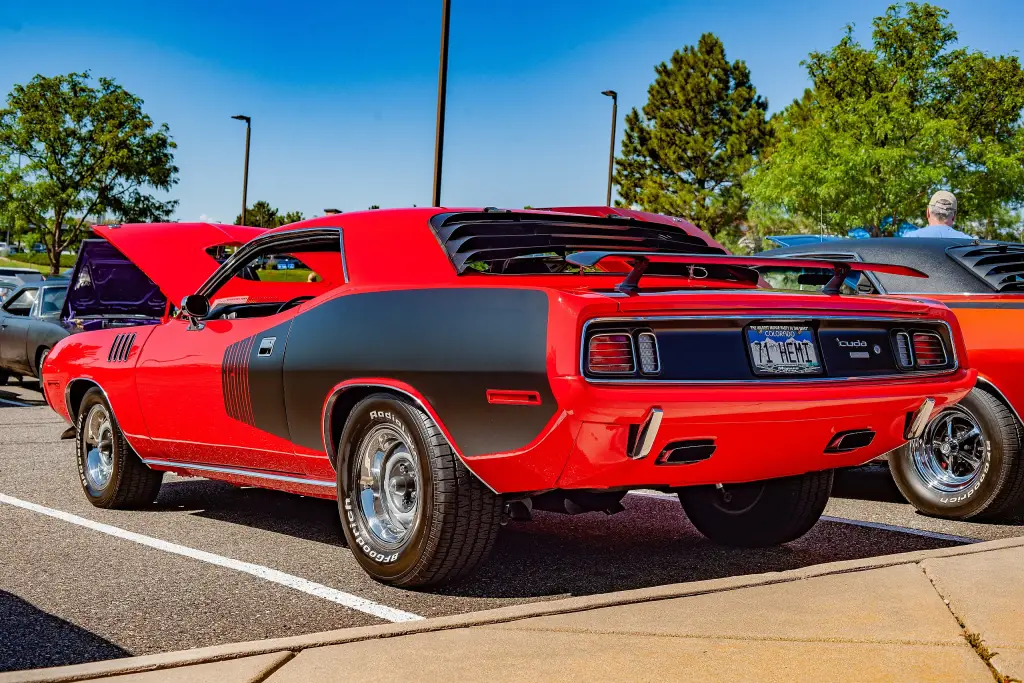
The Hemi ‘Cuda is the most powerful version of the third-generation Plymouth Barracuda, a two-door pony car built by Chrysler Corporation in the 1970 and 1971 model years with Chrysler’s 426 cu in (7.0 L) Hemi V8. The high-performance Barracudas were marketed as ‘Cuda, a name that came from a 1969 option.
Plymouth Hemi ‘Cuda at a glance
| Barracuda built | 1964 to 1974 model years, in three generations |
|---|---|
| Hemi years | 1970 and 1971; 1971 was the last year for the 426 Hemi |
| Platform | Chrysler E-body, shared with the Dodge Challenger |
| Styling | John E. Herlitz |
| Engine | 426 cu in (7.0 L) Hemi V8 with two four-barrel Carter carburettors |
| Output | 425 bhp (317 kW) SAE gross at 5,000 rpm and 490 lb·ft (664 N·m) at 4,000 rpm |
| Quarter mile | 13.4 seconds at 108 mph (173 km/h), according to German Wikipedia |
| Hemi option, 1971 | an extra $1,228, with very few sold |
| 1971 Hemi convertible | 13 built, seven of them sold in the United States |
| Record sale | $3.5 million at Mecum, Seattle, June 2014 |
History of the Plymouth Hemi ‘Cuda
The Barracuda debuted in fastback form on 1 April 1964, based on Chrysler’s A-body and sharing most of its parts with the Plymouth Valiant. Plymouth’s executives had wanted to call it the Panda, an idea unpopular with its designers; John Samsen’s suggestion of Barracuda prevailed. The second generation of 1967 to 1969 was heavily redesigned but still Valiant-based, and in 1969 Plymouth placed an increased emphasis on performance and released a new trim package called ‘Cuda, available with the 340, 383 and new 440 Super Commando V8s.
The E-body
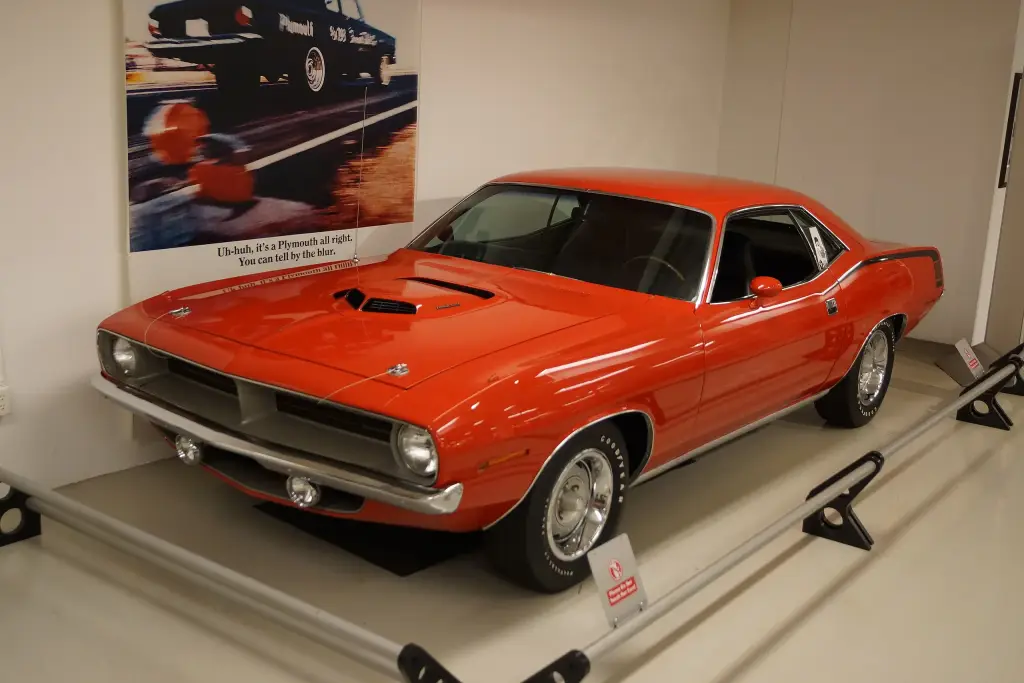
The all-new 1970 Barracuda was styled by John E. Herlitz and built on a shorter, wider version of Chrysler’s B platform, called the E-body. The redesign removed all commonality with the Valiant, and the fastback was dropped, so that the Barracuda came only as a coupé and a convertible. It shared its platform with the newly launched Dodge Challenger but no exterior sheet metal; the Challenger’s wheelbase of 110 inches was 2 inches longer and its body 5 inches longer. The new engine bay was larger than that of the old A-body and made room for Chrysler’s 426 Hemi. Three versions were offered for 1970 and 1971: the base Barracuda, the luxury Gran Coupe and the sporting ‘Cuda.
The ‘Cuda came as standard with a 383 cu in V8 of 335 hp SAE gross. Options included the 340 cu in “Six Barrel” with three two-barrel carburettors at 290 hp, a 440 cu in four-barrel Super Commando at 375 hp, a 440 Six Barrel at 390 hp and the 426 Hemi at 425 hp. The 440 and Hemi cars received upgraded suspension and structural reinforcements to put the power on the road. In 1970 and 1971 only, the Shaker hood, a scoop attached to the engine that shook with it and poked through the bonnet, and the heavy Spicer Dana 60 rear axle with a 9.75 in ring gear were available; the Dana 60 was standard with manual gearboxes and the 440 Six Barrel and Hemi engines. Buyers could also pick unusual “high impact” colours such as Lime Light, Bahama Yellow, Lemon Twist, Vitamin C, In-Violet and Moulin Rouge.
German Wikipedia gives quarter-mile times of 13.7 seconds at 103 mph for the 440 Six Barrel and 13.4 seconds at 108 mph for the Hemi. That performance came at a price: tests of the period criticised the cramped, uncomfortable interior and tiny boot, and poor handling and braking, especially with the larger, heavier engines.
1971 and the end of the Hemi
The 1971 car got a new grille and tail-lights, and it was the only year with four headlights and with fender “gills” on the ‘Cuda. The 340 Six Barrel was gone, and the 440 four-barrel could only be had by special order, with perhaps a dozen built. Compression ratios were reduced in most engines so they could run on regular petrol, except for the 426 and the high-performance 440. The Hemi cost an extra $1,228 and very few were sold, and 1971 was its last year. The Barracuda continued to 1974, but its power fell as emission and safety rules tightened, and it was discontinued on 1 April 1974, ten years after production began, a victim of the 1973 energy crisis.
Racing and rarity
Swede Savage and Dan Gurney raced identical factory-sponsored AAR ‘Cudas in the 1970 Trans-Am Series. They qualified for three pole positions but did not win any race, the best finish being second at Road America. Chrysler France raced four 1970 Hemi ‘Cudas from 1970 to 1973, and one won four French Group 1 class championships. Today the 1970–1974 E-body cars are collectible, and the 1971 Hemi ‘Cuda convertible is considered one of the most valuable muscle cars: only thirteen were built, seven of them sold in the United States, and a blue 4-speed car sold for $3.5 million at the Mecum auction in Seattle in June 2014. German Wikipedia counts 12 cars. The replica Hemi ‘Cudas driven in the late-1990s police series Nash Bridges had no Hemi under the bonnet.
Design and features
- Engine: the 426 Hemi, rated at 425 bhp, with two four-barrel carburettors.
- Hardware: the Shaker hood and the Dana 60 rear axle, both available only in 1970 and 1971.
- Colours: loud “high impact” paints, with names such as Vitamin C and In-Violet.
Plymouth Hemi ‘Cuda versions
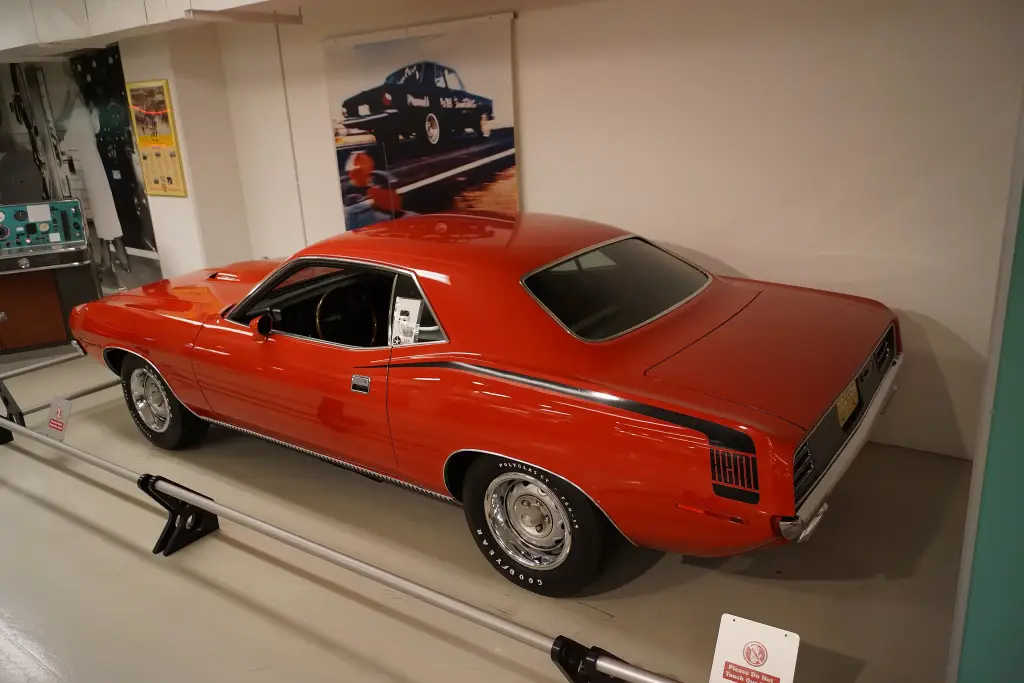
- Hemi ‘Cuda hardtop (1970–1971): the main version.
- Hemi ‘Cuda convertible (1971): 13 built and now the rarest.
- AAR ‘Cuda (1970): the Trans-Am racing version, with a 340 Six Barrel engine.
- 440 Six Barrel ‘Cuda: the three-carburettor 440 alternative to the Hemi.
The Hemi ‘Cuda is covered with the whole car in the Plymouth Barracuda article. Its stablemates were the Plymouth Superbird and the Dodge Charger Daytona; the engine is explained in Muscle car engines decoded. More cars are in our Plymouth collection.
Sources
- Plymouth Barracuda, English Wikipedia: generations, 1970–1971 E-body, engines, racing, collectibility
- Plymouth Barracuda, German Wikipedia: quarter-mile times, the Hemi convertible and the end of production