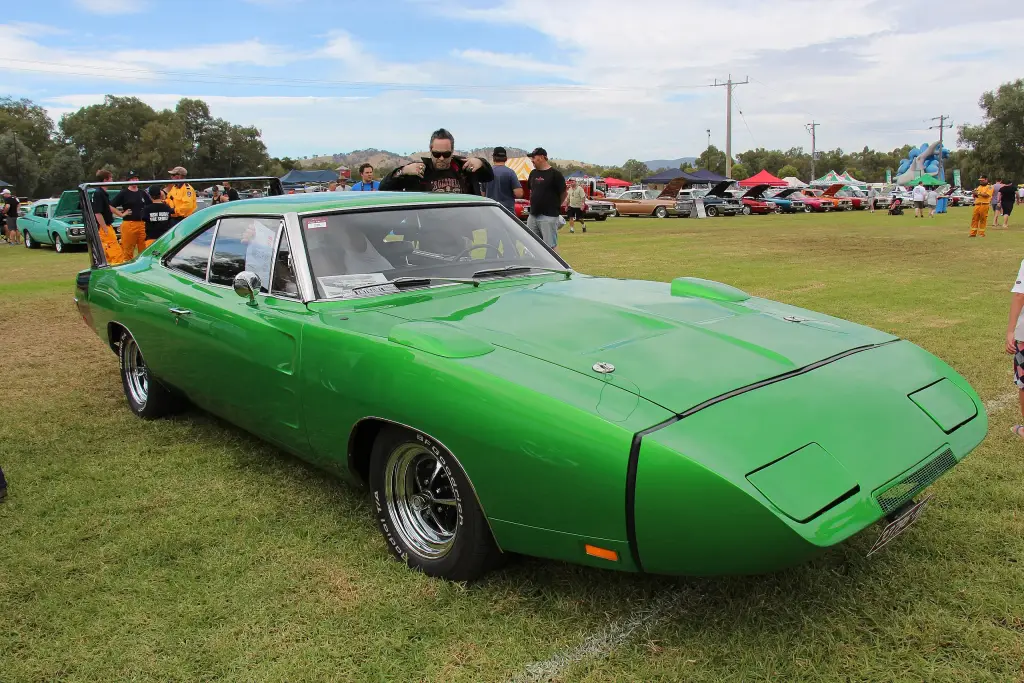
Dodge produced three separate models with the name Charger Daytona, all of them modified Chargers. The original, of 1969, was designed to beat the competition in NASCAR racing, and it was the first NASCAR vehicle to reach 200 miles per hour.
Dodge Charger Daytona at a glance
| Built | 1969 model year, in the summer of 1969 |
|---|---|
| Purpose | to win high-profile NASCAR races |
| Rear wing | 23 inches (584 mm) tall |
| Base car | 1969 Charger R/T specification |
| Standard engine | 440 cu in (7.2 L) Magnum V8 |
| Hemi option | 426 cu in (7.0 L), fitted to 70 of the 503 cars |
| First win | the inaugural Talladega 500, in the fall of 1969 |
| 200 mph | Buddy Baker, 24 March 1970, at Talladega |
| Race wins | six: two in 1969 and four in 1970 |
History of the Dodge Charger Daytona
With the racing failure of the 1968 Charger 500 in NASCAR and Plymouth’s star driver Richard Petty leaving for Ford, Dodge created the 1969 Charger Daytona. It was a high-performance, limited-edition Charger produced in the summer of 1969 for the sole purpose of winning NASCAR races. The Daytona won the inaugural Talladega 500 that fall, although the top names had left the track on Saturday in a boycott of the race.
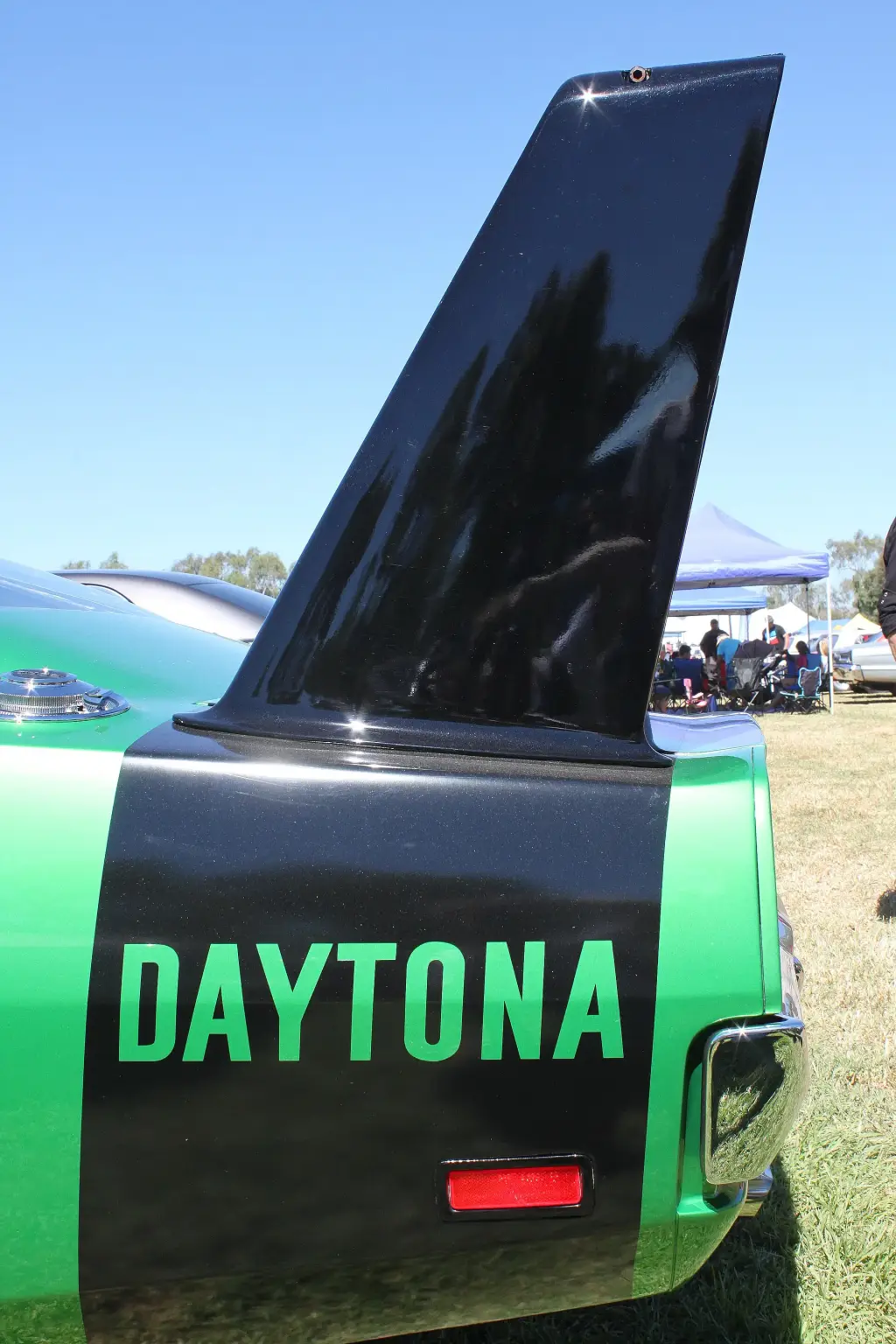
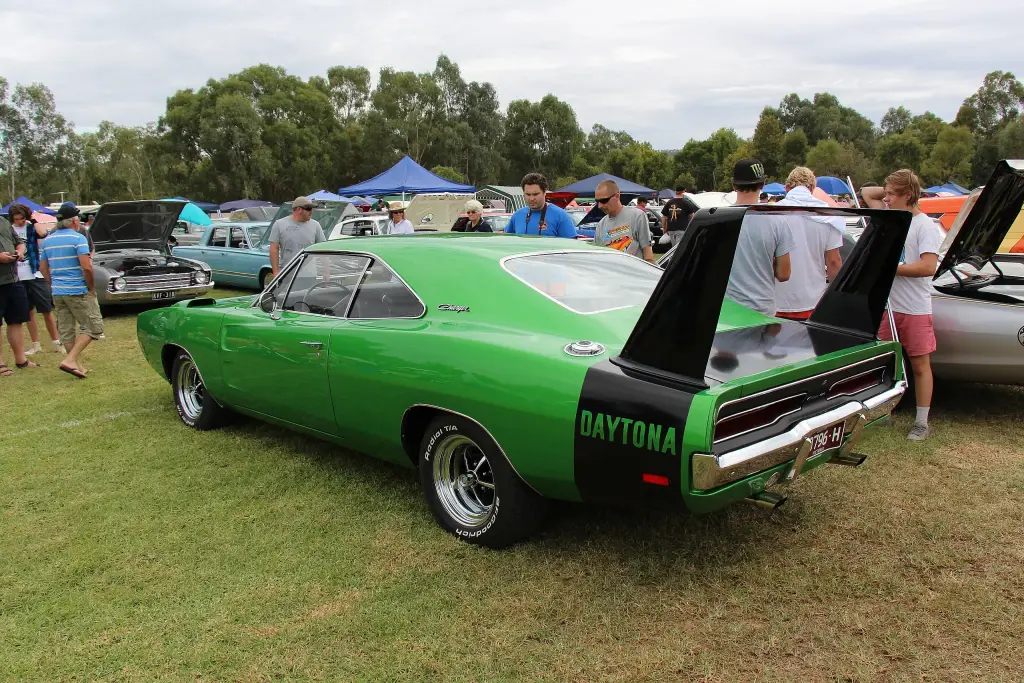
The Daytona was one of two famous aero cars, with special body modifications: a 23-inch-tall stabiliser wing on the rear deck, a sheet-metal nose cone replacing the upright grille, a flush rear window with a cap over the original recessed rear window, specific front fenders and hood based on the 1970 Charger, stainless steel A-pillar covers and fender-mounted cooling scoops. It was built to the R/T specification, with heavy-duty suspension and brakes and a 440 cu in Magnum engine as standard. The optional 426 cu in Hemi, fitted to only 70 of the 503 Daytonas, is of special note to collectors.
Racing record
On 24 March 1970 Buddy Baker, in the No. 88 Chrysler Engineering Charger Daytona, became the first driver in NASCAR history to break 200 mph (322 km/h), at Talladega. The Daytona won two races in 1969 and four in 1970, six in total; its successor, the 1970 Plymouth Superbird, won eight, all in 1970. Dodge Daytonas also won on the USAC and ARCA circuits and set many race and pole records.
The “Winged Warriors” did not compete for long in NASCAR’s top Grand National series. For the next season executives banned aero specifications on cars with engines larger than 305 cubic inches, the same five-litre limit imposed by the SCCA for the Trans-Am and by the FIA for Group 5. NASCAR then effectively banned all four aero cars, from Dodge, Ford, Mercury and Plymouth, from competition by the end of 1970. The 1971 Daytona 500 had only one winged car, which finished seventh.
The Daytona name returns
The name came back on the Charger in 1975–77, when the car was a re-badged Chrysler Cordoba and the Daytona was a two-tone stripe-and-decal package. For 2006 the reintroduced Charger had a limited Daytona package with a sportier interior, high-impact colours and a rear spoiler. The 2013 Charger Daytona debuted at the 2012 Los Angeles Auto Show with a 370-horsepower Hemi V8, and only 3,000 were made.
Design and features
- Nose and wing: a sheet-metal nose cone and a tall rear stabiliser wing for high-speed stability.
- Body details: a flush rear window, stainless A-pillar covers and fender scoops.
- Engines: a 440 cu in Magnum as standard and a 426 Hemi as an option.
Dodge Charger Daytona versions
- 1969 Charger Daytona: the winged NASCAR homologation car, 503 built.
- 1975–1977: a stripe-and-decal package on the Cordoba-based Charger.
- 2006–2009: a limited Daytona package on the new Charger.
- 2013: a limited edition of 3,000 cars.
Plymouth’s answer was the Plymouth Superbird. More Dodges are in our Dodge collection.
Sources
- Dodge Charger Daytona, English Wikipedia: all three generations, racing and production figures