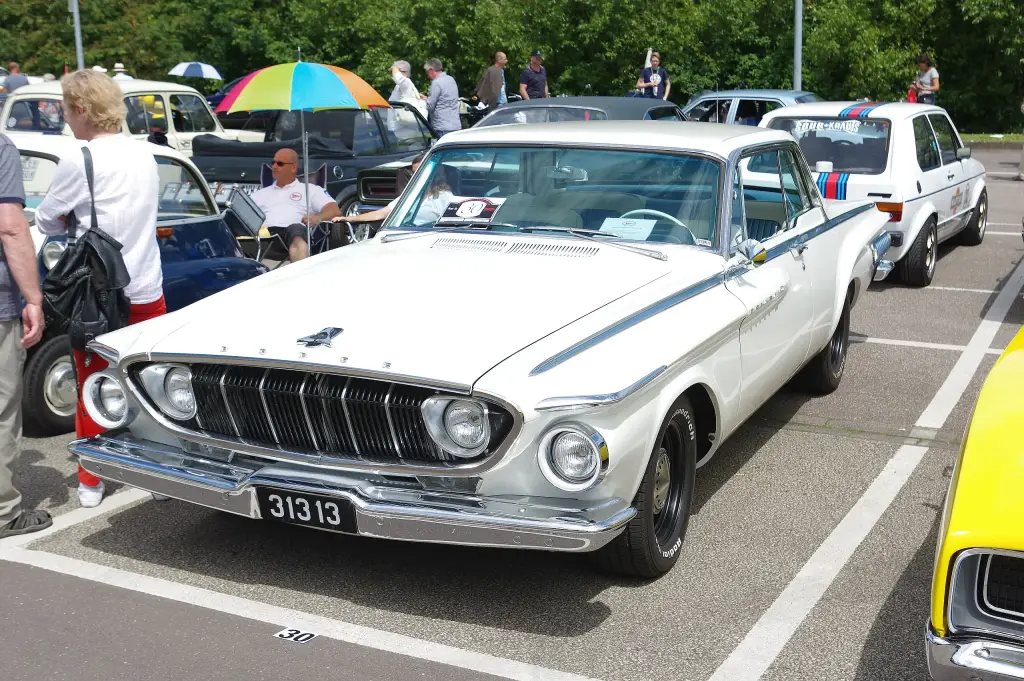
The Dodge Polara was introduced in the United States for the 1960 model year as Dodge’s top-of-the-line full-size car. After the Custom 880 arrived in 1962 the Polara became a step below the best-trimmed full-size Dodge, and in that year it had been downsized to what was effectively intermediate size. The name stayed in the range until 1973, when the Dodge Monaco took its place.
Dodge Polara at a glance
| Production | 1960-1973 |
|---|---|
| Class | full-size car, later mid-size |
| 1960 wheelbase | 122 in, shared with the Matador |
| 1962 platform | first Chrysler B-body, 116 in wheelbase |
| 1960 body styles | convertible, two- and four-door hardtops, sedan, wagon |
| 1960 grille | eight stacks of anodised aluminium rectangles |
| 1961 production | 14,032 full-size Dodges in the United States |
| Police order | 1,236 cars for the California Highway Patrol |
| Replaced by | Dodge Monaco in 1973 |
Based on one source: the English Wikipedia article on the Dodge Polara.
History of the Dodge Polara
The 1960 Polara and the other full-size Dodges carried styling cues from the 1959 models, themselves an evolution of Virgil Exner’s Forward Look cars of 1957, and 1960 was the first year in which all Chrysler models except the Imperial used unibody construction. The Polara and Matador kept the 122-inch wheelbase of their predecessors, while the new full-sized Dart line used a shorter 118-inch wheelbase shared with Plymouth. The Polara came as a two-door convertible, two-door hardtop, four-door hardtop sedan, four-door hardtop station wagon and a conventional pillared four-door sedan.
The 1960 Dodges kept the stacked jet-pod tail lights, but the lamps were significantly larger than before, with the lower lights set into the rear bumper. The shortened tail fins carried small vertical tail light lenses on their rear surface, and the clipped fin exaggerated the length of the jet pods. The front had a small grille of eight stacks of anodised aluminium rectangles in a massive chrome bumper. As the top model, the Polara had better interior fabrics and trim, more exterior chrome including stone guards behind the rear wheel arches, a full-length chrome spear and a broad chrome base above the headlight housings.
For 1961 Dodge dropped the Matador, leaving the Polara as the only senior Dodge while the shorter Darts continued. Exner’s studio reversed the fins, making them taller as they flowed towards the rear window and cutting slightly towards the centre to allow a single tail light housing on each side, wrapping down and back along the wing in a C-shaped chrome line. The massive front bumpers that had been a Dodge hallmark since 1957 gave way to a simple bar with a large concave grille shared with the Dart. Buyers turned away from the restyle: full-size Dodge sales fell to their lowest level since the company was founded in 1914, with only 14,032 built in the United States, while the Dart carried the make with 142,000 sales. Dodge sales overall fell 53 per cent against 1960 and the brand dropped from sixth to ninth in the market.
A special order of 1,236 cars was built for the California Highway Patrol under trim code 999. These four-door sedans were essentially low-cost models with rubber floor mats, grey vinyl interiors and limited chrome, because California insisted on a longer-wheelbase pursuit vehicle than the Dart. Power came from a 383 high-output V8 with a 413 camshaft and a four-barrel Carter carburettor. The 1961 Polara bodyshells were reused the following year for the 1962 Chrysler sedans and convertibles, which mated updated 1961 Chrysler front ends to the now de-finned 1961 Polara bodies, and the 1962 Chrysler wagons used a 1961 Plymouth wagon body instead.
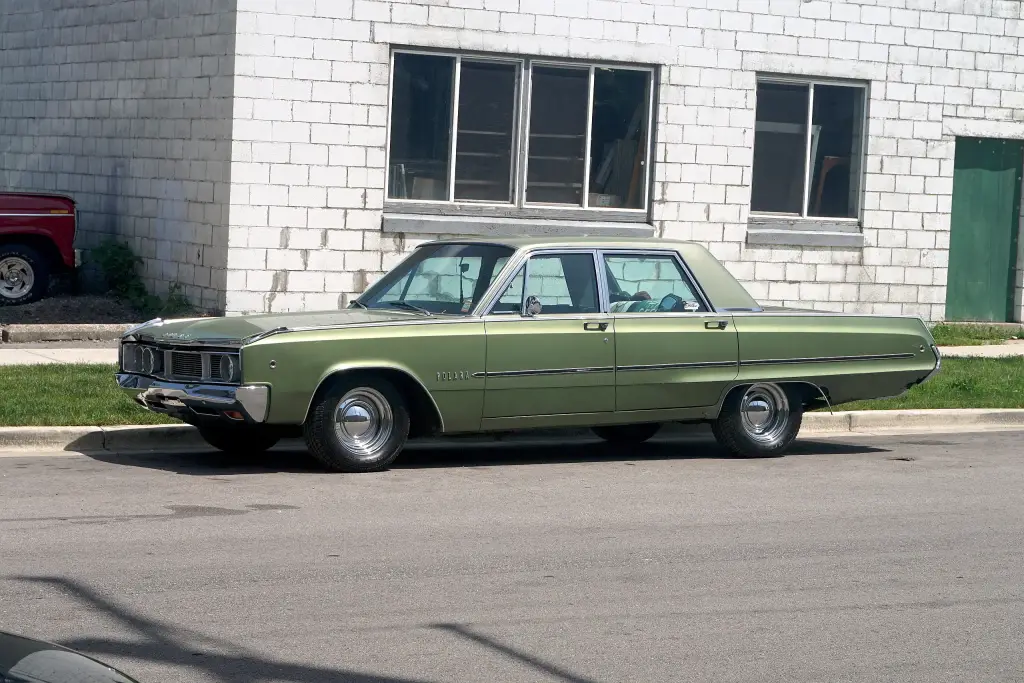
All Dodge models were redesigned for 1962 with smaller, lighter and more sculpted bodies on a 116-inch wheelbase, the first Chrysler B-body. The change followed Chrysler’s president misunderstanding a remark by Chevrolet’s Ed Cole that Chevrolet’s largest cars would be downsized for 1962, which forced Chrysler designers to shorten the planned full-size Dodge at the last moment. The Polara, now below the new Custom 880, continued in various forms until 1973, when the Monaco replaced it in the Dodge range. The name Polara refers to the Polaris star, chosen to appeal to the excitement around the Space Race in the early 1960s.
Design and features
- Flagship to mid-range: Dodge’s top full-size car in 1960-1961, then a step below the Custom 880.
- Jet-age styling: oversized stacked tail lights and shortened fins with vertical lenses.
- Police special: 1,236 cars for the California Highway Patrol with a 383 high-output V8.
- First B-body: the 1962 Polara moved to Chrysler’s new 116-inch B platform.
Dodge Polara versions
- Polara (1960): the top full-size Dodge with the 122-inch wheelbase.
- Polara (1961): the reversed-fin restyle and the only senior Dodge.
- Polara (1962-1964): the downsized B-body mid-range model.
- Polara 500 and later models: the sporty and luxury versions of the later line.
The Polara was the senior partner of the Dodge Matador in 1960 and sat above the Dodge 440 in the early 1960s, before the Dodge Monaco took its place. More Dodge models are in the Dodge collection.
Sources
- Dodge Polara, English Wikipedia: 1960-1961 models, styling, police order, 1962 change