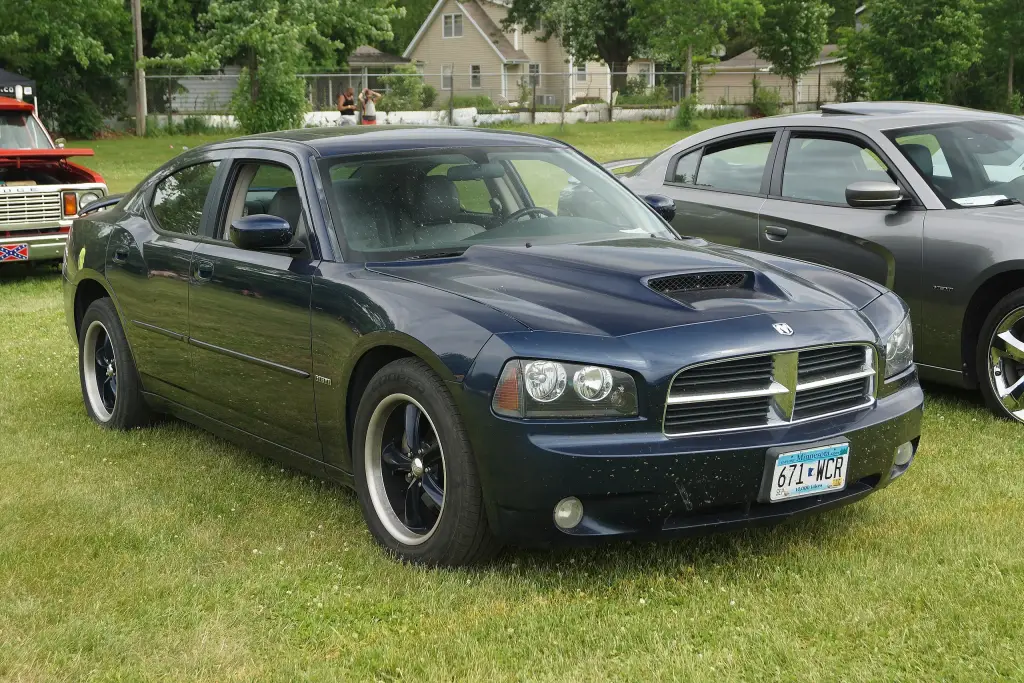
The sixth- and seventh-generation Dodge Charger are full-size four-door sedans first shown at the 2005 North American International Auto Show. The sixth generation replaced the Dodge Intrepid as Dodge’s full-size sedan and brought the Charger name back to a rear-wheel-drive platform.
Dodge Charger (2006) at a glance
| Production | 2006-2023 model years |
|---|---|
| Class | full-size sedan |
| Platform | Chrysler LX (sixth generation); LD for the seventh |
| Drive | rear-wheel drive or all-wheel drive |
| Mercedes-derived parts | E-Class and S-Class suspension, W5A580 gearbox, ESP, electrical architecture |
| Base engines | 2.7 L and 3.5 L Magnum V6 |
| AWD split | about 60 per cent rear, 40 per cent front |
| Predecessor | Dodge Intrepid |
| Seventh generation | from the 2011 model year |
| Eighth generation | introduced in 2024 |
Based on one source: the English Wikipedia article on the 2006 Dodge Charger.
History of the Dodge Charger (2006)
The first Charger was a 1964 show car based on the Dodge Polara with a 426 Wedge V8, and the first production Charger, based on the Coronet, arrived as a 1966 model. Several different vehicles have carried the name on three different platforms, including personal luxury coupes in the late 1970s and front-wheel-drive subcompact hatchbacks in the 1980s. In 1999 Dodge showed a new Charger R/T concept that took styling cues from the 1960s cars, with a long nose and rearward cabin but a four-door body, and it was shorter and 650 lb lighter than the 1966 car. The production car that followed in 2005 was a return to a rear-wheel-drive sedan platform Dodge had not offered since the mid-size Diplomat was discontinued in 1989.
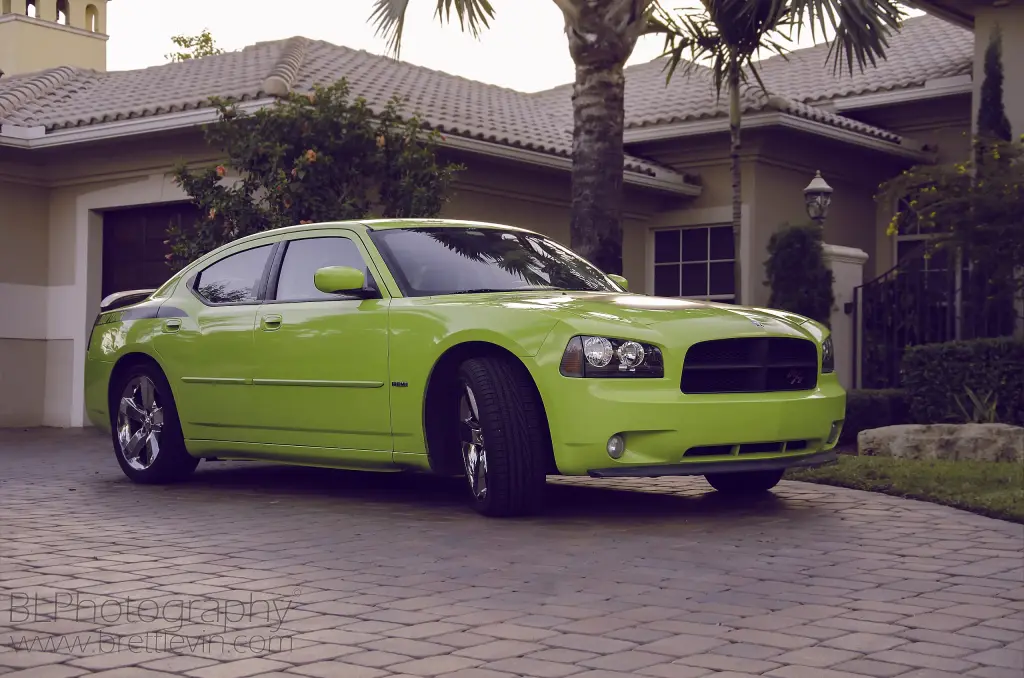
The sixth-generation Charger was based on the rear-wheel-drive Chrysler LX platform. Chrysler executives confirmed that structural elements such as the toe board, safety cage and load-path philosophy were used by then-partner Mercedes-Benz, and Mercedes executives confirmed that several components came from the W211 E-Class and the S-Class of the period. Shared or derived parts included the rear suspension cradle and five-link independent rear suspension from the E-Class, a double-wishbone front suspension with S-Class geometry, the five-speed NAG1 W5A580 transmission, the rear differential, driveshaft, ESP and ABS systems, the steering system, the CAN bus electrical architecture, cabin electronics, switchgear, seat frames and wiring harness. Later cars even used a Mercedes-derived laser key ignition, and all-wheel-drive models used Mercedes 4MATIC transfer case components. Rivals included the Ford Taurus and Five Hundred, Pontiac G8, Chevrolet Impala, Nissan Maxima, Hyundai Azera and Toyota Avalon.
Both the SXT and R/T models were available with rear- or all-wheel drive from 2007. The all-wheel-drive system was engaged at all times, sending about 60 per cent of the power to the rear wheels and 40 per cent to the front. After three years of production the 2009 cars received an update: the CHARGER badging moved from the left of the boot lid to the right to make room for DODGE on the left, the tail lights were revised, and the 2009 all-wheel-drive cars used a BorgWarner Torque-on-Demand system that disconnected the front axles until extra traction was needed, giving a small gain in fuel economy.
A base model with no name sat at the bottom of the range, powered by a 3.5-litre Magnum V6 in 2006 and 2007 and a 2.7-litre Magnum V6 from 2008, with four- or five-speed automatics depending on the year and drive type. It came with 17-inch steel wheels and plastic covers, an AM/FM radio with a single-disc CD player, cloth seats, power windows and locks, remote keyless entry and air conditioning, while ABS, satellite radio and cruise control were options. A SE Plus model was offered only for 2008. The seventh-generation Charger arrived for 2011, and in November 2021 Stellantis announced that the 2023 model year would be the last for the Charger and Challenger as the company turned to electric cars; the eighth-generation Charger was introduced in 2024, replacing both the seventh-generation Charger and the third-generation Challenger.
Design and features
- LX platform: rear-wheel drive with Mercedes E-Class and S-Class suspension designs.
- All-wheel drive: available on SXT and R/T, normally splitting power 60/40.
- Mercedes switchgear: from the gearbox and ESP to the seat frames and laser key.
- Four-door muscle sedan: a return to rear-wheel drive after the front-wheel-drive Intrepid.
Dodge Charger (2006) versions
- Base model: 3.5-litre V6 in 2006-2007 and 2.7-litre V6 from 2008.
- SXT: the volume model with rear- or all-wheel drive.
- R/T: the V8 version of the range.
- SE Plus (2008): a single-year trim above the base car.
The four-door Charger replaced the Dodge Intrepid and shared its LX platform with the Dodge Magnum and the modern Dodge Challenger. More Dodge models are in the Dodge collection.
Sources
- Dodge Charger (2006), English Wikipedia: history, LX platform, trims, end of production