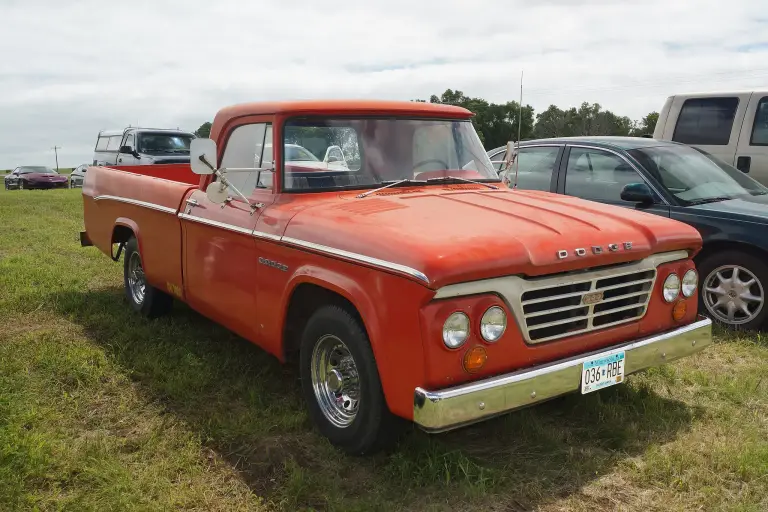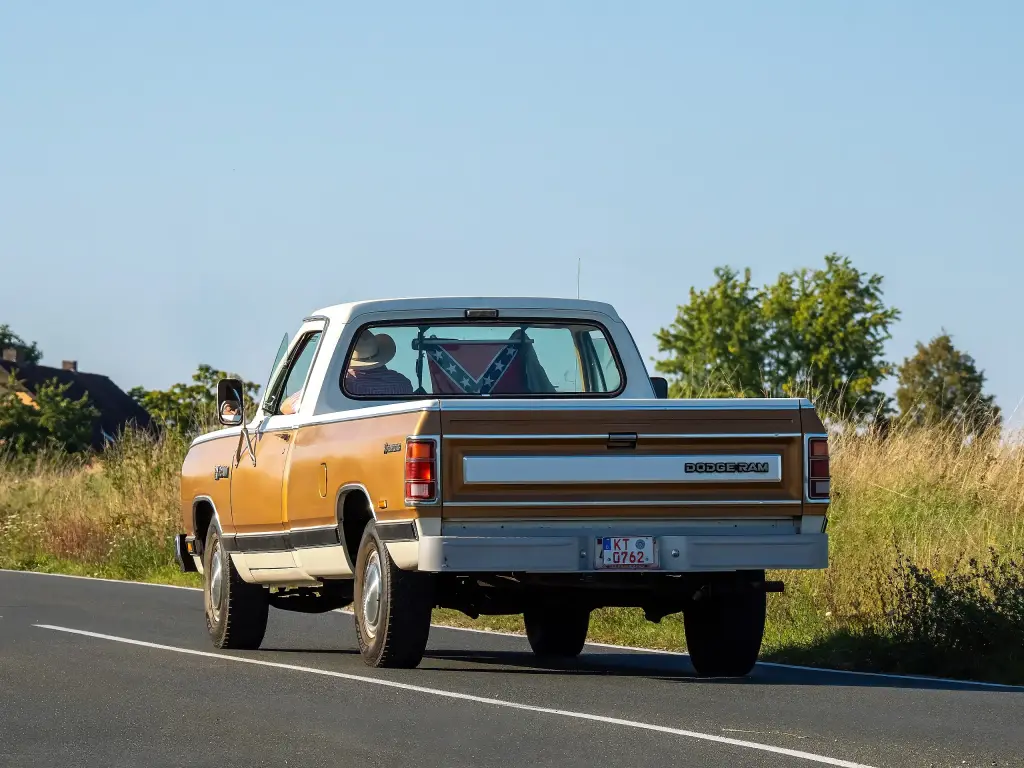
The Ram pickup, sold as the Dodge Ram until 2010, is a full-size pickup truck that Chrysler has built in several generations. The Ram name was introduced in October 1980 for the 1981 model year, when Dodge rebranded its D series pickups and B series vans, although a ram’s-head hood ornament had appeared on some Dodge trucks as early as 1933.
Dodge Ram at a glance
| Name introduced | October 1980, for the 1981 model year |
|---|---|
| Class | full-size pickup truck |
| Model designations | D or Ram for two-wheel drive; W or Power Ram for four-wheel drive |
| Payload series | 150 half-ton, 250 three-quarter-ton, 350 one-ton |
| Cabs | standard, Club extended and crew cab |
| Beds | 6.5 and 8 ft, with Utiline and Sweptline styles |
| Engines | 225 slant-six; 318 and 360 V8s; 3.9 V6 from 1988 |
| Bed options | Utiline and crew cab dropped after 1985 |
| Truck of the Year | eight Motor Trend awards across the generations |
Based on one source: the English Wikipedia article on the Ram pickup, which covers the Dodge Ram generations.
History of the Dodge Ram
The first-generation Ram trucks and vans introduced in October 1980 carried a ram hood ornament first used on Dodge vehicles from 1932 to 1954, most often seen on four-wheel-drive models. Dodge kept the previous generation’s designations: D or Ram for two-wheel drive and W or Power Ram for four-wheel drive. As with Ford’s F-Series, 150 meant a half-ton truck, 250 a three-quarter-ton and 350 a one-ton. The trucks came in standard cab, Club extended cab and crew cab form with 6.5 ft and 8 ft beds, and with Utiline and Sweptline styled boxes as well as standard beds.
Externally the first-generation Rams were facelifted versions of the Dodge D series pickups introduced in 1972. The new model brought larger wraparound tail lights, dual rectangular headlamps and squared-off body lines. Engine choices were pared down to the 225 slant-six and the 318 and 360 V8s. The interior was updated with a new bench seat, a completely new dashboard and an instrument cluster with an optional three-pod design: a speedometer in the centre, an ammeter top left, a temperature gauge bottom left, a fuel gauge top right and an oil pressure gauge bottom right. Cars without the full gauge package had only warning lights for temperature and oil pressure. Options included front bumper guards, a sliding rear cab window, air conditioning, cruise control, a tilt steering column, power locks and windows, an AM/FM cassette stereo, styled road wheels, aluminium turbine wheels, paint and stripe packages, two-tone paint and a Snow Commander plough package for four-wheel-drive models.
The Club Cab was dropped after 1982, but Dodge kept the tooling and brought it back for 1990. The four-door crew cab and the Utiline beds were dropped after 1985 to make room on the line for the 1987 Dodge Dakota and were never reintroduced in this generation. Basic Ram 100 models returned for 1984, replacing the Miser trim on the Ram 150, and a Ram-Trac shift-on-the-fly transfer case was added to the 1985 Power Rams. For 1988 the slant-six gave way to a 3.9-litre fuel-injected V6 first used in the Dakota, and the 318 V8 also received electronic fuel injection. Because of the new computer-controlled fuel injection, ignition and ABS, a message centre with four small warning lights replaced a small dash compartment, showing the check engine light, parking brake and ABS warnings. Rear anti-lock brakes became standard on 250 and 350 models for 1989, and on all versions for 1991.
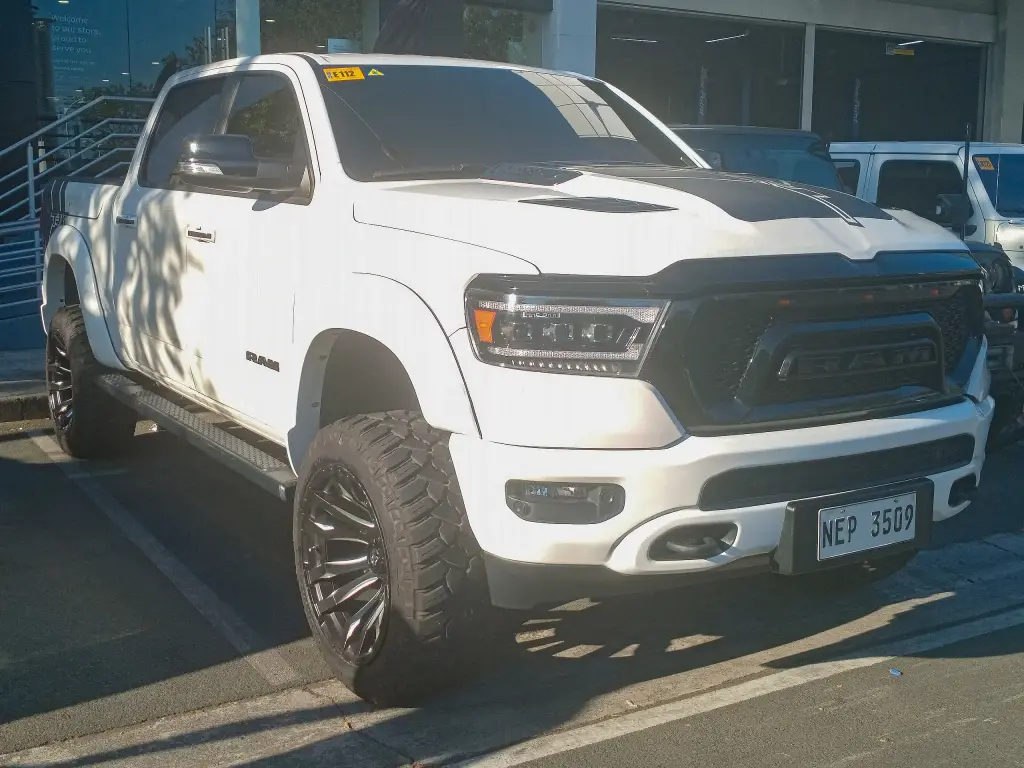
These trucks were popular with fleets but sold poorly against the Ford F-Series and GM C/K, rarely breaking 100,000 units a year, partly because the cab and chassis dated from 1972, there was no powerful diesel until 1989 and no big-block petrol V8. Ram trucks have nevertheless been named Motor Trend Truck of the Year eight times, including the second-generation Ram in 1994, the third-generation heavy-duty in 2003, the fourth-generation heavy-duty in 2010 and the fourth-generation 1500 in 2013 and 2014. The fifth-generation Ram pickup was the first truck to win the award four times, in 2019, 2020, 2021 and 2025. Ram Trucks was spun off from Dodge in 2010, and the fifth-generation Ram debuted at the 2018 North American International Auto Show.
Design and features
- Ram name: introduced in 1980 on the facelifted D series trucks.
- Ram hood ornament: a revival of a Dodge feature used from 1932 to 1954.
- Three-pod dash: an optional instrument cluster with five gauges.
- Power Ram: the four-wheel-drive versions with a shift-on-the-fly transfer case from 1985.
Dodge Ram versions
- Ram 150, 250 and 350: the half-, three-quarter- and one-ton models.
- Ram 100 (1984-1989): the basic model that replaced the Miser.
- Club Cab: the extended cab, dropped in 1982 and brought back for 1990.
- Power Ram: the four-wheel-drive line.
The Ram replaced the Dodge D series and shared its chassis with the Dodge Ramcharger, while the smaller Dodge Dakota sat below it. More Dodge trucks are in the Dodge collection.
Sources
- Ram pickup, English Wikipedia: first generation, engines, equipment, awards