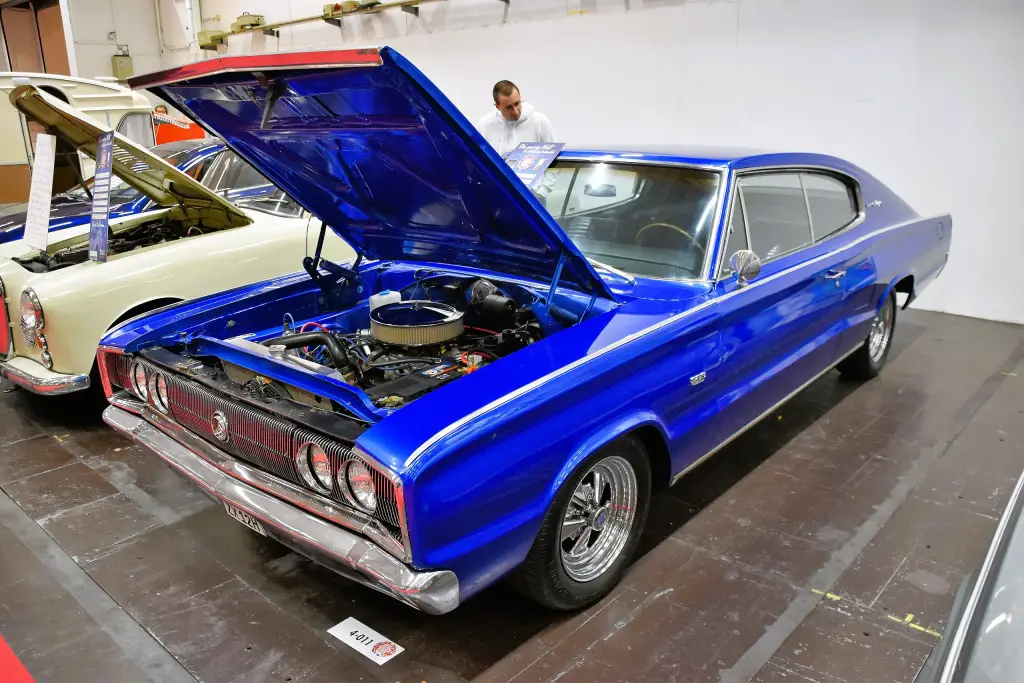
The Dodge Charger is a mid-size car that Dodge produced from the 1966 through 1978 model years on the Chrysler B platform. The first generation arrived in the middle of the 1966 season as a fastback coupe based on the Coronet, with an interior unlike anything else in the range.
Dodge Charger (1966) at a glance
| Production | 1966-1978 model years |
|---|---|
| Class | mid-size car |
| Platform | Chrysler B |
| Basis | Dodge Coronet chassis and front sheet metal |
| Designer | Carl Cameron |
| Body | two-door fastback coupe |
| Seats | four individual buckets with a full-length console |
| 1966 engines | 318, 361, 383 and 426 cu in V8s |
| 1966 price | 2,850 to 3,100 dollars |
| 1966 production | 37,344 cars |
| Hemi cars in 1966 | 468 |
| NASCAR first | first US production car with a spoiler |
Based on one source: the English Wikipedia article on the 1966 Dodge Charger.
History of the Dodge Charger (1966)
In the early 1960s Chrysler was slow to enter the specialty car market, and it chose Dodge to build a mid-size B-body sporty car that would sit between the Ford Mustang pony car and the Ford Thunderbird personal luxury car. The idea was to create a fastback look while sharing as much existing hardware as possible, using lessons from the Chrysler 300. The result was a Coronet-based Charger introduced in the middle of the 1966 model year in response to the Rambler Marlin, Ford Mustang and Plymouth Barracuda. Its styling was a departure from Dodge’s mainstream cars, and along with the 1965 Marlin it set a new standard for radical fastback design in American mid-size cars.
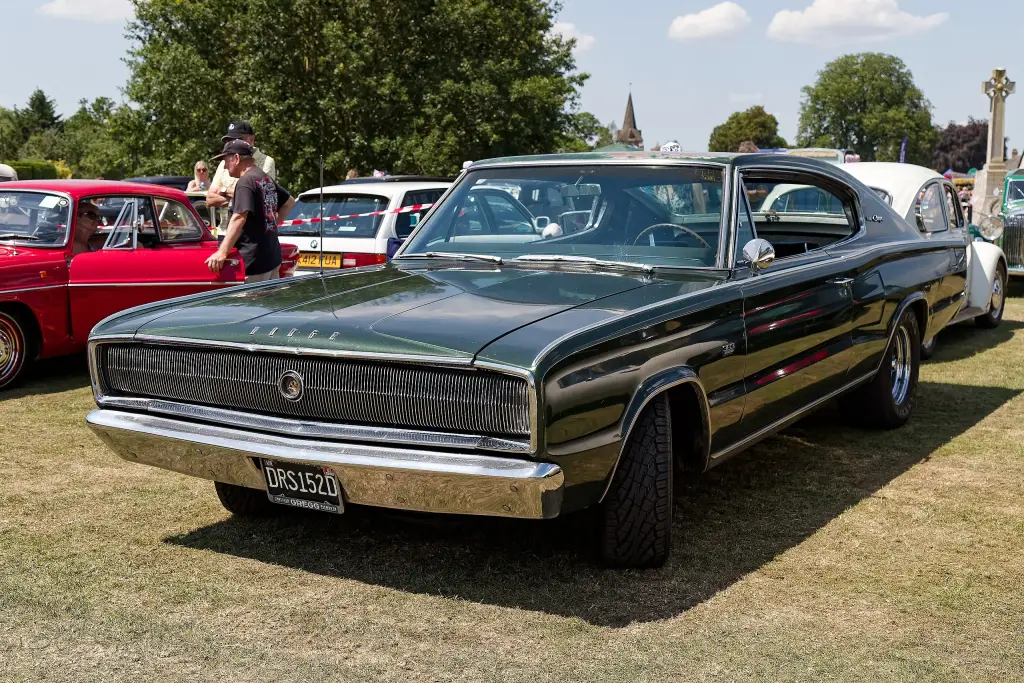
The 1966 Charger shared its chassis and front sheet metal with the mid-sized Coronet and was positioned against the conceptually similar Rambler Marlin. It was better looking but somewhat more expensive, at 2,850 to 3,100 dollars. Its interior was different from every other car in the range, with a full-length centre console and bucket seating front and rear inspired by the 1960-1962 Chrysler 300 and similar to the 1964 Pontiac 2+2. The rear pseudo-buckets could be folded down to create cargo space reached through the rear hatch. On 1 January 1966 viewers of the Rose Bowl were introduced to the new Charger, designed by Carl Cameron, with its fastback roofline, pot-metal “electric shaver” grille and fully rotating headlights, a feature not seen on a Chrysler product since the 1942 DeSoto. The fastback ended over a full-width six-lamp tail light with chromed CHARGER lettering.
Inside, the standard Charger had a simulated wood-grain steering wheel, four individual bucket seats and a console running from front to rear. The rear seats and centre armrest folded forward while the trunk divider dropped back to make cargo room. The instrument panel used electroluminescence rather than ordinary bulbs to light four chrome-ringed circular pods, along with the needles, radio, gear indicator and the clock and air-conditioning controls. A 0-6000 rpm tachometer, a 0-150 mph speedometer and alternator, fuel and temperature gauges were standard. All engines were V8s: the 318 two-barrel, 361 two-barrel, 383 four-barrel and the new 426 Street Hemi, of which only 468 Chargers were built. Total 1966 production came to 37,344 cars.
Dodge took the Charger into NASCAR in 1966, hoping the fastback would win on the high banks, but the body generated lift and drivers said the car was like driving on ice. A small lip spoiler on the boot lid improved traction above 150 mph; it became a dealer-installed option in late 1966 and, because of NASCAR homologation rules, made the 1966 Charger the first American production car to offer a spoiler. The spoiler helped David Pearson win the 1966 NASCAR Grand National championship with 15 wins, though only one of them, at Richmond, came in a Charger. The first generation continued through 1978, with later versions moving away from the original fastback shape.
Design and features
- Fastback body: a radical roofline with long side windows and a full-width tail light.
- Four bucket seats: a full-length console and folding rear seats unique in the Dodge range.
- Rotating headlights: hidden lamps behind the “electric shaver” grille.
- Electroluminescent dash: four chrome-ringed pods lit without ordinary bulbs.
Dodge Charger (1966) versions
- Charger (1966): the original fastback with V8 power only.
- 426 Hemi: the top engine, fitted to 468 cars in 1966.
- NASCAR spoiler: a dealer-installed option from late 1966 and standard in 1967.
- Later first-generation cars: the line continued to 1978 with redesigned bodies.
The Charger shared its base with the Dodge Coronet and later gave its name to the modern four-door Charger. More Dodge models are in the Dodge collection.
Sources
- Dodge Charger (1966), English Wikipedia: origin, 1966 model, engines, NASCAR