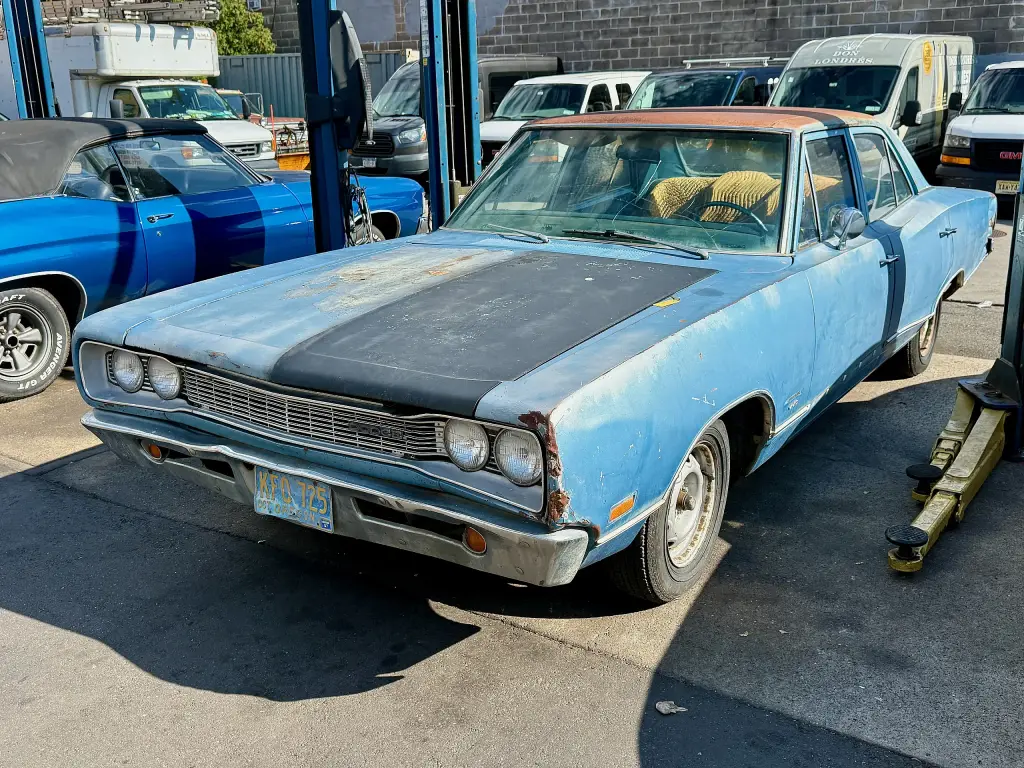
The Dodge Coronet is a nameplate that Dodge used in seven generations, sharing bodies with other models by varying the equipment. It arrived in 1949 as the division’s highest trim line, dropped to the lowest level from 1955 to 1959, and returned on intermediate models from 1965 to 1976.
Dodge Coronet at a glance
| Generations | seven, 1949-1976 |
|---|---|
| First | 1949 full-size, Dodge’s top trim |
| Lower lines | Wayfarer and Meadowbrook |
| 1949 engine | 230 cu in flathead six, 103 hp |
| First-generation gearbox | Gyromatic semi-automatic |
| 1953 option | 241 cu in Red Ram Hemi V8 |
| 1955 position | base Dodge, with Suburban wagons |
| 1965-1976 | intermediate model with 383 and 426 engines |
| Performance model | Super Bee with 383 Magnum |
| 1980s | name used on Dodges sold in Colombia |
Based on one source: the English Wikipedia article on the Dodge Coronet.
History of the Dodge Coronet
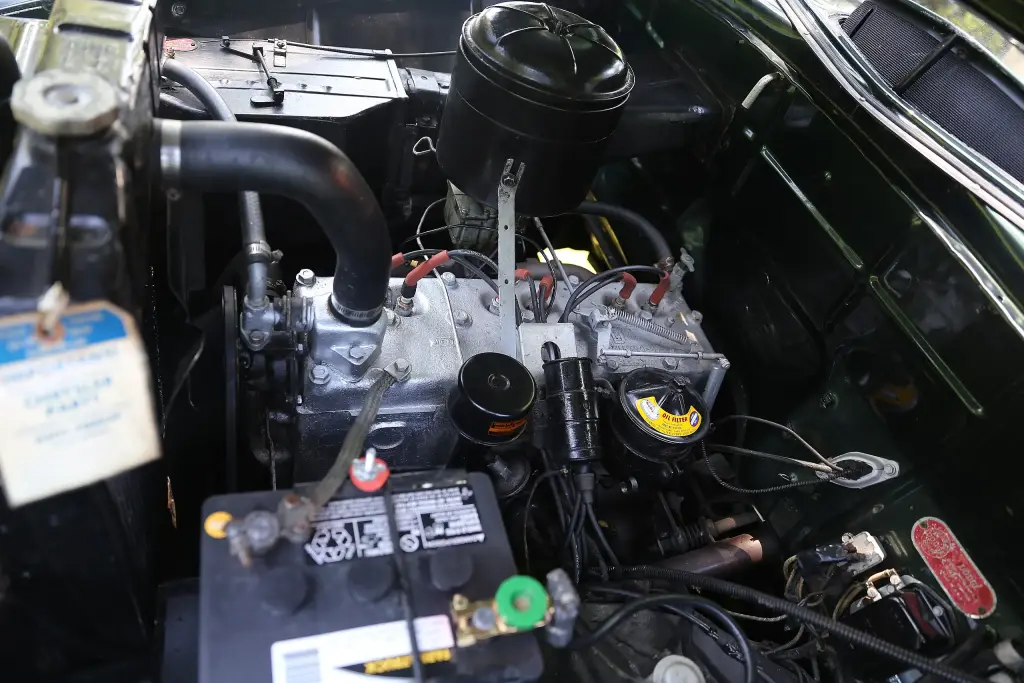
The Coronet was introduced with Dodge’s first post-war body styles as the division’s highest trim line. Below it sat the Wayfarer and Meadowbrook, with the Wayfarer on a shorter 115-inch wheelbase. The only Dodge engine was a 230 cu in flathead straight-six with a single-barrel Stromberg carburettor producing 103 hp gross, enough to take the car to 90 mph. A limited-production four-door, eight-passenger limousine was an extended Coronet related to the DeSoto Suburban. One of the most notable features was Chrysler’s four-speed fluid-driven semi-automatic transmission, which Dodge called Gyromatic: after the driver used the clutch and gear lever to select the high range, upshifts and downshifts were made with the accelerator pedal, and the clutch did not need to be pressed in stop-and-go driving. The car had full instrumentation and 37 inches of head room front and rear.
All Dodges were facelifted for 1950 with a new grille of three heavy horizontal bars forming an oblong, a thick centre bar with parking lights at each end and a large chrome plaque bearing the Dodge crest; the eight-passenger sedan was 216.8 inches long. For 1951 the grille lost its vertical centre bar and gained six horizontal vents, and the cars stayed almost unchanged for two model years while Dodge built military vehicles for Korea. The Coronet Diplomat of that period was Dodge’s first hardtop coupe, with a pillarless steel roof styled after the Chrysler Newport.
For 1953 the Coronet was totally redesigned. It gained an optional 241 cu in Red Ram Hemi V8 and set over 100 land speed records at the Bonneville Salt Flats, the windscreen finally became one piece, and electric wipers were standard while the radio cost 83 dollars. The Dodge Royal line was added above the Coronet in 1954, and that year brought Chrysler’s first fully automatic transmission, the two-speed PowerFlite, as an extra-cost option on all Dodges.
In 1955 the Coronet dropped to the lower end of the range as the Wayfarer and Meadowbrook names disappeared and the Custom Royal was added above the Royal. Bodies restyled with help from newly hired Virgil Exner were lower, wider and longer, and sales rose sharply. Power came from a 230 cu in flathead six with 123 hp, a 270 cu in Polyspheric V8 with 175 hp or a 315 cu in Hemi. The Coronet and its Suburban station wagon were the base models, the only line to offer the 230 six and the 270 Red Ram V8, and Coronets came in all body styles except the convertible. The hardtop coupe was officially called the Lancer but wore only Coronet badges, and the wheelbase was 120 inches.
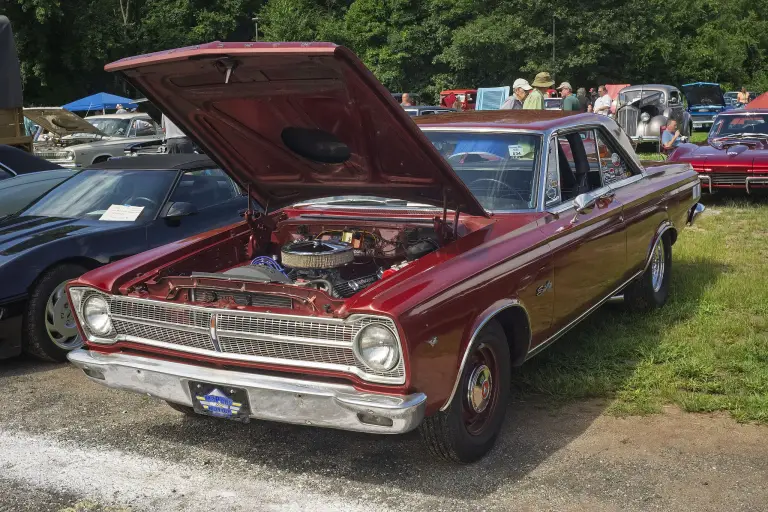
After a pause, the name returned on intermediate-sized models from 1965 to 1976. Muscle car versions arrived in 1965 with the 383 and 426 cu in Chrysler RB wedge engines, followed in 1966 by the 426 Hemi. Other performance models included the Super Bee, which used the 383 cu in Magnum among other engines. In the 1980s the Coronet name was also used on Dodge models sold in Colombia.
Design and features
- Seven generations: from the 1949 flagship to the 1976 intermediate, with a break in between.
- Gyromatic: a semi-automatic transmission shifted with the accelerator pedal.
- Red Ram Hemi: the 1953 option that helped the Coronet set land speed records.
- Super Bee: the 1960s performance version with the 383 Magnum and other V8s.
Dodge Coronet versions
- Coronet (1949-1952): the top full-size Dodge with the flathead six.
- Coronet and Suburban (1955-1959): the base Dodge, with the wagon sold as the Suburban.
- Coronet (1965-1976): the intermediate range with wedge and Hemi V8s.
- Super Bee: the muscle car version of the late 1960s.
The Coronet lent its chassis to the first Dodge Charger and sat below the Dodge Polara in later years, while its wagon body was shared with the Dodge Meadowbrook generation. More Dodge models are in the Dodge collection.
Sources
- Dodge Coronet, English Wikipedia: generations, engines, transmissions, Super Bee