The Plymouth Satellite is a mid-size car introduced for the 1965 model year as the top trim of Plymouth’s B-platform Belvedere line. It stayed the top model until 1967, gained a wagon and a higher Sport trim, and was discontinued in 1974 when the Fury name moved to Plymouth’s mid-size cars.
Plymouth Satellite at a glance
| Maker | Plymouth (Chrysler Corporation) |
|---|---|
| Year introduced | 1965 model year |
| Platform | Chrysler B body |
| Bodies at launch | two-door hardtop and convertible |
| 1965 standard engine | 273 cu in V8 |
| 1965 hardtop production | 23,341, at $2,612 |
| 1965 convertible production | 1,860, at $2,827 |
| 1966 production | 35,399 hardtops and 2,759 convertibles |
| 1968 addition | four-door sedan and station wagon |
| Discontinued | after 1974 |
History of the Plymouth Satellite
First generation (1965–1967)
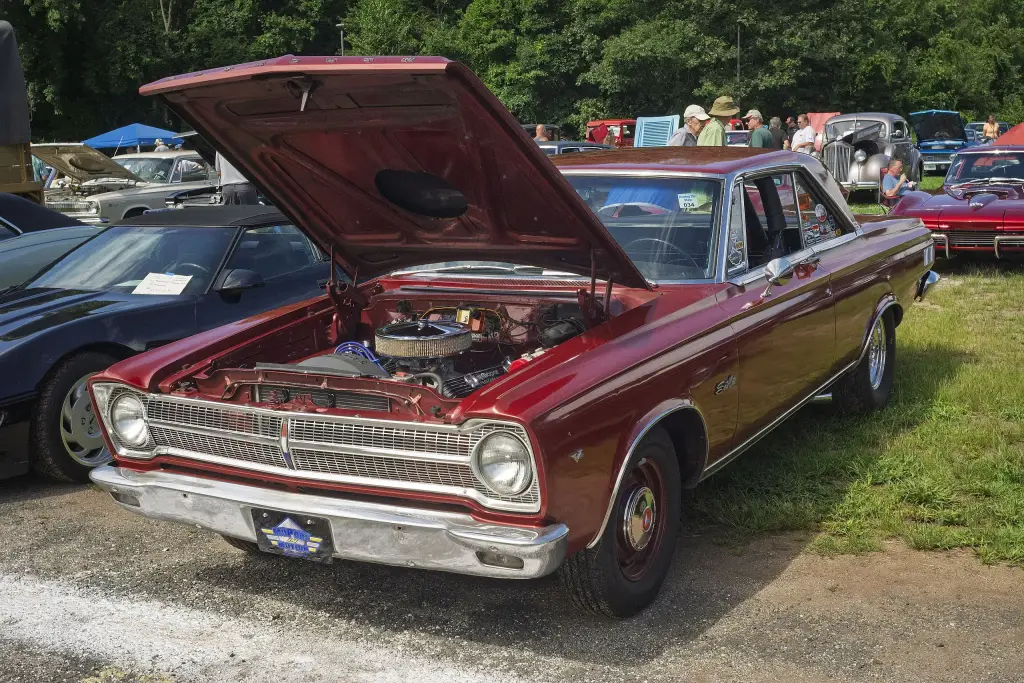
When the new Chrysler B body arrived in 1962, the Belvedere name moved from the full-size line to Plymouth’s new mid-size cars. From 1965 the line was split into the Belvedere I, the Belvedere II and the Belvedere Satellite, the last being the top trim and offered only as a two-door hardtop or a convertible. Bucket seats and a centre console came as standard, along with a V8. The 273 cu in engine was standard and the options ran through 318, 361, 383 and 426 cu in units, the last a “Commando” with wedge combustion chambers rather than the 426 Hemi that arrived for 1966. The front end had single headlights on each side and a grille divided into four thin horizontal rectangles. The 1965 hardtop cost $2,612 and weighed 3,220 lb, and 23,341 were built; the convertible cost $2,827, weighed 3,325 lb and found 1,860 buyers.
The redesigned 1966 Satellite could be ordered with the “Street Hemi”, two four-barrel carburettors and 10.25:1 compression giving 425 hp at 5,000 rpm. The other V8s were the 273 at 180 hp, the 318 at 230 hp, the 265 hp Commando 361 and the Commando 383, down from 330 to 325 hp. Production reached 35,399 hardtops and 2,759 convertibles. The 1967 cars carried over from 1966 with trim changes: a new grille with dual side-by-side headlights, a changed rear boot panel and taillights with multiple horizontal ribs, and new aluminium trim along the lower body crease with silver lower paint that gave every 1967 Satellite a two-tone look. The vinyl seats and door panels wore a “Western Scroll” pattern imitating tooled leather, the premium interior shared with the GTX in 1967.
Second generation (1968–1970)
For 1968 a restyled and better-equipped Sport Satellite with a standard 318 V8 sat above the regular cars. It took the blacked-out horizontal-blade grille used on the Road Runner, while the regular Satellite shared its grille with the Belvederes. A four-door sedan and a station wagon joined the range for the first time, and there was no Sport Satellite sedan in 1968 although a Satellite Sport Wagon with simulated woodgrain trim was offered. A Sport Satellite sedan arrived for 1969 and the wagons became part of the regular Sport Satellite line. The 1968 model year also brought the Road Runner on the same body. That shell lasted through 1970 with new grilles for 1969 and a light front and rear restyle for 1970, the last year of the Belvedere name.
Third generation (1971–1974)
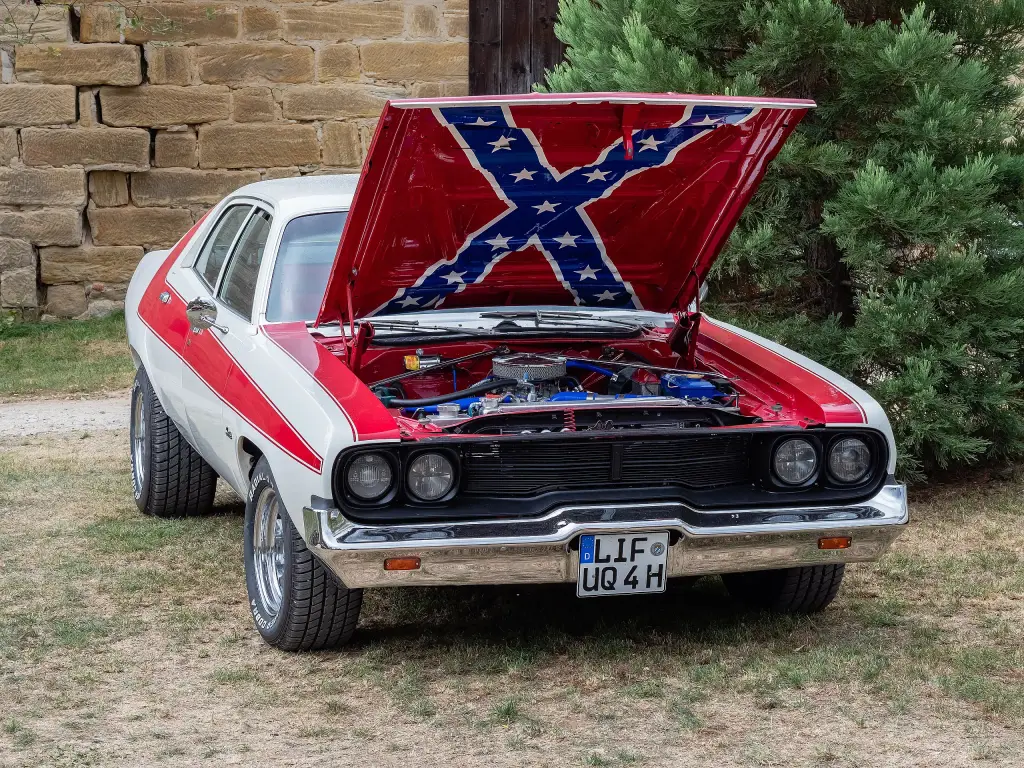
The 1971 Satellite adopted the “fuselage” styling used on the larger Chrysler C-body cars. Sedans and two-door coupes no longer shared sheet metal: sedans came in base, Custom and Brougham trim, while two-doors had five levels, base RL, Road Runner RM, Sebring RH, Sebring Plus RP and GTX RS. Two-doors had a loop-type front bumper and a 115-inch wheelbase, while sedans and wagons measured 117 inches. For 1973 the two-doors received a more conventional squared-off front end, and the 1974 cars added 5 mph bumpers on the sedans and wagons. The Satellite name was dropped after 1974, when Plymouth’s intermediate cars took the Fury name; the Sebring, named after the Sebring race circuit, was replaced by the Chrysler Cordoba.
Design and features
- Top Belvedere trim: bucket seats, console and a V8 as standard from 1965.
- Sport Satellite: the better-equipped model from 1968, with the Road Runner’s grille.
- Full range: hardtop, convertible, sedan and wagon bodies by 1968.
- Fuselage styling: the 1971 shape with separate styling for two-doors and four-doors.
Plymouth Satellite versions
- Satellite (1965–1967): the original top-trim hardtop and convertible.
- Sport Satellite (1968–1974): the upmarket line above the regular cars.
- Satellite Sebring and Sebring Plus: the 1971–1974 two-door trims.
- Satellite wagon: added in 1968, with simulated woodgrain on the Sport Wagon.
The Satellite shared its body with the Belvedere and the Road Runner, and its top version was the GTX. More cars are in the Plymouth collection.
Video: 1971 Plymouth Satellite Sebring plus
Video by Moparheppu on YouTube.
Sources
- Plymouth Satellite, English Wikipedia: range, engines, production, generations