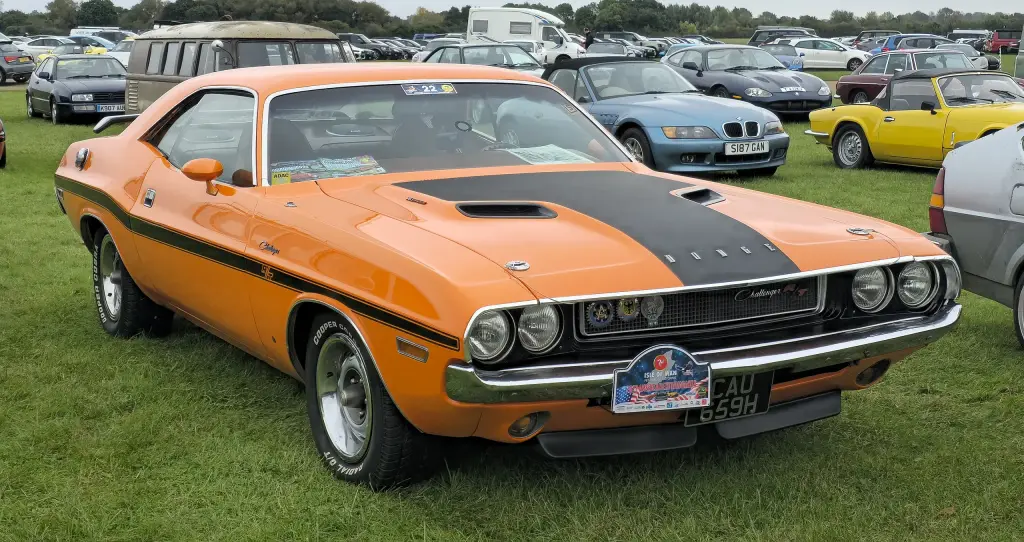
The Dodge Challenger was introduced in the autumn of 1969 for the 1970 model year as Dodge’s entry in the pony car market. Built on the Chrysler E platform in hardtop and convertible form, it shared major components with the Plymouth Barracuda and remained in production until the middle of 1974.
Dodge Challenger (1970) at a glance
| Production | 1970-1974 model years |
|---|---|
| Class | pony car |
| Platform | Chrysler E |
| Body styles | two-door hardtop, Special Edition hardtop, convertible |
| Wheelbase | 110 in |
| Base engines | 225 cu in six; 318 cu in V8 |
| Optional engines | 340, 383, 440 and 426 cu in V8s |
| R/T engine | 383 Magnum, 335 hp |
| Top engine | 426 Hemi, 425 hp |
| Rivals | Mercury Cougar, Pontiac Firebird, Ford Mustang |
| Total built | 165,437 first-generation cars |
| Special model | 1970 Challenger T/A homologation car |
Based on one source: the English Wikipedia article on the 1970 Dodge Challenger.
History of the Dodge Challenger (1970)
The Challenger was one of two Chrysler E-body cars, the other being the slightly smaller Plymouth Barracuda. It was positioned against the Mercury Cougar and Pontiac Firebird at the upper end of the pony car market, and it arrived as a rather late answer to the Ford Mustang of 1964. Chrysler intended it to be the most potent pony car yet, and like the cheaper Barracuda it was offered in a large number of trim and option levels with almost every engine in Chrysler’s inventory. Its longer wheelbase, larger dimensions and more luxurious interior were a response to the 1967 Mercury Cougar: the 110-inch wheelbase was two inches longer than the Barracuda’s, and the two cars differed substantially in their sheet metal. Air conditioning and a rear window defogger were optional. Except in 1971, the Challenger had four headlights where the Barracuda had two.
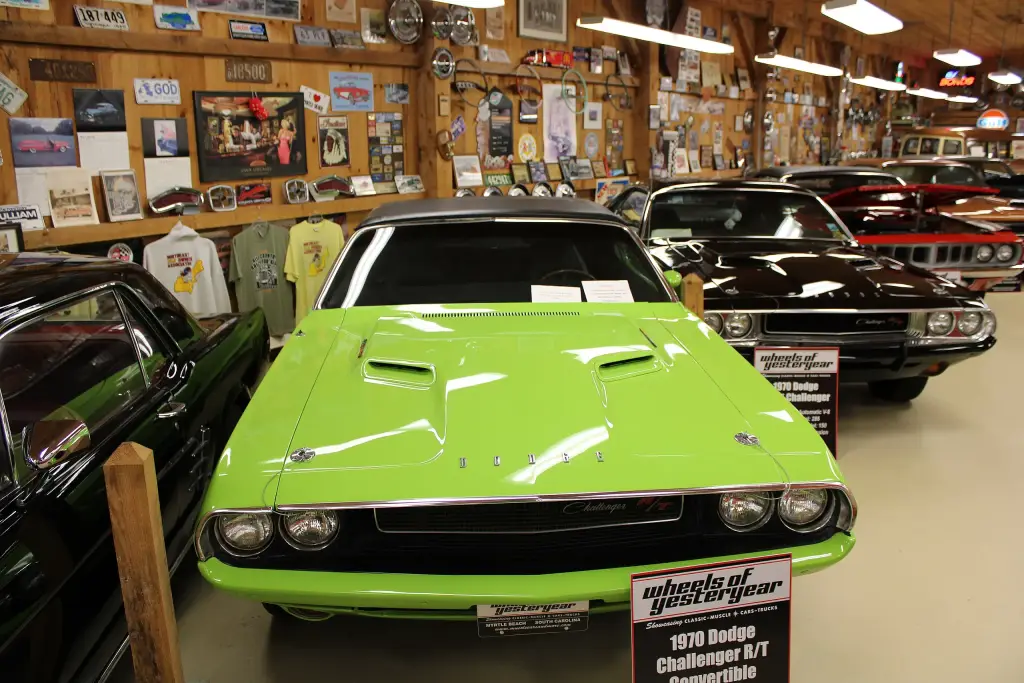
The exterior was designed by Carl Cameron, who had also styled the 1966 Dodge Charger. Cameron based the 1970 Challenger grille on an older sketch for a stillborn 1966 Charger prototype that was to have used a turbine engine. The Challenger was offered in two series, Challenger and Challenger R/T, and in three models: two-door hardtop, Special Edition two-door hardtop and convertible. The base model came with a 225 cu in straight-six, while the higher trims started with the 318 cu in V8. Optional engines included the 340, 383, 440 and 426 cu in V8s, with a three-speed manual as standard except on the 383 Magnum, which was available only with the TorqueFlite automatic; a four-speed manual was optional on all engines except the six and the two-barrel 383.
The performance model was the Challenger R/T (Road/Track), with a 383 cu in Magnum V8 rated at 335 hp, or 300 hp in 1971 after a drop in compression. Its standard transmission was a three-speed manual, and optional engines were the 375 hp 440 Magnum, the 390 hp 440 Six-Pack and the 426 cu in Hemi rated at 425 hp at 5,000 rpm with 490 lb-ft of torque at 4,000 rpm. The R/T came as a hardtop or convertible with a Rallye instrument cluster that included a 150 mph speedometer, an 8,000 rpm tachometer and an oil pressure gauge; the shaker hood scoop was not available after 1971. A mid-year addition was the low-priced Challenger Deputy coupe, which had fixed rear quarter windows and less trim, named after a sheriff-type character used in Dodge television commercials.
For 1970 only, Dodge also built the Challenger T/A, a street version of its Trans Am racing car. The race cars used a destroked 303 cu in version of the modified 340, while the street cars took the 340 and added three two-barrel carburettors on an aluminium intake to create the 340 Six Pack, rated at 290 hp. Air came in through a suitcase-sized scoop moulded into a matte-black fibreglass hood, and a low-restriction exhaust exited through chrome-tipped megaphone outlets in front of the rear wheels. Options included a TorqueFlite automatic or a pistol-grip Hurst-shifted four-speed and 3.55:1 or 3.90:1 axle ratios. The pony car market was already declining when the Challenger arrived, sales fell sharply after 1970, and production ended midway through 1974 with 165,437 first-generation cars built.
Design and features
- E-body shell: a longer, wider and more luxurious pony car than the Plymouth Barracuda.
- Four headlights: a Challenger signature in every year except 1971.
- Huge engine list: from a 225 six to the 426 Hemi with 425 hp.
- SE hardtop: a 1970-only luxury version with vinyl roof, formal rear window and overhead console.
Dodge Challenger (1970) versions
- Challenger: the base series with six-cylinder or small-block V8 power.
- Challenger R/T: the performance series with 383, 440 or Hemi engines.
- Challenger SE: the 1970-only Special Edition with leather and vinyl seats.
- Challenger T/A (1970): the Trans Am homologation model with the 340 Six Pack.
The first Challenger shared its E-body with the Plymouth Barracuda and was a stablemate of the Dodge Charger and Dodge Dart. More Dodge models are in the Dodge collection.
Sources
- Dodge Challenger (1970), English Wikipedia: model history, engines, T/A, production