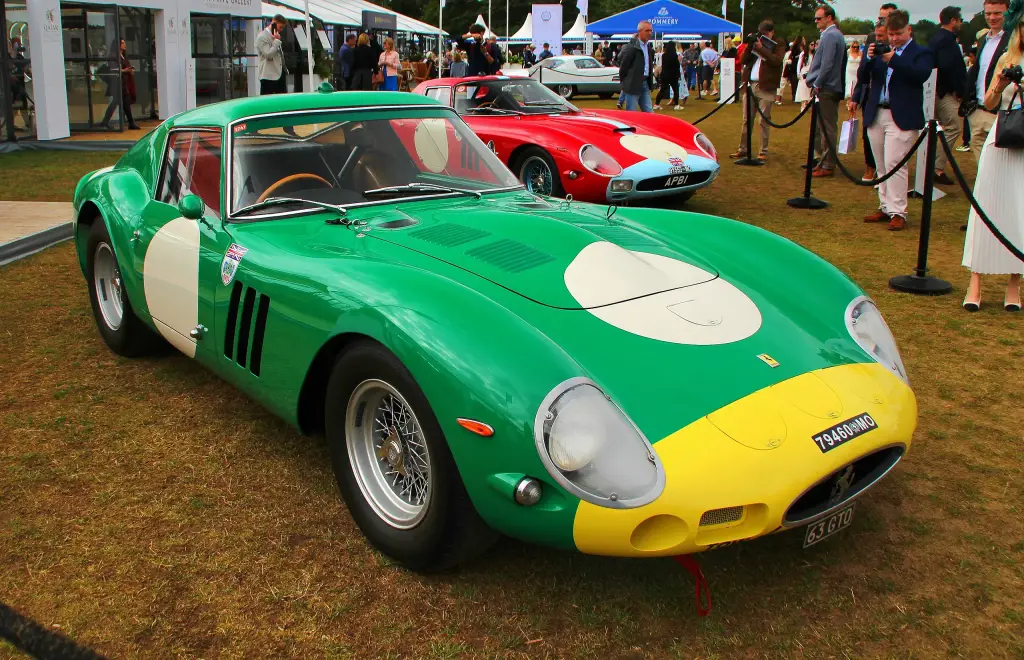
The Ferrari 250 GTO is a front-engined V12 grand tourer built from 1962 to 1964 to homologate a racing car for the FIA’s Group 3 Grand Touring category. Just 36 were made, and it has become the most valuable car in the world.
Ferrari 250 GTO at a glance
| Production | 1962–1964 |
|---|---|
| Built | 36 (33 Series I, three Series II) |
| Purpose | Group 3 GT homologation |
| Engine | Tipo 168/62 Colombo V12, 3.0 L (2,953 cc) |
| Power | about 300 PS (221 kW) at 7,500 rpm |
| Torque | 294 N·m at 5,500 rpm |
| Carburettors | six Weber 38DCN |
| Gearbox | five-speed with Porsche-type synchromesh |
| Chassis | hand-welded oval tube frame, based on the 250 GT SWB |
| Body | aluminium, by Scaglietti |
| Price when new | $18,000 in the United States |
| Auction record | $70 million, 1963 car chassis 4153GT, 2018 |
based on one source (English Wikipedia).
History of the Ferrari 250 GTO
The GTO — Gran Turismo Omologato, Italian for homologated grand tourer — was designed to compete in Group 3 GT racing against the Shelby Cobra, Jaguar E-Type and Aston Martin DP214. The rules required at least 100 cars within twelve months, but Ferrari convinced the FIA and the Le Mans organisers to count earlier 250 GT SWB cars that had been homologated in June 1960, so only 36 GTOs were needed.
Design and development
Development was headed by chief engineer Giotto Bizzarrini, though he and most other Ferrari engineers were dismissed in 1962 after a dispute with Enzo Ferrari; further work was overseen by Mauro Forghieri together with Scaglietti, so the design cannot be credited to one person. Mechanically the car was conservative, using parts proven in earlier competition cars. The chassis followed the 250 GT SWB with minor changes to reduce weight, stiffen and lower it: a hand-welded oval tube frame with A-arm front suspension, a rear live axle with Watt’s linkage, disc brakes and Borrani wire wheels. The engine was the race-proven Tipo 168/62 Competition V12 from the Le Mans-winning 250 Testa Rossa — all alloy, dry sump, six Weber 38DCN carburettors — giving about 300 PS at 7,500 rpm. The gearbox was a new five-speed with Porsche-type synchromesh.
Aerodynamics and interior
Bizzarrini concentrated on aerodynamics to improve top speed and stability, using wind tunnel testing at Pisa University as well as road and track testing with prototypes. The aluminium body had a long, low nose, a small radiator inlet and distinctive air intakes with removable covers; testing led to a rear spoiler, and the underside was covered by a belly pan with a further spoiler formed by the fuel tank cover. Bodies were built by Scaglietti, apart from early prototypes made in-house or by Pininfarina. The interior was minimal: no speedometer, cloth seats, no carpeting or headliner, and an exposed metal gate for the shift pattern that became a Ferrari tradition.
Prototypes and series
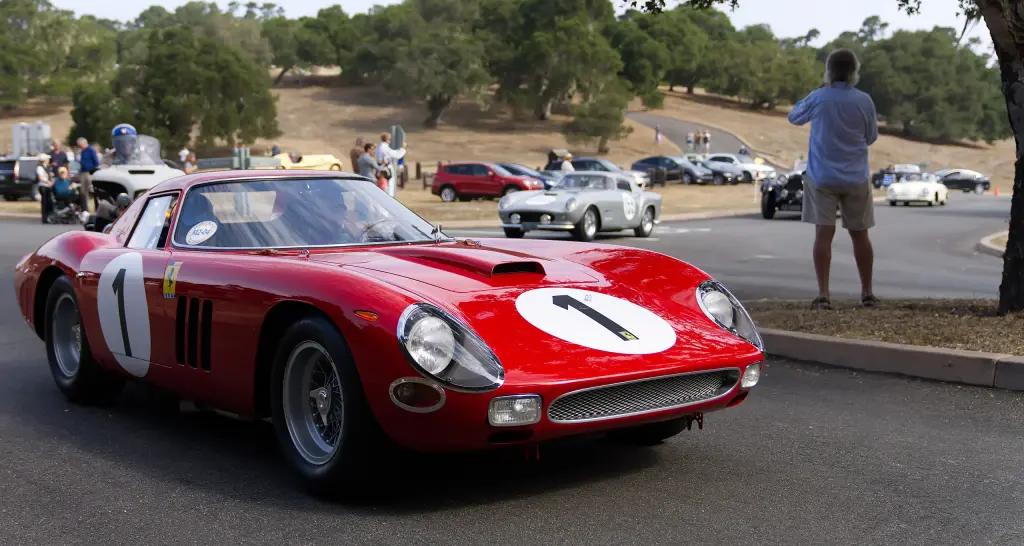
Ferrari built two prototypes in 1961 by converting existing 250 GT SWB chassis. The first, chassis 2643GT, was entered at Le Mans in 1961 by Scuderia Ferrari and ran as high as eighth before retiring with engine failure; the information gathered was used to modify the car, including adding a rear spoiler. The production cars came in 33 Series I examples with 1962–63 bodywork and three Series II cars with 1964 bodywork similar to the 250 LM; four older Series I cars were later rebodied to Series II, bringing the total to 36.
The most expensive car in the world
When new, a 250 GTO cost $18,000 in the United States, and buyers had to be personally approved by Enzo Ferrari and his North American dealer Luigi Chinetti. Prices have since become legendary: $38,115,000 for chassis 3505GT in 2012, $52 million privately for chassis 5111GT in 2013, $48,405,000 for chassis 3413GT at auction in 2018, and a record $70 million for chassis 4153GT in a private sale in June 2018. In 2004 Sports Car International placed it eighth among the top sports cars of the 1960s and named it the top sports car of all time; Motor Trend Classic put it first among the greatest Ferraris, and Popular Mechanics called it the hottest car of all time.
Design and features
- Race-bred V12: the Tipo 168/62 engine from the 250 Testa Rossa, with dry sump and six twin-choke Webers.
- Aerodynamic body: wind-tunnel tested at Pisa, with a long low nose, rear spoiler and flat underside.
- Light tube frame: based on the 250 GT SWB, with Watt’s linkage at the rear and disc brakes all round.
- Racing interior: no speedometer, cloth seats, no carpet, and the famous exposed gear gate.
- Investment status: repeated auction records, up to $70 million in 2018.
Ferrari 250 GTO versions
- Prototypes (1961): two converted 250 GT SWB chassis, including Le Mans car 2643GT.
- Series I (1962–1963): 33 cars with the original bodywork.
- Series II (1964): three cars with 250 LM-style bodywork.
- Rebodied cars: four Series I cars updated to Series II specification.
The GTO grew out of the 250 series and shared its engine with the 250 Testa Rossa; its mid-engined successor was the 250 LM.
Sources
- Ferrari 250 GTO, English Wikipedia: design, production numbers, prototypes, auction prices