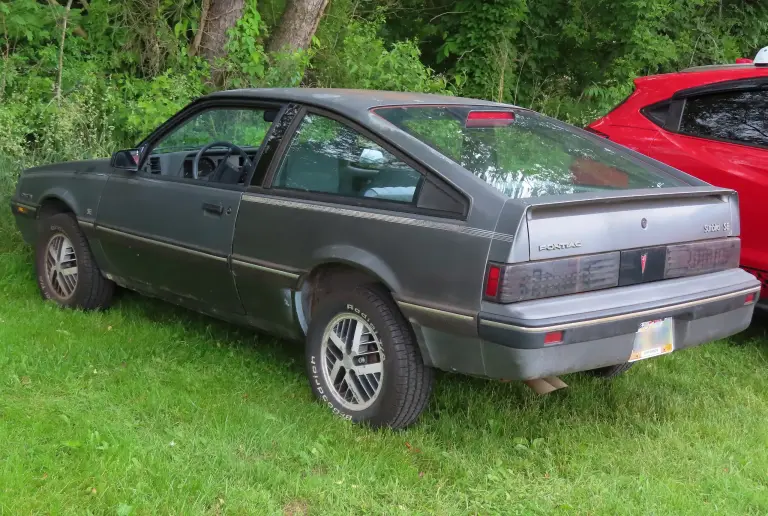
The Pontiac LeMans was the name Pontiac used from 1961 to 1993, borrowed from the French city that hosts the 24 Hours race. It began as a trim upgrade on the compact Tempest, became a separate model in 1963, and in 1964 was the car on which the GTO option first appeared.
Pontiac LeMans at a glance
| Maker | Pontiac, General Motors |
|---|---|
| Years | 1961–1993 |
| First form | top trim of the compact Tempest, 1961 |
| Separate model | 1963 |
| First generation | 1961–1963, Y-body compact |
| Second generation | 1964–1967, A-body intermediate |
| Engine, 1963 | 194.5 cu in four standard; 336 cu in V8 optional |
| Engine, 1964 | 215 cu in six; 326 cu in V8 |
| GTO option | 1964, 389 cu in V8, 325 or 348 hp |
| Sixth generation | 1988–1993, Daewoo-built front-wheel drive |
Based on one source: the English Wikipedia article on the LeMans.
History of the Pontiac LeMans
1961–1963: a Tempest trim
Late in the 1961 model year the LeMans appeared as the top trim package of the compact Tempest on GM’s new Y-body platform, with sportier equipment, different badging and bucket seats, offered only as a two-door pillared coupé. For the first generation the car had a front engine and a rear transaxle that came close to a 50/50 weight distribution, four-wheel independent suspension, and an optional Buick 215 aluminium V8. For 1962 a convertible joined the range along with a 194.5 cu in four with a four-barrel carburettor; no pillarless hardtop was offered. For 1963 the LeMans was still sold only as a two-door coupé or convertible but was now a separate model, with the 194.5 four as standard and a 336 cu in V8 optional.
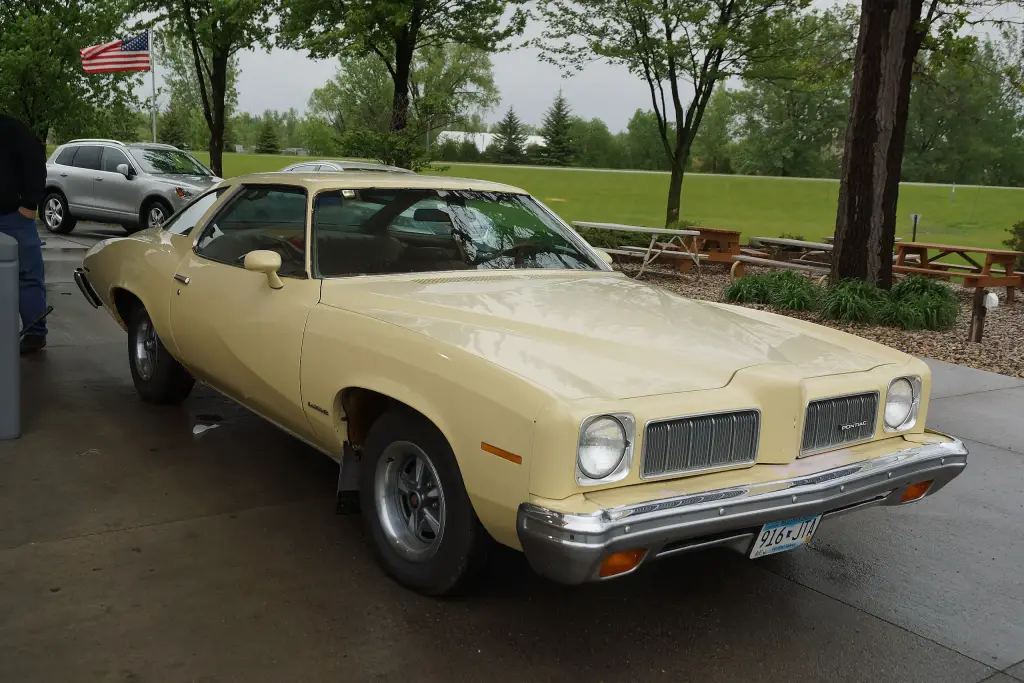
1964–1967: the intermediate years
The Tempest line moved to the intermediate A-body for 1964, and the LeMans became its own model again with carpeted lower door panels, a deluxe steering wheel, courtesy lighting and full wheel covers. A two-door hardtop was added, along with a new 215 cu in six and a redesigned 326 cu in V8. Shortly after the start of that model year the LeMans became available with the GTO package: a 389 cu in V8 of 325 hp with a four-barrel carburettor, or 348 hp with Tri-Power. The 1965 restyle added 3.1 inches to overall length and stacked quad headlights, and a four-door sedan joined the range; a 326 HO with a four-barrel gave 285 hp. For 1966 the pillared four-door was replaced by a four-door hardtop and the GTO became a separate model, while the LeMans took the new SOHC 230 cu in six with 165 hp, or 207 hp in the Sprint package. Peak Sprint power rose to 215 hp for 1967.
Later generations and the Daewoo years
The LeMans continued through further rear-wheel-drive generations, with the 1970 model year bringing the GT-37 package and the 1973–75 Grand Am and 1977 Can Am combining luxury with performance. The first five generations ran from 1961 until 1981, or 1983 in Canada. From 1988 to 1993 the name returned for a sixth generation, a front-wheel-drive subcompact built by Daewoo in South Korea.
Design and features
- Rear transaxle: the first generation’s layout gave near 50/50 weight distribution.
- Four-wheel independent suspension: unusual in a compact of 1961.
- Bucket seats: part of the original LeMans trim upgrade.
- Home of the GTO: the 1964 option that created the muscle car.
- Sprint six: the four-barrel SOHC engine with up to 215 hp.
Pontiac LeMans versions
- Tempest LeMans (1961–62): the trim package with bucket seats.
- LeMans coupé and convertible (1963): the separate model with four and V8.
- 1964 GTO option: the 389 V8 package.
- Sprint (1966–67): the four-barrel overhead-cam six.
- 1988–1993 LeMans: the Daewoo-built front-wheel-drive car.
The LeMans grew out of the Tempest and gave its body to the GTO. More Pontiacs are in the Pontiac collection.
Sources
- Pontiac LeMans, English Wikipedia: generations, engines, GTO option