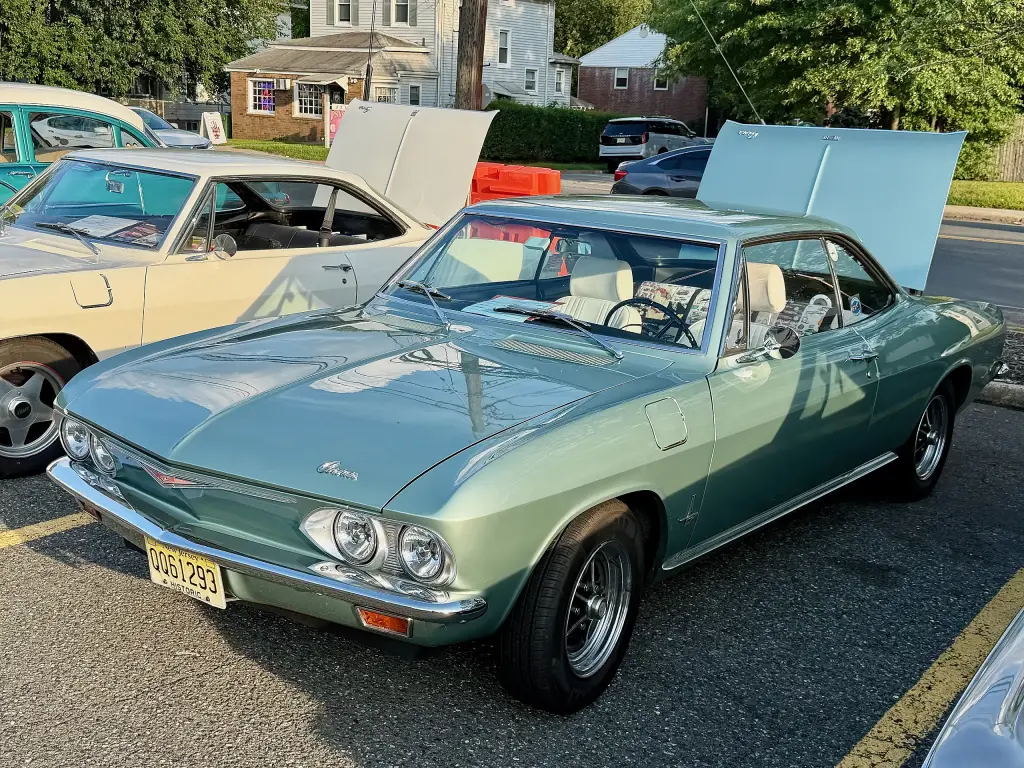
The Chevrolet Corvair was a compact car with a rear-mounted, air-cooled flat-six, built by Chevrolet from 1960 until 1969. It was General Motors’ unconventional answer to the Volkswagen Beetle and the American compacts, and it remains the car most associated with Ralph Nader’s campaign for vehicle safety.
Chevrolet Corvair at a glance
| Production | 1960–1969, two generations |
|---|---|
| Class | Compact car |
| Layout | Rear-engined, air-cooled flat-six |
| Body styles | Sedan, coupé, convertible, station wagon; Corvair 95 van and pickup |
| Total production | about 1.8 million |
| Launched | 2 October 1959 |
| Assembly | Willow Run, Michigan |
| Replaced by | Chevrolet Vega for 1970 |
| Best known version | Corvair Monza |
| Controversy | Ralph Nader, Unsafe at Any Speed |
History of the Chevrolet Corvair
By the late 1950s the Big Three’s entry-level cars had grown so much that the market for small, cheap cars had been left to imports and to American Motors. The Volkswagen Beetle, Renault and Fiat were selling in growing numbers, the Rambler had made AMC the third-largest American maker, and Studebaker’s Lark showed that a compact could work. Ford and Chrysler answered with scaled-down conventional cars, the Falcon and the Valiant. General Motors did something else.
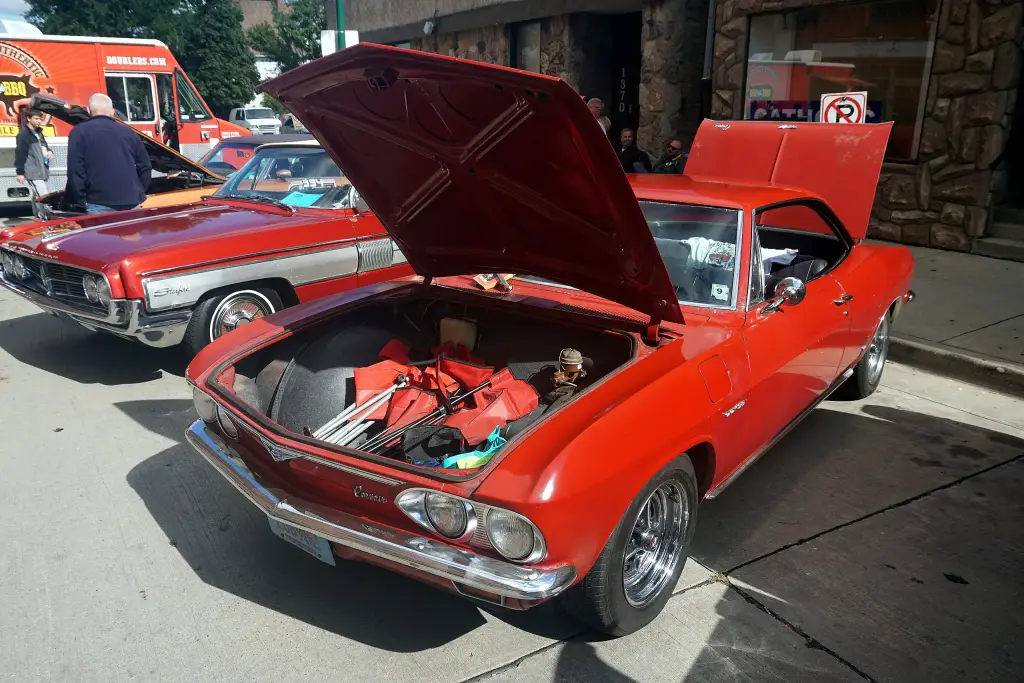
The Corvair, launched on 2 October 1959 and built at a new plant at Willow Run, put an air-cooled flat-six behind the rear axle, with aluminium used for many major components. It was Chevrolet’s second attempt at an air-cooled engine, after the failed Copper-Cooled of 1923. The first generation, from 1960 to 1964, came as a four-door sedan, two-door coupé, convertible and four-door station wagon, and the platform also produced the Corvair 95 subseries of 1961 to 1965, with a passenger van, a commercial van and a pickup. About 1.8 million Corvairs were built in ten years.
The car’s place in history was secured by its handling. Early models used a rear swing axle, and Ralph Nader argued in Unsafe at Any Speed that the resulting behaviour was dangerous; the publicity was enormous. A 1972 report by Texas A&M University for the National Highway Traffic Safety Administration found that the 1960–1963 Corvair had no greater potential for loss of control in extreme situations than contemporary compacts, but the damage to the car’s reputation had long been done. Chevrolet replaced the Corvair with the conventional Vega for 1970, and the name was retired.
Design and features
- Rear engine: an air-cooled flat-six behind the axle, with no radiator or water pump.
- Aluminium: many major engine components were cast in light alloy.
- Corvair 95: forward-control vans and a pickup on the same platform.
- Monza: the sporty trim that made the Corvair fashionable in the early 1960s.
Chevrolet Corvair versions
- First generation (1960–1964): sedan, coupé, convertible and wagon.
- Corvair 95 (1961–1965): the Greenbrier passenger van, Corvan and Rampside pickup.
- Second generation (1965–1969): the restyled car with a new rear suspension.
- Monza and Spyder: the sporty and turbocharged versions.
The Corvair was replaced by the Chevrolet Vega and sat below the Chevrolet Chevelle in the range. More cars are in the Chevrolet collection.
Video: 1966 Chevrolet Corvair Yenko Stinger
Video by Jay Leno’s Garage on YouTube.
Sources
- Chevrolet Corvair, English Wikipedia: development, launch, body styles, production, controversy