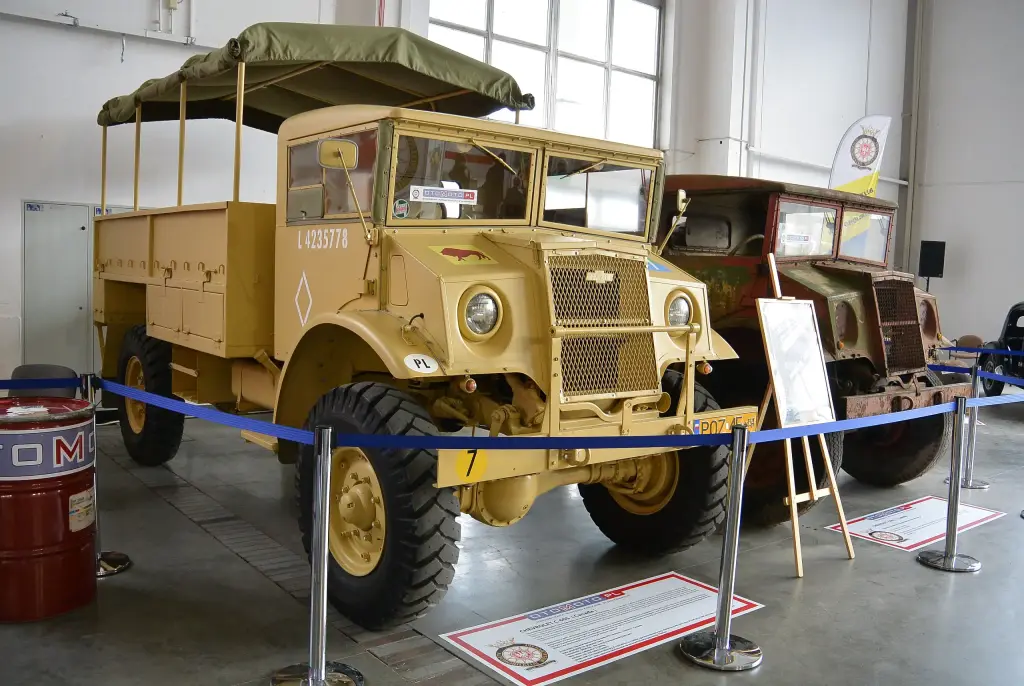
The Chevrolet CMP was the General Motors of Canada version of the Canadian Military Pattern truck, a family of military lorries built to British Army specifications during the Second World War. Together with Ford of Canada and Chrysler of Canada, Canadian factories turned out more than 800,000 trucks, and the CMP is credited with motorising the British and Commonwealth armies.
Chevrolet CMP at a glance
| Maker | General Motors of Canada (Chevrolet), with Ford of Canada |
|---|---|
| Period | 1939–1945 |
| Type | Military trucks, 15 cwt to 3-ton class |
| Original designation | Department of National Defence (DND) Pattern, renamed Canadian Military Pattern |
| Canadian wartime output | about 850,000 vehicles, over 800,000 of them trucks |
| Main users | Britain, Canada, Australia, New Zealand, Soviet Union |
| Theatre of war | North Africa, Sicily, Italy, Burma, the Philippines, Northwest Europe |
| Post-war use | Indonesia, French Indochina, Portuguese colonies in Africa |
| Significance | called Canada’s most important contribution to Allied victory |
The article is based on the English Wikipedia page on Canadian Military Pattern trucks; production figures cover all Canadian wartime truck output, not CMP vehicles alone.
History of the Chevrolet CMP
The story began in 1937, when the Canadian Department of National Defence asked Ford of Canada and General Motors of Canada to build a prototype light infantry truck of 15 hundredweight (three-quarter ton in American terms), similar to the Morris CS8 just adopted by the British War Office. By 1938 the interest had moved to heavier 4×4 and 6×4 designs, and Ford and GM of Canada were asked for prototypes of a medium artillery tractor derived from the British Scammell Pioneer. By 1939 the plans for mass production existed, and the vehicles were first known as the DND Pattern; once it became clear that they would serve far beyond Canada, the class was renamed Canadian Military Pattern.
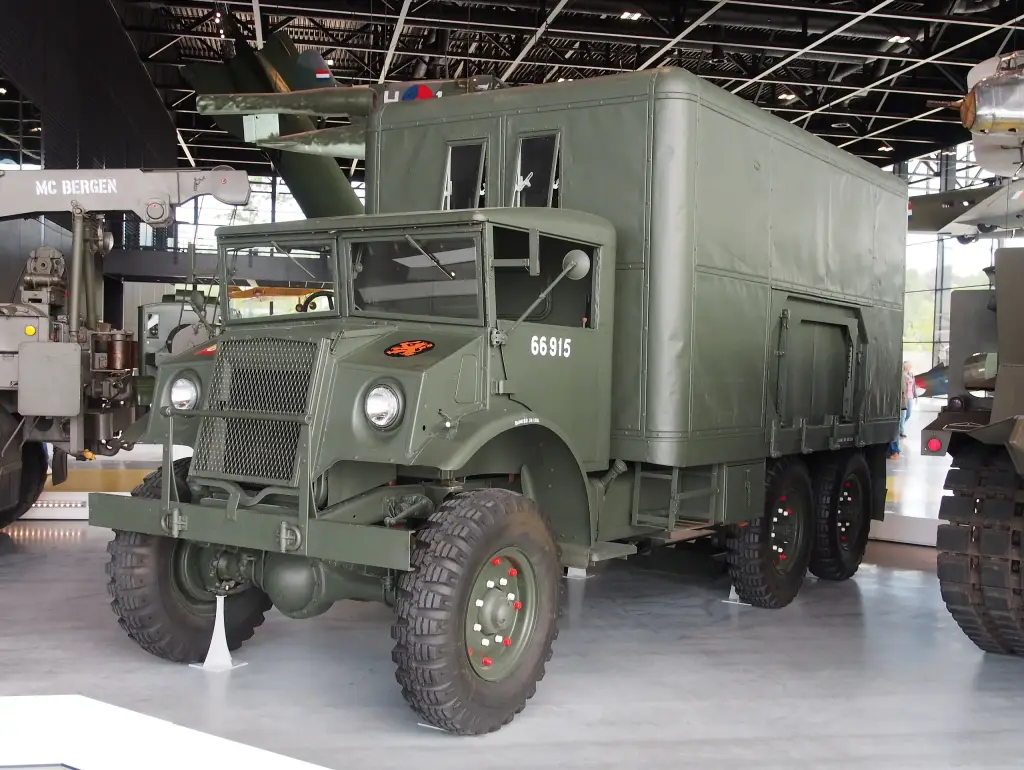
The Dunkirk evacuation of 1940 left the British Expeditionary Force without most of its vehicles, and the Commonwealth armies were expanding fast. Canada’s large pre-war car industry was switched over to military production, and the CMP was the logical answer: a truck designed to British specifications and built in huge numbers. Canadian factories produced some 850,000 vehicles during the war, including about 50,000 armoured vehicles, self-propelled guns and tanks; the bulk were medium and medium-heavy trucks from Ford, GM and Chrysler of Canada.
CMP trucks served in the North African campaign, the invasion of Sicily, the Italian campaign, the Eastern Front, Burma, the Philippines, the liberation of Northwest Europe and the invasion of Germany. They were also shipped to the Soviet Union under Canada’s Gift and Mutual Aid programme. After the war they stayed in service in Indonesia, French Indochina and the Portuguese colonies in Africa. The official British History of the Second World War described Canada’s soft-skinned truck production as the country’s most important contribution to Allied victory, and by the end of the war Canada supplied one vehicle for every three soldiers in the field, against one per seven American soldiers.
Design and features
- One pattern, many classes: the same design family covered light 15 cwt trucks, medium lorries and heavier 3-ton models.
- Built to a British specification: the trucks were designed from the start to fit the British Army’s requirements and to work alongside British equipment.
- Mass production: rival Canadian subsidiaries of Ford and General Motors built the same class of vehicle in a single wartime programme.
- Worldwide service: from the desert to the Eastern Front, the CMP was the standard Commonwealth lorry.
Chevrolet CMP versions
- 15 cwt (Chevrolet C15): the light class that began the programme in 1937.
- 30 cwt and 3-ton models: the medium and medium-heavy lorries that made up most of the output.
- Ford-built CMP: mechanically different but built to the same pattern and often mistaken for the Chevrolet version.
- Post-war survivors: many CMPs were sold on to civilian owners and to the armies of newly independent states.
The CMP sat alongside the Chevrolet C/K light trucks in wartime production, and its civilian descendants are covered in the Chevrolet collection.
Video: Canadian Military Pattern trucks
Video by mfhilgers on YouTube.
Sources
- Canadian Military Pattern truck, English Wikipedia: design, production, service