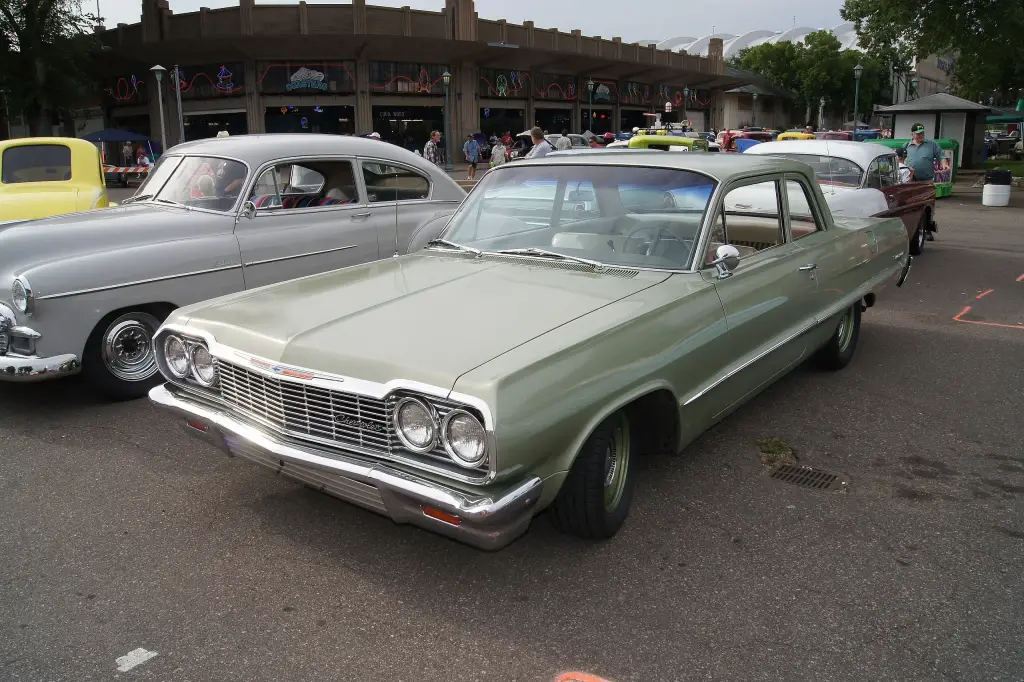
The Chevrolet Biscayne was the least expensive full-size Chevrolet from 1958 until 1975, apart from the 1958-only Delray. Named after Biscayne Bay near Miami, it was built mainly for fleets but could be ordered with any Chevrolet engine, including the biggest V8s.
Chevrolet Biscayne at a glance
| Production | 1958–1975 |
|---|---|
| Class | Full-size car, entry level |
| Named after | Biscayne Bay, Florida |
| Body styles | Two- and four-door sedans; wagon 1962–1968 and in Canada after 1973 |
| Position | Below the Bel Air, Impala and Caprice |
| Cheapest version | Fleetmaster, 1960–1961, under 5,000 built |
| Tail lights | Two per side, against three on the Impala and Caprice |
| Engines | Six-cylinders until the late 1960s, then V8s by the early 1970s |
| Notable dealer special | Baldwin Chevrolet Street Racer Special, 1968 |
History of the Chevrolet Biscayne
The Biscayne name first appeared on a 1955 show car built for the General Motors Motorama. The production car arrived for 1958 as a two- or four-door pillared sedan, below the Bel Air and Impala. For that first year only there was also a cheaper Chevrolet Delray; a two-door Delray Utility Sedan with a platform instead of a rear seat was listed in the brochure. The car was redesigned for 1959 on a wheelbase an inch and a half longer, and the two-door Utility Sedan without a rear seat returned as a delivery vehicle. In 1959 a Biscayne cost 2,365 dollars, against 2,295 for the Fleetmaster and 2,772 for the Impala.
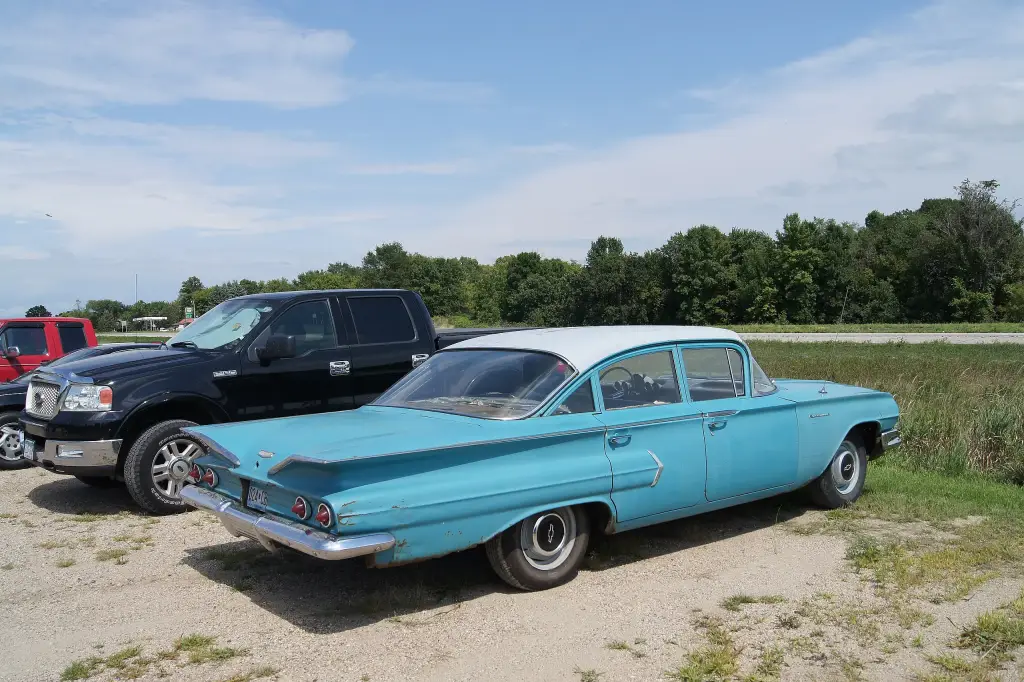
For 1960 Chevrolet added the Biscayne Fleetmaster, a sparser version for fleets with lower-grade upholstery, no cigarette lighter, no door armrests, no passenger sun visor and painted instead of chromed parts. Both two- and four-door sedans were offered, and economy options were reserved for the Fleetmaster, although the performance engines and transmissions could still be ordered for police use. Fewer than 5,000 were made before it was dropped after 1961. The full model change came for 1961, with series numbers 1100 and 1200 for the six- and eight-cylinder Biscaynes and 1300 and 1400 for the Fleetmasters; the short-stroke Turbo-Thrift six replaced the old 235 in 1963. A four-door station wagon joined the range in 1962, replacing the Brookwood.
Throughout its life the Biscayne was deliberately plain: little exterior chrome, small hubcaps, lower-grade cloth or vinyl trim, a centre horn button and rubber floor mats, with luxury options such as power windows unavailable. Even so, a buyer could specify any high-output big-block V8 and a floor-shifted four-speed with a Hurst shifter and a low final drive, and such cars are now highly prized. Baldwin Chevrolet of Long Island built the Street Racer Special, a 1968 Biscayne coupé with a dealer-fitted 427 and heavy-duty suspension, and hot rodders nicknamed fast Biscaynes ‘Bisquick’. The two-door sedan was dropped after 1969, leaving only a four-door from 1970 to 1972, and the model disappeared after 1975.
Design and features
- Two tail lights per side: the easiest way to tell a Biscayne from an Impala or Caprice with three.
- Fleetmaster: a still cheaper fleet version sold in 1960–1961 in very small numbers.
- Big-block option: the plain body could be ordered with Chevrolet’s largest V8s and a four-speed.
- Utility Sedan: a two-door delivery version without a rear seat.
Chevrolet Biscayne versions
- 1958 first generation: pillared two- and four-door sedans, with the Delray below it.
- 1959–1960: longer wheelbase and the Fleetmaster.
- 1961–1964: full model change and the return of a station wagon in 1962.
- Later cars: four-door only from 1970 to 1972, and the Street Racer Special of 1968.
The Biscayne sat below the Chevrolet Bel Air and Chevrolet Impala, and its place at the bottom of the range was later taken by the Chevrolet Caprice at the top. More cars are in the Chevrolet collection.
Video: 1959 Chevrolet Biscayne patrol car
Video by Saabkyle04 on YouTube.
Sources
- Chevrolet Biscayne, English Wikipedia: history, generations, Fleetmaster, options