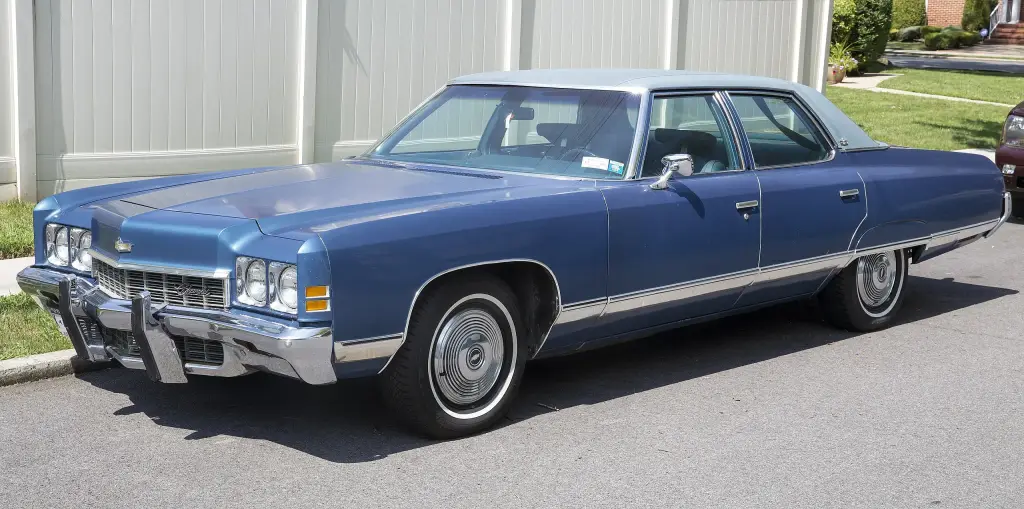
The Chevrolet Caprice was the top of Chevrolet’s full-size range for three decades. It started in mid-1965 as a luxury trim package on the Impala four-door hardtop and ended in 1996 as the standard American police car, before the name was borrowed from Holden.
Chevrolet Caprice at a glance
| North American production | 1965–1996 |
|---|---|
| First shown as | Caprice Custom Sedan option on the 1965 Impala |
| Option price | 200 dollars on a 2,742-dollar Impala |
| Standard engine | 283 cu in V8, 195 hp |
| Optional flagship | 427 cu in V8, up to 425 hp |
| Body styles | Four-door hardtop, two-door hardtop, six- and nine-passenger wagons |
| Largest | 1971–1976 models, the biggest Chevrolets built |
| Award | Motor Trend Car of the Year for 1977 and 1991 |
| Police revival | 2011–2017, rebadged Holden WM/WN |
History of the Chevrolet Caprice
The Caprice began in mid-1965 as an option package on the Impala four-door hardtop, adding 200 dollars to a 2,742-dollar car. It brought a heavier frame, revised suspension, a black-accented grille and rear panel with the Caprice nameplate, Fleur-de-lis roof emblems, better cloth and vinyl trim, thicker carpet and imitation walnut on the dashboard and doors. A 283 cu in 195 hp V8 and a column-shifted three-speed manual were standard. The point was to answer the Ford LTD, Plymouth VIP and AMC Ambassador DPL, cars that offered luxury interiors and quieter running at a mainstream price.
For 1966 the Caprice became a series in its own right at the top of the range, with a four-door hardtop, a two-door hardtop on a formal squared-off roofline, and six- or nine-passenger station wagons including the woodgrained Caprice Custom Estate. The 283 V8 remained standard, a 325 hp 396 was optional and the L72 425 hp 427 could be ordered. The 1966 car had a revised grille and rectangular tail lights instead of Chevrolet’s traditional triple round lamps. Options included the Comfortron air conditioning that held a chosen temperature year-round, a tilt and telescopic steering wheel, and Strato bucket seats in the coupé.
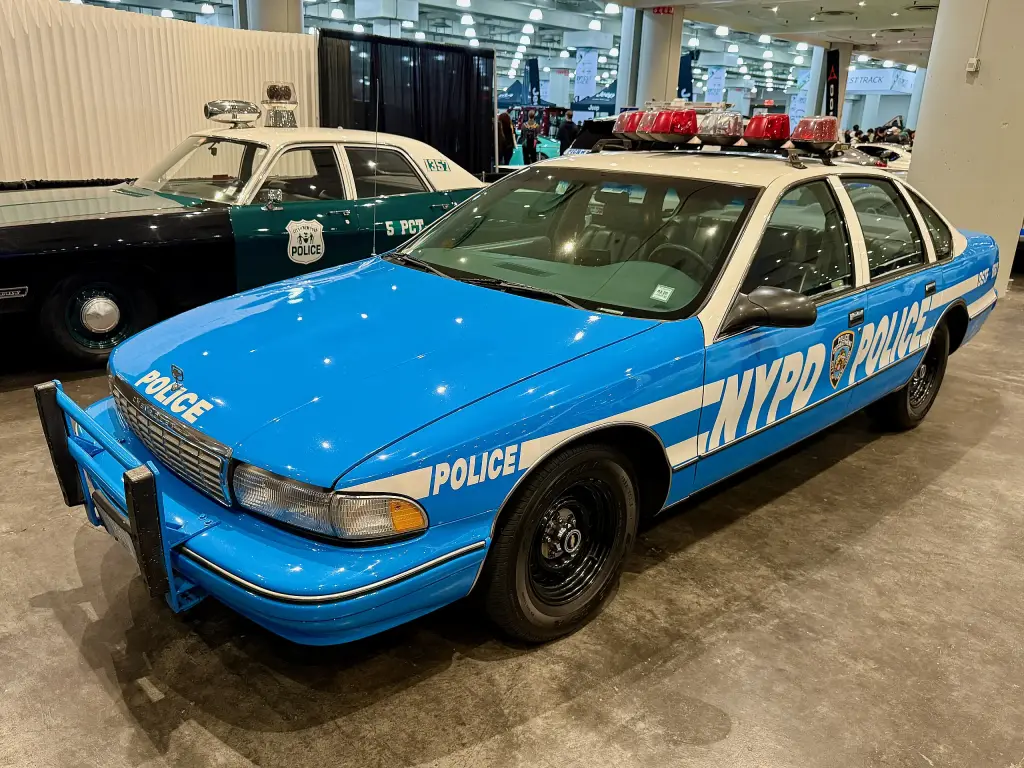
The Caprice grew to its largest in the 1971–1976 models, the biggest Chevrolets ever built. The downsized 1977 Caprice and the restyled 1991 car each won Motor Trend Car of the Year. Production ended in 1996, by which time the rear-wheel-drive Caprice was the standard police car in much of the United States. From 2011 to 2017 the name returned to North America on a police vehicle imported from Australia and based on the Holden WM/WN Caprice, and the same Holden was sold as the Chevrolet Caprice in the Middle East from 1999 to 2017.
Design and features
- Luxury origins: the 1965 Caprice was an option package, not a model.
- Three tail lights: Caprices and Impalas can be told from the cheaper Bel Air and Biscayne by their three lamps per side.
- Biggest Chevrolets: the 1971–1976 cars are the largest the company built.
- Police work: the later rear-wheel-drive Caprice became the standard American police cruiser.
Chevrolet Caprice versions
- 1965 Caprice Custom Sedan: the original option package on the Impala hardtop.
- Custom Estate wagon: the woodgrained station wagon from 1966.
- 1977 downsized Caprice: smaller and lighter, and Car of the Year.
- 1991 restyled Caprice: the rounded final generation, also Car of the Year.
- 2011–2017 police car: the Holden-based Caprice PPV.
The Caprice topped the range above the Chevrolet Impala and Chevrolet Bel Air; the Australian car that revived the name is related to the Chevrolet Lumina SS. More cars are in the Chevrolet collection.
Video: 1983 Chevrolet Caprice Classic station wagon
Video by Mike Robinson on YouTube.
Sources
- Chevrolet Caprice, English Wikipedia: history, generations, engines, police versions