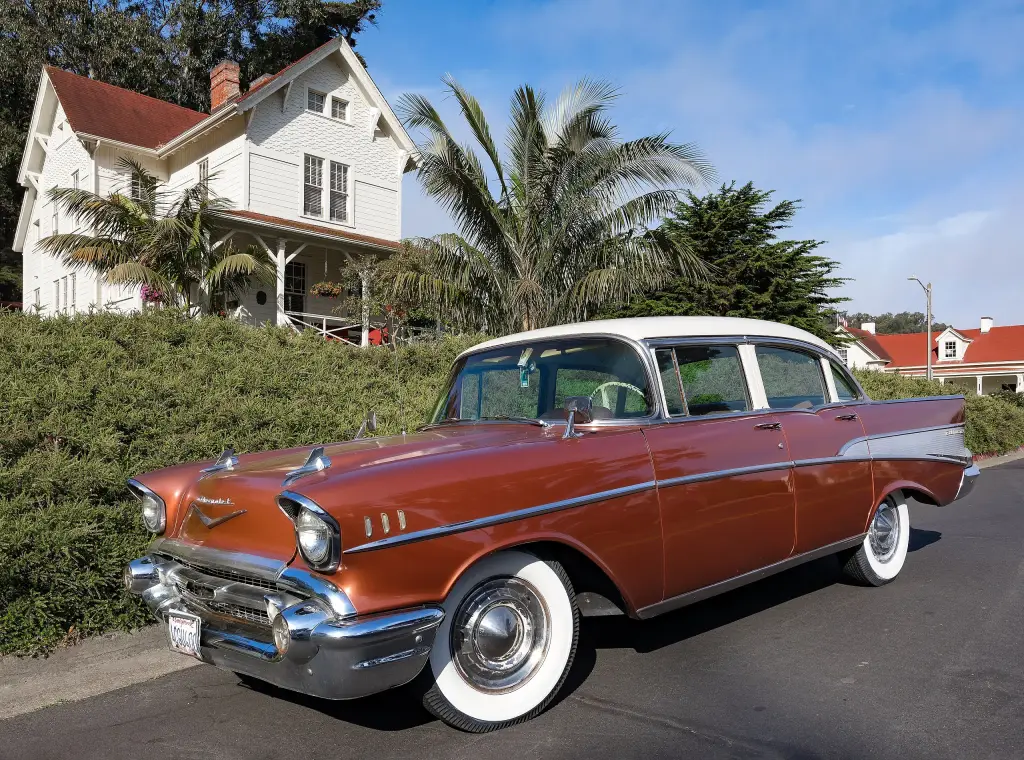
The Chevrolet Bel Air was produced over the 1950–1981 model years. It started as the name for Chevrolet’s two-door hardtops, became a premium trim level across the range in 1953, and by the time US production ended in 1975 it was a budget fleet sedan. The 1955–1957 cars are among the best-known American designs of the century.
Chevrolet Bel Air at a glance
| Production | 1950–1981, US sales to 1975, Canada to 1981 |
|---|---|
| Class | Full-size car |
| Named after | the Bel Air district of Los Angeles |
| First year output | 76,662 cars |
| 1950 price | 1,741 dollars |
| 1950 engine | 216.5 cu in Thriftmaster six, 92 hp |
| Body style 1950–1952 | Two-door hardtop only |
| From 1953 | Premium trim level across several body styles |
| V8 from 1955 | 265 cu in small-block |
| Wheelbase | full-size platform shared with the 150 and 210 |
History of the Chevrolet Bel Air
From 1950 to 1952 the Bel Air name was used only for the two-door hardtops in the Chevrolet range, to set them apart from the Styleline and Fleetline models. The car was named after the wealthy Bel Air neighbourhood on the west side of Los Angeles. First-year production reached 76,662 cars at 1,741 dollars each, weighing 3,225 lb; the front suspension was independent ‘knee-action’ and the standard engine was the 216.5 cu in Thriftmaster six with 92 hp. The early Bel Air shared its front sheet metal ahead of the A-pillar with the rest of the range, but its roof, rear quarters and three-piece rear window were unique.
For 1953 Chevrolet renamed its series and made Bel Air the premium range, with the 150 and 210 beneath it. The restyled body brought a one-piece curved windscreen and a wide chrome strip from the rear wing to the bumper, its inner panel painted to match the body and carrying Bel Air scripts. Lesser models had no model name anywhere on the car, only a Chevrolet crest. Power steering and the Guidematic headlight dimmer arrived in 1953, and power brakes, a power front seat and power windows in 1954; the Beauville station wagon with woodgrain trim joined the range in 1954.
The 1955 model year brought completely new styling, a V8 option and the advertising nickname ‘the Hot One’. Bel Airs gained carpet, chrome headliner bands on hardtops, chrome spears on the front wings, stainless window mouldings and full wheel covers. The 1956 and 1957 cars refined the theme, and the 1957 Bel Air with its tail fins and fuel-injected 283 V8 became the icon of the range. The name continued on ever larger and then smaller Chevrolets until 1975 in the United States, and Canadian production ran to 1981.
Design and features
- Hardtop origins: the name began as the pillarless two-door body style rather than a trim level.
- Premium trim from 1953: chrome, carpet and the Bel Air script set it apart from the 150 and 210.
- The Hot One: the 1955 car brought new styling and the first Chevrolet V8 option to the line.
- Long life: thirty model years from the first hardtop to the last Canadian fleet sedan.
Chevrolet Bel Air versions
- 1950–1952 hardtop: the original two-door Bel Air, Deluxe trim only.
- 1953–1954: convertible, hardtop, sedans and the Beauville wagon.
- 1955–1957: the classic chrome-era cars with V8 power.
- Later Bel Airs: ever larger full-size cars until 1975, with Canadian production to 1981.
The Bel Air topped the 1953–1957 range above the Chevrolet 210 and the Chevrolet 150, and its body was shared with the Chevrolet Nomad wagon. More cars are in the Chevrolet collection.
Video: 1956 Chevrolet Bel Air
Video by Brooks Rowburrey on YouTube.
Sources
- Chevrolet Bel Air, English Wikipedia: history, generations, engines, production