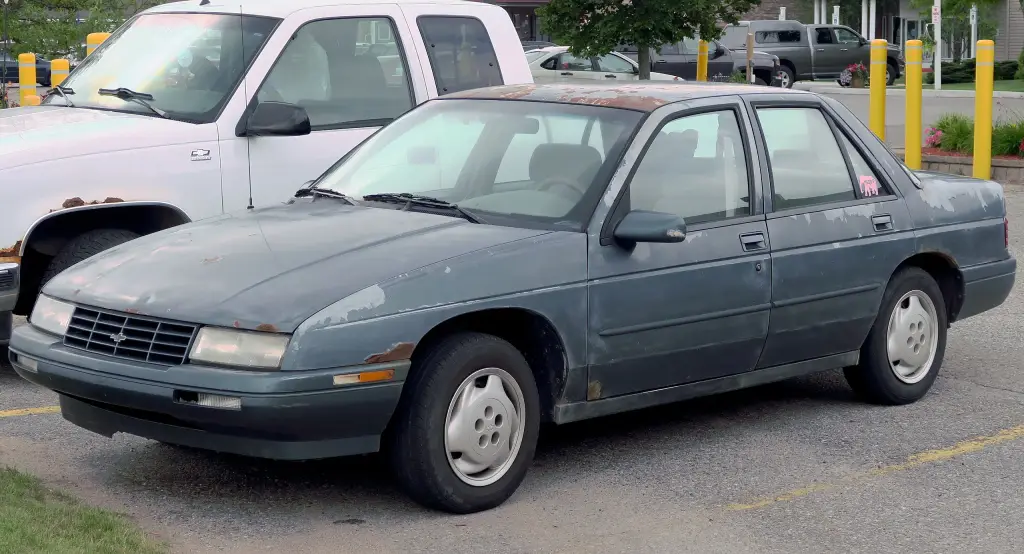
The Chevrolet Corsica was a compact car sold from 1987 to 1996. Named after the French island, it replaced the Citation, shared its platform with the Beretta coupé, and was the second-best-selling passenger car in America in 1988.
Chevrolet Corsica at a glance
| Production | 1987–1996 |
|---|---|
| Class | Compact car |
| Platform | GM L-body, shared with the Chevrolet Beretta |
| Replaced | Chevrolet Citation |
| Replaced by | Chevrolet Malibu for 1997 |
| Body styles | Four-door sedan; five-door hatchback 1989–1991 |
| Assembly | Wilmington, Delaware and Linden, New Jersey |
| Launch engines | 2.0 L four and 2.8 L V6 |
| Later engines | 2.2 L four and 3.1 L V6, then the 3100 V6 with 160 hp |
| Canadian twin | Pontiac Tempest, 1987–1991 |
| Notable first | standard daytime running lights in 1995 |
History of the Chevrolet Corsica
The Corsica was developed by Chevrolet on the new L platform, an extension of the J-body architecture rather than a downsizing, while the rest of General Motors adopted the Oldsmobile-designed N-body. It went on sale in 1987, at first to rental agencies and large companies before reaching private buyers, and shared its body and running gear with the Beretta coupé. Cars were built at Wilmington, Delaware and Linden, New Jersey, and in Canada the same car was sold by Pontiac dealers as the Pontiac Tempest from 1987 to 1991. Much of the suspension came from the Cavalier. The Corsica and Beretta together were the second-best-selling passenger cars in the United States in 1988, behind only the Ford Escort.
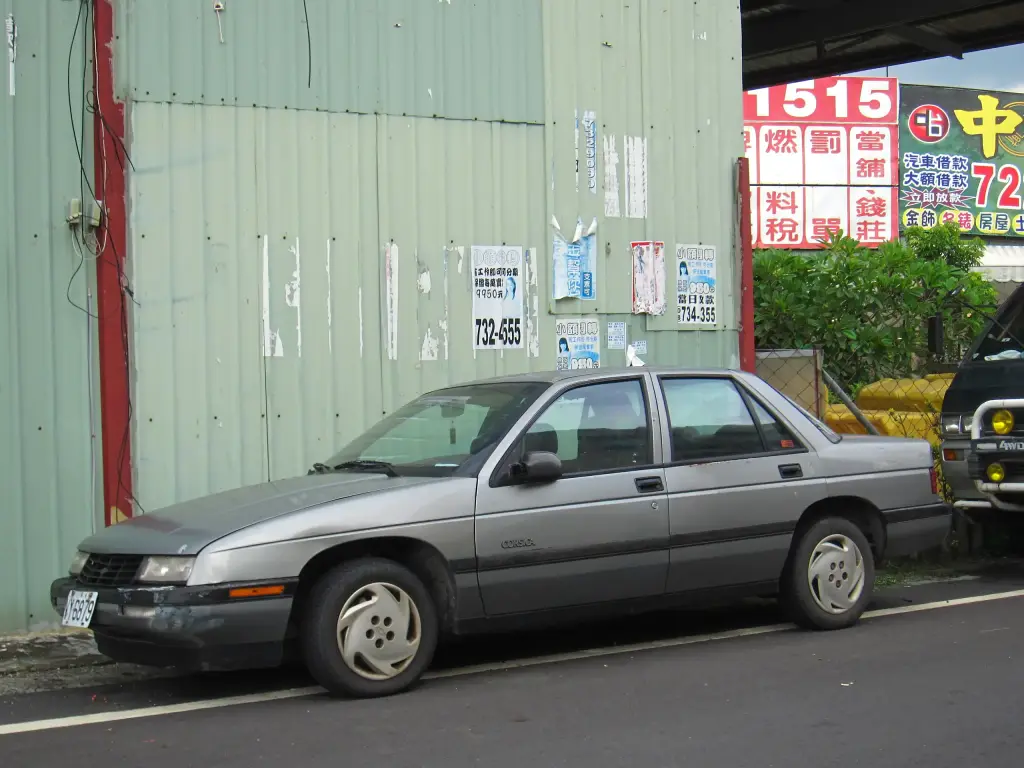
At launch the engine choice was the 2.0-litre four from the Cavalier or the 2.8-litre V6 from the Celebrity, and some early cars had a column shifter with the handbrake between the front seats, an unusual arrangement for a compact. A five-door hatchback and the LTZ performance package arrived for 1989, the latter with suspension parts from the Beretta; a rare XT trim added a leather interior and a body kit. For 1990 the base model was dropped, the engines grew to 2.2 and 3.1 litres, and from 1991 the car had a standard driver’s airbag and a redesigned interior. The hatchback was dropped after 1991 and the LT became the only trim in 1992, with the manual gearbox available only to special order.
The 1994 model brought the 160 hp 3100 V6 with a four-speed automatic and R-134a air conditioning, and the manual gearbox disappeared from US cars. In 1995 the Corsica became the first American car with daytime running lights as standard equipment, and it also received body-coloured mirrors and side mouldings and a revised rear suspension. The 1996 cars moved to OBD-II. Chevrolet ended the Corsica and the Beretta after 1996, because the safety standards due in 1997 would have required a complete redesign and because the new Cavalier was taking the same customers; the Corsica’s place went to the larger Malibu for 1997.
Design and features
- Fleet start: the first Corsicas went to rental companies before private buyers could order one.
- L-body: a Chevrolet-designed platform shared only with the Beretta.
- Daytime running lights: the first American car to fit them as standard, in 1995.
- LTZ and XT: the rare performance and luxury trims.
Chevrolet Corsica versions
- Sedan: the main body style throughout production.
- Five-door hatchback (1989–1991): a short-lived second body style.
- LT and LTZ: the trim levels that replaced the base car in 1990.
- Pontiac Tempest: the Canadian version sold through Pontiac dealers.
The Corsica shared its platform with the Chevrolet Beretta and replaced the Chevrolet Citation; its own replacement was the Chevrolet Malibu. More cars are in the Chevrolet collection.
Video: 1993 Chevrolet Corsica LTZ
Video by Marko Lumivuori on YouTube.
Sources
- Chevrolet Corsica, English Wikipedia: history, year changes, engines, end of production