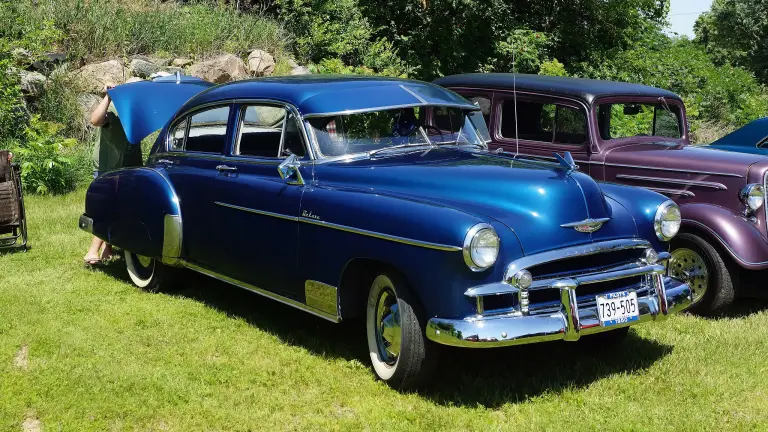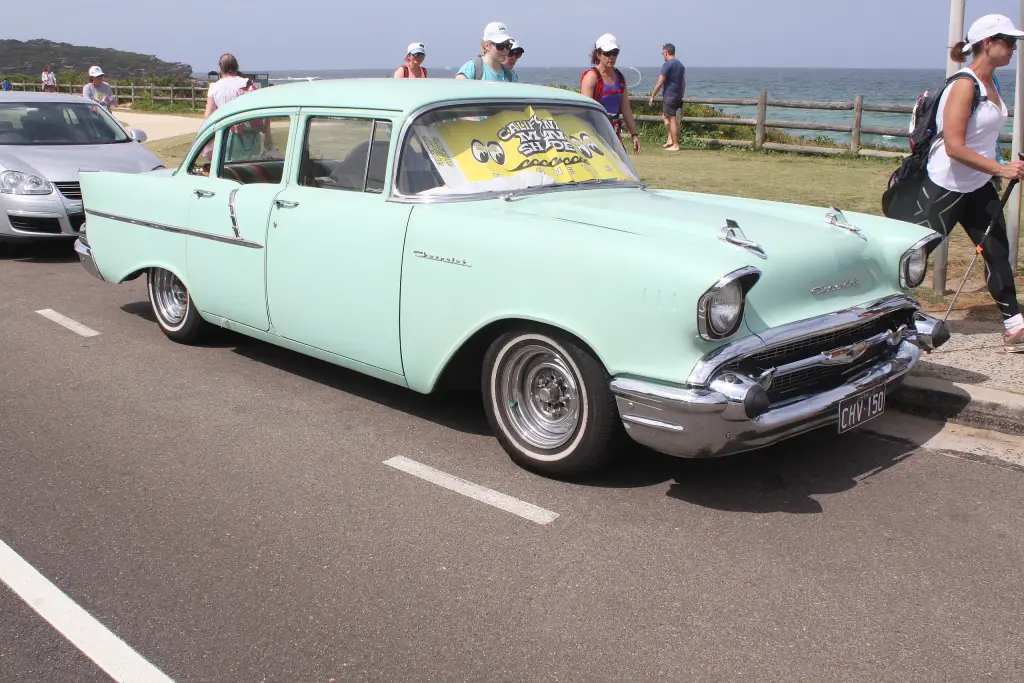
The Chevrolet One-Fifty, usually written 150, was the economy and fleet model of the Chevrolet passenger range from 1953 until 1957. It replaced the Styleline Special, took its name from the shortened 1500 series number, and was the cheapest way into a new Chevrolet — and, in 1957, the basis of one of the most famous stock cars of the era.
Chevrolet 150 at a glance
| Production | 1953–1957 |
|---|---|
| Class | Full-size car, economy and fleet model |
| Replaced | Chevrolet Styleline Special |
| Replaced by | Chevrolet Delray |
| Body styles | Sedans, Handyman wagons, club coupe until 1955, business/utility sedan |
| Standard engine 1953 | 235 cu in Thrift-King six, 108 hp |
| Standard engine 1954 | 235 cu in Blue Flame six, 115 hp |
| First V8 | 265 cu in Turbo-Fire, 162 hp, from 1955 |
| Top engine 1957 | 283 cu in with fuel injection, 283 hp |
| Transmissions | Three-speed manual; Powerglide from 1954; Turboglide 1957 |
| 1957 four-door sedans built | 56,266 |
History of the Chevrolet 150
The One-Fifty was conceived mainly as a fleet model, and Chevrolet put little marketing effort into selling it to ordinary buyers, although sales were never restricted to fleets. Police departments, state governments, small businesses, economy-minded customers and hot rodders were its natural audience. In every year of its life Chevrolet sold far fewer One-Fifties than Two-Tens or Bel Airs.
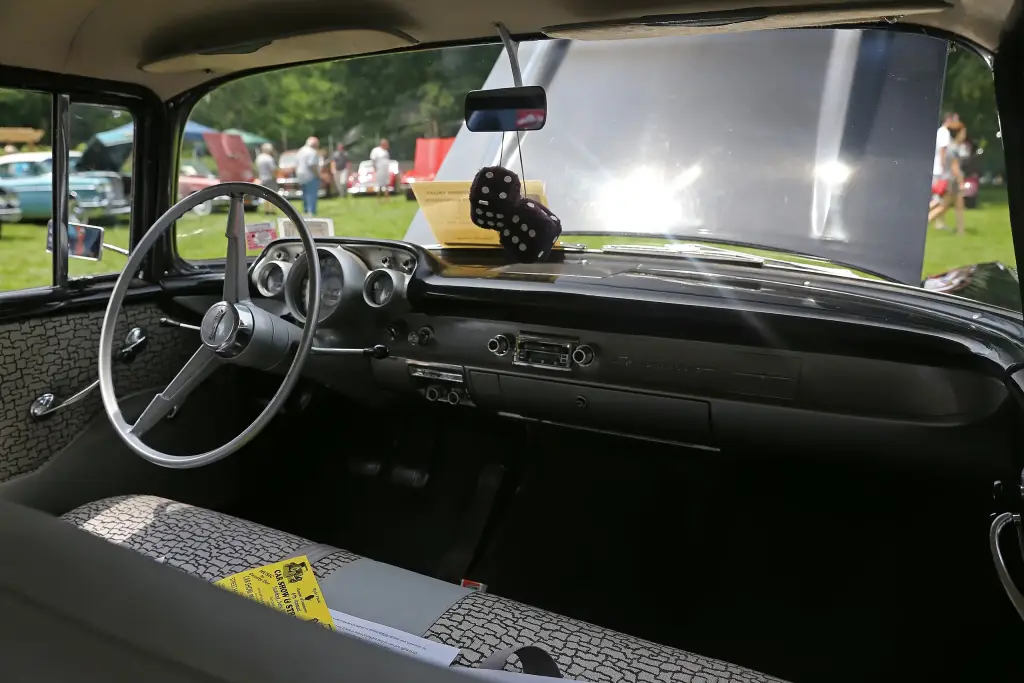
True to that brief, the 150 was basic transport. Options were limited, the trim was stark, paint was in solid colours only, upholstery was plain heavy-duty material and the floor was rubberised. Ashtrays, cigarette lighters and even mirrors were extra-cost items, and the horn had a button instead of the horn ring used on the 210 and Bel Air. Body styles were restricted to sedans, the Handyman wagon (four-door in 1953–1954, two-door from 1955) and, until 1955, a club coupe. Only the business sedan — a two-door with fixed rear windows and no back seat — was specific to the 150. Until 1954 the powertrain choice was limited to manual gearboxes and low-output engines.
The 1955 model year brought a new chassis, new bodywork and Chevrolet’s small-block V8, and from then on the One-Fifty buyer could order any powertrain in the range. The 1957 model also offered a race-ready version, known as the Black Widow for its black-and-white livery, with heavy-duty four-wheel brakes, six-lug wheels and dual shock absorbers. For 1957 Chevrolet built 56,266 four-door 150 sedans against roughly 75,000 two-door cars. The model was dropped after 1957 and replaced by the Delray.
Design and features
- Fleet-first design: plain paint, rubber floor covering and a minimum of equipment kept the price down.
- Business sedan: a two-door sedan without a rear seat or opening rear windows, aimed squarely at fleets.
- Small-block V8 from 1955: the same 265 cu in engine as the more expensive models, and from 1957 the 283.
- Black Widow: the 1957 race-prepared version with heavy-duty brakes, six-lug wheels and dual shocks.
Chevrolet 150 versions
- 1953–1954 first generation: 235 six only at first, Powerglide automatic from 1954.
- 1955–1957 second generation: new chassis and the option of a V8.
- Handyman wagon: four-door in 1953–1954, two-door from 1955.
- Black Widow (1957): the competition version in black and white.
The 150 was the cheapest of the 1953–1957 range, below the Chevrolet 210 and the Chevrolet Bel Air. More cars are in the Chevrolet collection.
Video: 1957 Chevrolet 150
Video by Vanguard Motor Sales on YouTube.
Sources
- Chevrolet 150, English Wikipedia: history, body styles, engines, production