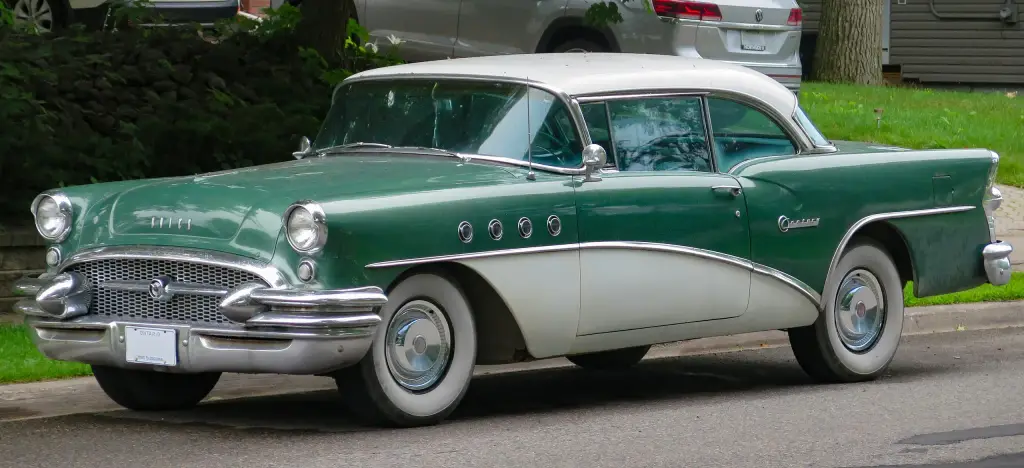
The Buick Century is one of the marque’s longest-running nameplates. It was used for upscale full-size cars from 1936 to 1942 and again from 1954 to 1958, and then for mid-size cars from 1973 to 2005.
Buick Century at a glance
| Maker | Buick, General Motors |
|---|---|
| First use | Series 60, 1930–1935 |
| Century name | 1936–1942, 1954–1958, 1973–2005 |
| 1936–42 engine | 320 cu in (5.2 L) straight-eight, 141 hp |
| 1936–42 body | Special wheelbase with the Roadmaster engine |
| 1954–58 engine | 322 cu in (5.3 L) Fireball V8 |
| 1955 milestone | Century Riviera among the first four-door hardtops |
| Later layout | front-wheel drive from 1982 |
| Nickname | «the banker’s hot rod» |
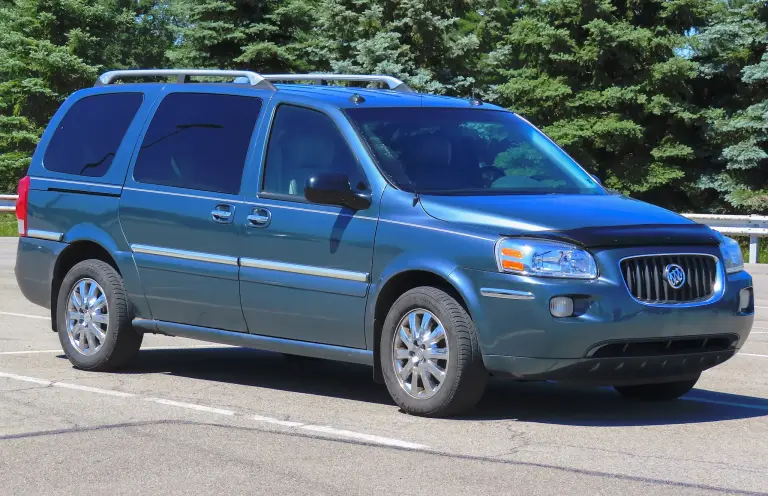
Based on one source, the English Wikipedia article on the Century. The free photographs offered for this page showed a modern Chinese GL8 Century rather than the car described here, so none are used.
History of the Buick Century
The story starts with the Series 60 of 1930. It used the 331.4-cubic-inch straight-six from the Series 70 and, at first, a full-length running board that marked it out as a top model. In 1931 a smaller 220.7-cubic-inch straight-eight replaced the six, and in 1933 the radiator was hidden behind a grille. The 1934 cars were rounder and used a new 278-cubic-inch eight, and in 1935 six body styles were offered.
For 1936 Buick renamed its whole range: the Series 40 became the Special, the Series 60 the Century, the Series 80 the Roadmaster and the Series 90 the Limited. The Century formula was simple and effective — the short wheelbase and body of the Special combined with the larger 320-cubic-inch straight-eight of the Roadmaster. With 141 hp (105 kW) it was the fastest Buick of its day, capable of sustained 100 mph running, which is where the name comes from. The car earned the nickname «the banker’s hot rod».
Prices started at $1,055 for the two-door Victoria Coupe and reached $1,135 for the convertible; by 1940 the range ran from $1,175 for the Sport Coupe to $1,620 for the four-door Convertible Phaeton. Production stopped in the abbreviated 1942 model year, when civilian car building ended on 4 February 1942.
Buick brought the name back for 1954 using the same idea in modern form: the smaller, lighter Special body with the biggest engine available, the 322-cubic-inch Fireball V8, driving through a Dynaflow automatic. A station wagon joined the range, something the pre-war Century had never offered. In the middle of the 1955 model year the four-door Century Riviera appeared and was among the first four-door hardtops ever built.
The Century went on to be used on six generations of quite different cars, from full-size models to mid-size ones from 1973, and it moved to front-wheel drive in 1982. In 1969 Buick also built a Century Cruiser concept. The name was finally retired in 2005, when the LaCrosse replaced both the Century and the Regal.
Design and features
- The original formula: a small body with the biggest engine in the range.
- Straight-eight power: 320 cubic inches and 141 hp in 1936–1942.
- Four-door hardtop pioneer: the 1955 Century Riviera was among the first.
- Six generations: rear-drive full-size cars, then front-drive mid-size ones.
Buick Century versions
- Series 60 (1930–1935): the car that became the Century.
- First generation (1936–1942): Special body, Roadmaster engine.
- Second generation (1954–1958): Fireball V8 and, from 1955, a wagon.
- Later generations (1973–2005): mid-size cars, front-wheel drive from 1982.
The Century was replaced by the LaCrosse in 2005, and it shared its engines with the Roadmaster and Special. More Buicks are in the Buick collection.
Sources
- Buick Century, English Wikipedia: Series 60, 1936-42 and 1954-58 generations, later history