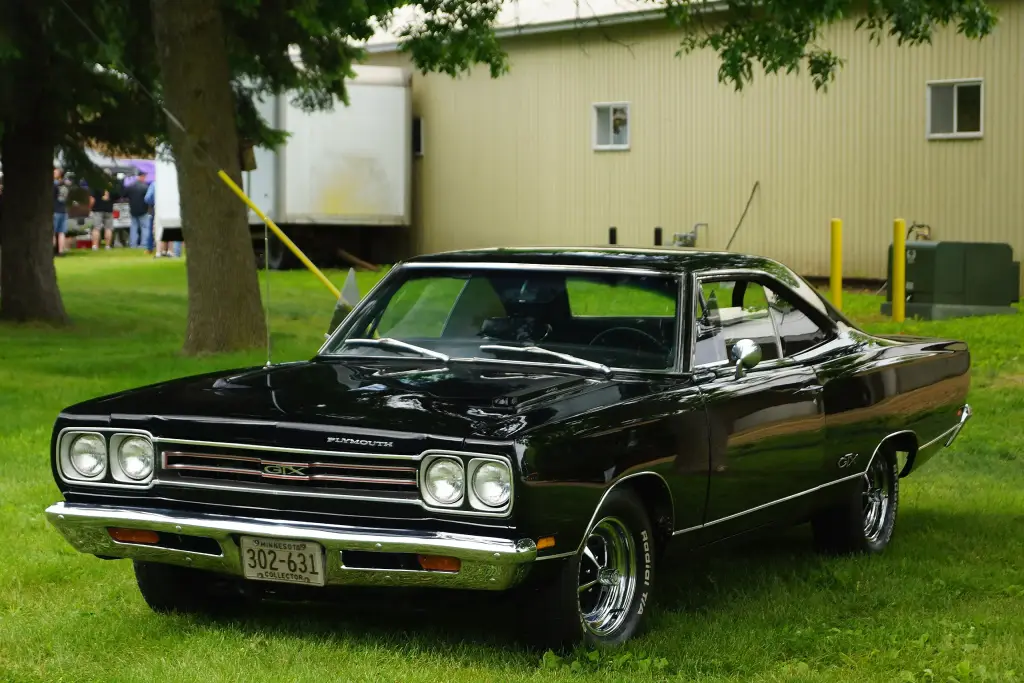
The Plymouth GTX was built by Chrysler and sold under its Plymouth division from 1967 to 1971. Introduced as the Belvedere GTX, it was pitched as a mid-sized, upscale-trimmed performance muscle car, and Plymouth called it a “gentleman’s muscle car”.
Plymouth GTX at a glance
| Maker | Plymouth (Chrysler Corporation) |
|---|---|
| Years | 1967–1971 |
| Introduced as | Belvedere GTX |
| Standard engine | 440 cu in (7.2 L) V8, 375 hp |
| Optional engine | 426 cu in (7.0 L) Hemi |
| Chassis | heavy-duty suspension as standard |
| 1968 body | convertible and two-door hardtop |
| 1969 convertibles | 701 built, 11 with the Hemi |
| 1971 production | 2,942 cars, 30 with the Hemi |
| From 1972 | any Road Runner ordered with the 440 became a Road Runner GTX |
History of the Plymouth GTX
The GTX was based on the Belvedere and distinguished by a blacked-out grille and a special rear fascia, fibreglass simulated hood scoops with optional racing stripes, a chrome pop-open fuel filler cap and a tachometer mounted on the centre console. Under the bonnet, Plymouth’s 440 cu in Super Commando V8 rated at 375 hp was standard and Chrysler’s 426 Hemi was optional, with a heavy-duty suspension system fitted as standard.
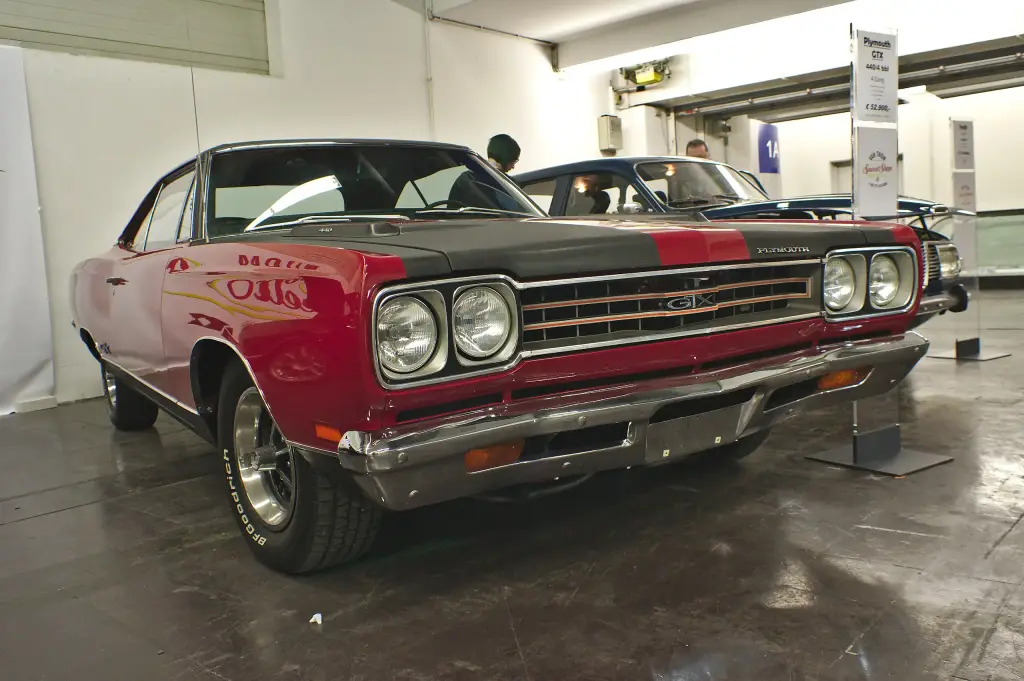
1968–1970
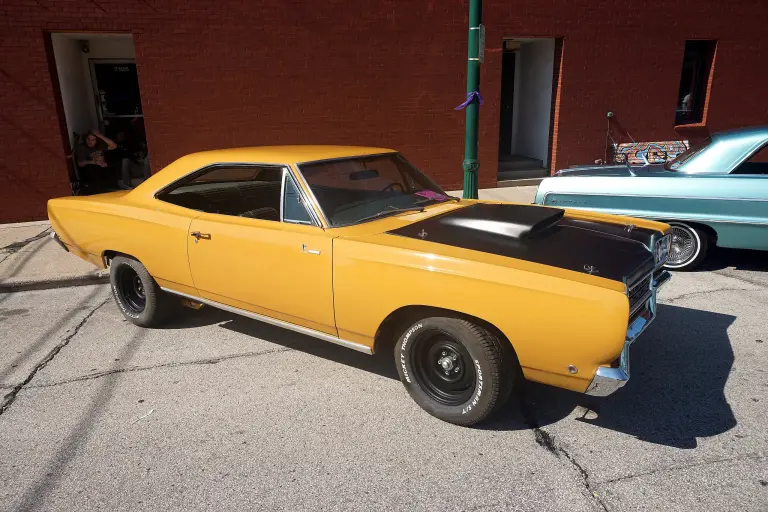
Chrysler redesigned its B-body cars for 1968 with a new hourglass shape in place of the previous rectilinear design. The GTX kept the high-performance 440 as standard along with the TorqueFlite automatic, which was an extra-cost option on the Road Runner; it used Sport Satellite trim and came as a two-door hardtop without a B-pillar or as a convertible, all with dual horizontal racing stripes along the lower sides ending in a GTX emblem ahead of the rear wheel openings. It was positioned as the upmarket version of the Road Runner, adding luxury to performance.
Sales fell in 1969 once the Road Runner was offered as a convertible. The GTX received minor changes to the taillights, grille and side marker lights, black lower-body side paint replaced the stripes, and an optional Air Grabber hood with openings on both sides of the bonnet, controlled from the dashboard, was standard on Hemi cars. That year 701 GTX convertibles were built, eleven of them with the 426 Hemi. For 1970 a new grille and taillights arrived, along with smoother lines, a “power bulge” hood and non-functional rear brake air scoops; the convertible was dropped. The Air Grabber returned with a single scoop on the power bulge, and the 440 was available with a four-barrel, with three two-barrels as the 440+6 or with the Hemi.
1971 and the end
The B-body was redesigned again for 1971 with rounded “fuselage” styling, a raked windshield, a hidden cowl and a loop-type front bumper around a deeply inset grille. It was the last year for the GTX as a stand-alone model: emissions rules lowered the base 440 to 370 hp, the 440 Six Pack to 385 hp, while the Hemi stayed at 425 hp. With insurance rates on muscle cars rising, sales fell to 2,942 cars, only 30 of them with the Hemi, which was discontinued after that year. From 1972 to 1974 any Road Runner ordered with the 440 was renamed Road Runner GTX and carried the badges of both models.
Design and features
- Gentleman’s muscle car: big-block performance combined with a higher level of trim than the Road Runner.
- 440 standard: the 375 hp Super Commando was fitted to every GTX, with the Hemi as the option.
- Air Grabber hood: a dash-controlled fresh-air intake, standard on Hemi cars in 1969.
- Convertible option: sold in 1968 and 1969, and dropped for 1970.
Plymouth GTX versions
- Belvedere GTX (1967): the first year, with the blacked-out grille and simulated hood scoops.
- 1968–1969 GTX: the hourglass body, with hardtop and convertible versions.
- 1970 GTX: the power bulge hood and the 440+6 option.
- 1971 GTX: the last stand-alone year, with fuselage styling.
- Road Runner GTX (1972–1974): the badge carried on the Road Runner with the 440.
The GTX was the upmarket version of the Road Runner and was based on the Satellite body. More cars are in the Plymouth collection.
Video: 1970 Plymouth GTX 440 Six Pack 4 Speed
Video by Smoky Mountain Traders on YouTube.
Sources
- Plymouth GTX, English Wikipedia: model years, engines, bodies, production