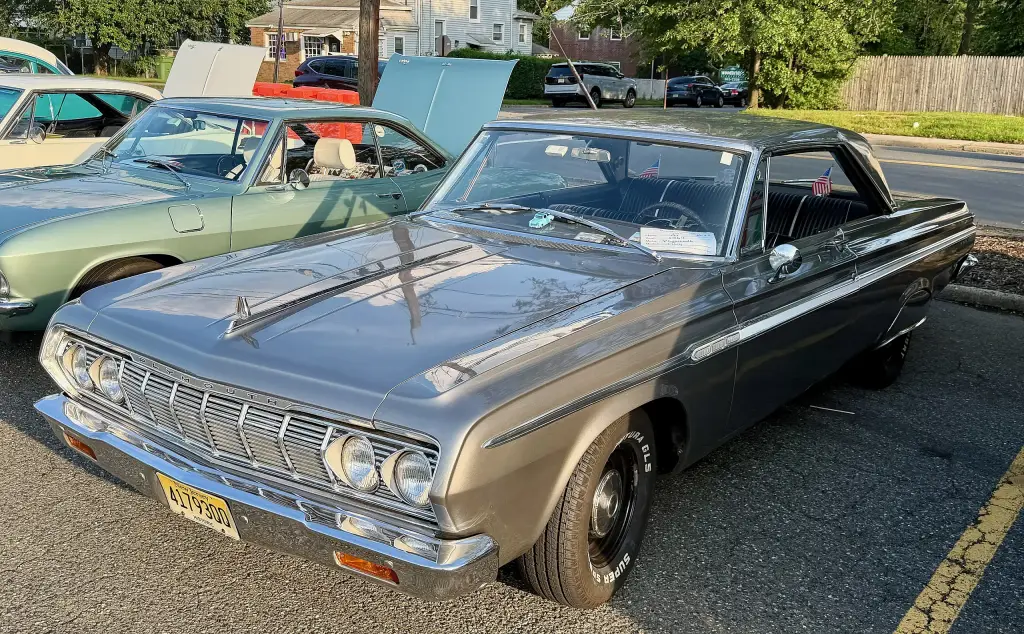
The Plymouth Fury was produced by Plymouth from 1955 until 1989. It was introduced for the 1956 model year as a sub-series of the Belvedere, became a separate series one level above it for 1959, and over the decades moved between full-size and mid-size size classes before the last V8, rear-drive example left the Kenosha plant in December 1988.
Plymouth Fury at a glance
| Maker | Plymouth (Chrysler Corporation) |
|---|---|
| Years | 1955–1989 |
| Introduced | 1956 model year, as a Belvedere sub-series |
| Separate series | 1959 |
| Full-size | 1959–1961 and 1965–1974 |
| Mid-size | 1962–1964 and 1975–1978 |
| Top model, 1959 | Sport Fury |
| 1957–1958 engine | 318 cu in V8, 290 hp |
| Last car | Kenosha, 23 December 1988 |
| Later cars | M-body Fury from 1982 |
History of the Plymouth Fury
The early Furys (1956–1958)
For its first three years the Fury was a sub-series of the Belvedere, sold only as a two-door hardtop: in sandstone white with gold anodised aluminium trim in 1956 and 1957, and in buckskin beige with the same trim in 1958. These cars had special interiors, bumper wing-guards and V8 engines with twin four-barrel carburettors, and the 318 cu in unit of 1957 and 1958 produced 290 hp, shared with the Dodge Coronet. The 1957 models were longer and wider, with very large vertical tailfins and a new torsion bar front suspension replacing coil springs, though quality control suffered across Chrysler products as the new cars were rushed to market. For 1958 a 350 cu in “Golden Commando” V8 with two four-barrels made 305 hp, and a 315 hp fuel-injected option was withdrawn when the Bendix system was recalled, owners receiving a conventional dual four-barrel instead.
Flagship years (1959–1974)
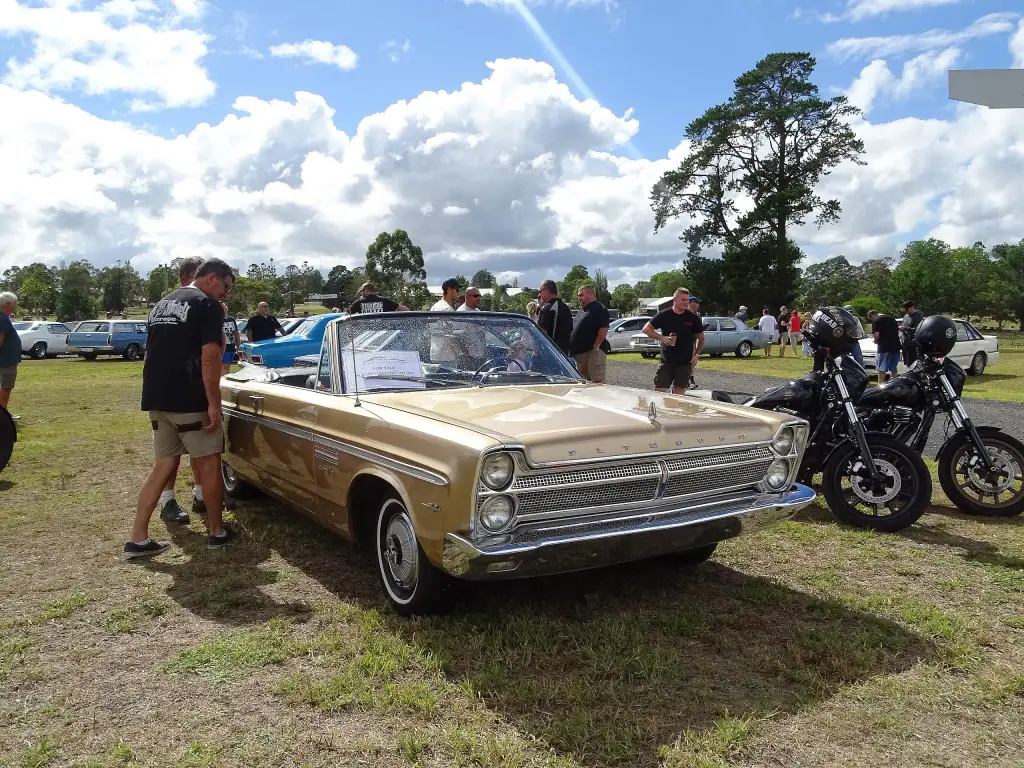
In 1959 Plymouth introduced the Sport Fury as its top model and moved the Fury to second from the top, replacing the Belvedere at the head of the range. The Fury came as a four-door sedan, a two-door hardtop and a four-door hardtop, the Sport Fury as a two-door hardtop and a convertible, and the wagon version was sold as the Sport Suburban rather than a Fury. The Sport Fury was dropped at the end of 1959 but returned in mid-1962 and lasted until 1971. The 350 gave way to a 361 cu in Golden Commando.
The 1960 cars were the first with unibody construction, the first with Chrysler’s ram induction and the first with the new slant-six, which made 145 hp from 225 cu in while the 383 was rated at 330 hp; the tailfins were removed for 1961. For 1962 the Fury was downsized onto the new B-body unibody platform, sales were slow and the Sport Fury was brought back, and the range regained size and sales in 1963 and 1964. In 1965 the Fury returned to full size on the new C-body and the range split into Fury I, Fury II and Fury III, with the Sport Fury as the highest trim, aimed at the Chevrolet Impala Super Sport and Ford Galaxie 500/XL.
Design and features
- Gold-trimmed debut: the first Furys were single-specification hardtops in white or beige with gold anodised trim.
- Big V8s: the 318, the 350 Golden Commando and later the 361 and 383.
- Sport Fury: the top trim from 1959 and again from 1962 to 1971.
- Changing size: full-size, mid-size and full-size again as Plymouth reorganized its range.
Plymouth Fury versions
- Fury hardtop (1956–1958): the original Belvedere sub-series in white or beige.
- Sport Fury (1959, 1962–1971): the sporting top model, with hardtop and convertible bodies.
- Fury I, II and III (from 1965): the three trim levels of the full-size C-body car.
- Later mid-size Fury (1975–1989): the B-body and then M-body cars that closed the line.
The Fury began as a version of the Belvedere and later shared showrooms with the GTX. More cars are in the Plymouth collection.
Video: 1958 Plymouth Fury – LIVING CHRISTINE
Video by theAFICIONAUTO on YouTube.
Sources
- Plymouth Fury, English Wikipedia: early history, generations, engines, Sport Fury