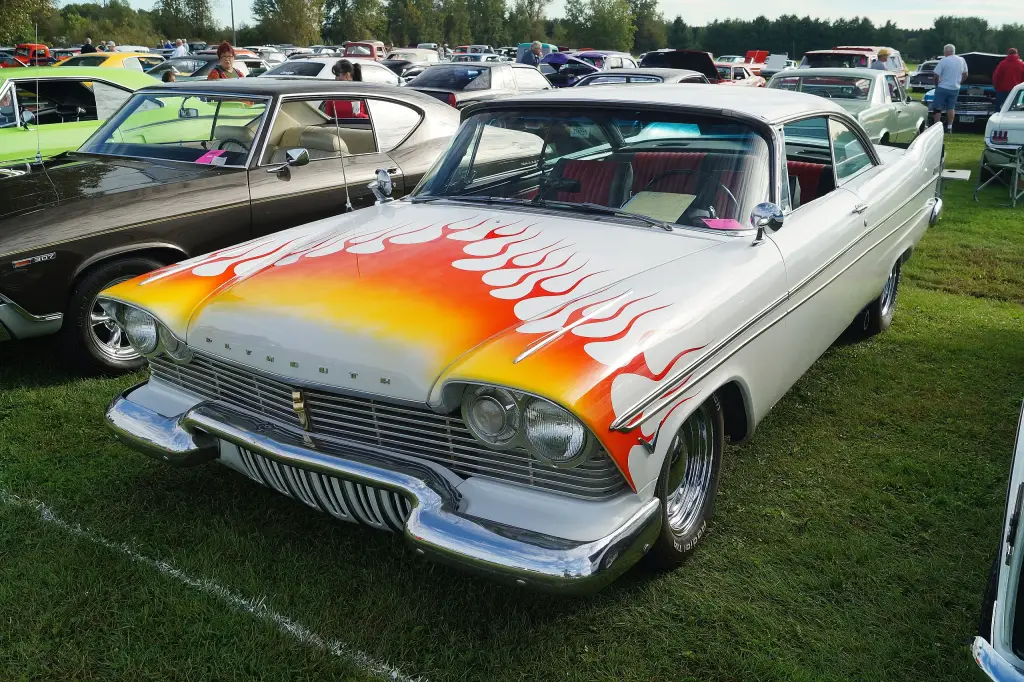
The Plymouth Belvedere was a series of American cars made by Plymouth from 1954 until 1970. The name first appeared in 1951 on a new pillarless hardtop body in the Cranbrook line and returned as Plymouth’s full-size model until it became an intermediate in 1965.
Plymouth Belvedere at a glance
| Maker | Plymouth (Chrysler Corporation) |
|---|---|
| Series | 1954–1970 |
| Name first used | 1951, Cranbrook Belvedere hardtop |
| 1951 wheelbase | 118.5 in (3,010 mm) |
| 1951 engine | 217.8 cu in flathead six, 97 hp |
| 1953 engine | 217.8 cu in six, 100 hp, Hy-Drive available |
| 1954 range | sedan, convertible, two-door wagon, Sport Coupe |
| 1954 engine | 230.2 cu in six, 110 hp |
| 1956 first | push-button automatic in an American car |
| Replaced by | Satellite, after 1970 |
History of the Plymouth Belvedere
Cranbrook Belvedere (1951–1953)
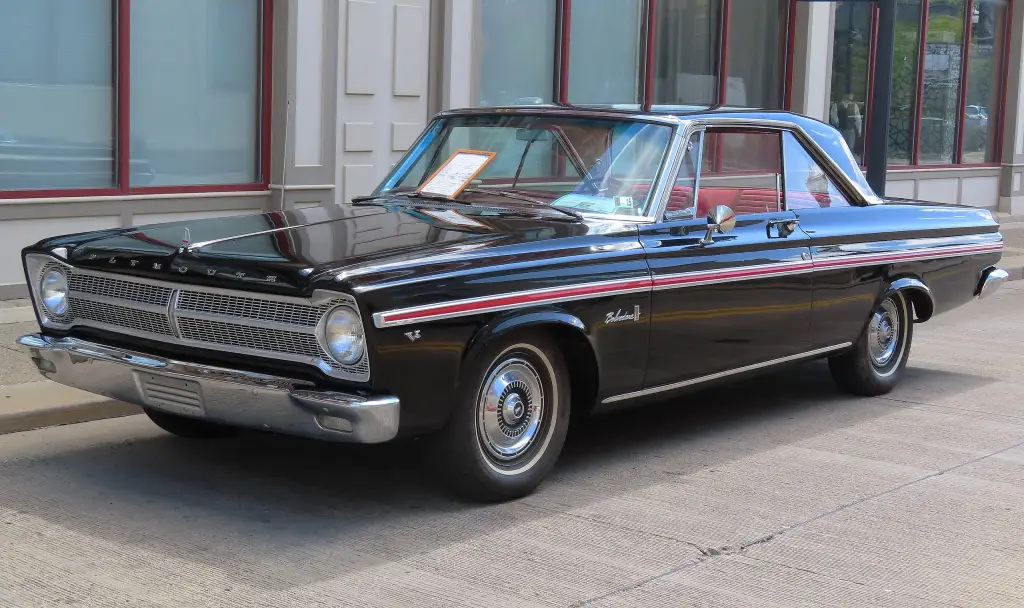
The Plymouth Cranbrook Belvedere was introduced as a two-door pillarless hardtop on 31 March 1951, Plymouth’s first such body. It was developed in answer to the 1950 Chevrolet Bel Air and the Ford Victoria, the first two-door hardtops in the low-priced American market, and it was built on the Cranbrook’s 118.5-inch wheelbase. Power came from Chrysler’s flathead 217.8 cu in straight six with a 7.00:1 compression ratio and 97 hp.
For 1952 the car was essentially unchanged apart from the two-tone “saddleback” paint treatment, which now flowed from the roof over the beltline onto the trunk, in sable bronze over suede, black over mint green or grey over blue. Overdrive was offered as an option, giving three engine revolutions per rear-wheel revolution instead of four. The 1953 Plymouths were completely restyled with a shorter 114-inch wheelbase, a one-piece windshield, flush rear fenders and a lower hood line, the compression ratio rose to 7.10:1 for 100 hp and Hy-Drive semi-automatic transmission arrived in April 1953.
Full-size series (1954–1959)
For 1954 the Belvedere replaced the Cranbrook as the top-line offering and became a separate model line with a convertible, a two-door station wagon and a four-door sedan; the two-door hardtop was now called the Sport Coupe. Small chrome tailfins appeared on the rear fenders, the entry-level Plaza joined below it, and in March 1954 Plymouth at last offered a fully automatic transmission, the two-speed Chrysler PowerFlite, with a larger 230.2 cu in six rated at 110 hp.
The 1955 cars were completely new in Virgil Exner’s “Forward Look”, and mid-way through the year the engine’s stroke grew by a quarter inch, taking displacement from 217.8 to 230.2 cu in. For 1956 the styling gained twin tailfins and the industry’s first push-button automatic, seat belts were added, and in early 1956 the Fury joined the range as a high-performance coupe. V8 options ran from a 270 cu in unit of 180 bhp to the Fury’s 240 bhp 303. The 1957 redesign was so radical that Chrysler advertised it with the slogan “Suddenly, it’s 1960!”. The Belvedere continued as Plymouth’s full-size car until 1965, then became an intermediate, and was replaced after 1970 by the Satellite.
Design and features
- First Plymouth hardtop: the 1951 two-door pillarless body was a new shape for the marque.
- Forward Look: the 1955 and 1956 cars brought Exner’s styling and tail fins to the range.
- Push-button automatic: Plymouth offered the first such transmission in an American car for 1956.
- Long-lived name: the Belvedere stayed in the range for two decades, as full-size and then intermediate.
Plymouth Belvedere versions
- Cranbrook Belvedere (1951–1953): the pillarless hardtop version of the Cranbrook.
- 1954 full line: sedan, convertible, wagon and Sport Coupe hardtop.
- Fury (from 1956): the high-performance coupe that joined the Belvedere range.
- 1965–1970 intermediate: the smaller Belvedere that gave way to the Satellite.
The Belvedere sat above the Plaza and later below the Fury, and it was replaced by the Satellite. More cars are in the Plymouth collection.
Video: 1958 Plymouth Belvedere – Christine Shows Her Latest Trick – Take 1
Video by AudioMobil on YouTube.
Sources
- Plymouth Belvedere, English Wikipedia: 1951-1957 history, engines, transmissions, export assembly