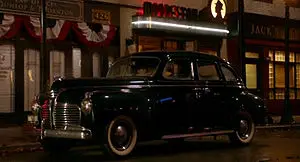
The Plymouth Roadking was a large passenger car built by Chrysler under the Plymouth name for the 1938, 1939 and 1940 model years. It replaced the Plymouth Business and sat below the Deluxe in the range.
Plymouth Roadking at a glance
| Maker | Plymouth (Chrysler Corporation) |
|---|---|
| Model years | 1938–1940 |
| Position | low-priced model, below the Deluxe |
| 1938 model | P5, renamed from the Business mid-year |
| 1939 model | P7, new construction from August 1938 |
| 1940 model | P9, the last year |
| Optional engine, 1938 | higher compression, 86 bhp |
| 1938 production | 74,785 Business and Roadking cars |
| 1939 production | 102,368 cars |
| 1940 production | 106,738 cars |
| End | dropped in August 1940, leaving only the Deluxe |
Based on one source, the German Wikipedia article on the Roadking, which follows the Standard Catalog of American Cars; production figures are given there for each model year.
History of the Plymouth Roadking
Model P5 (1938)
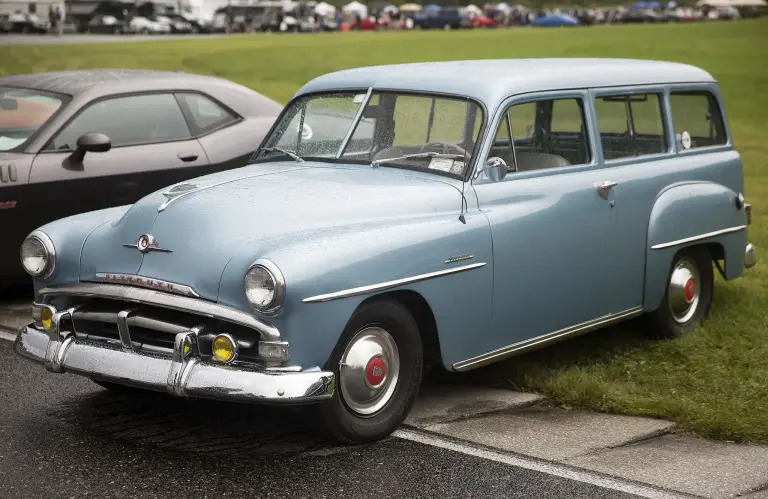
The P5 had fuller front wings that reached further forward and a slightly higher beltline than its predecessor, which made the cars look rather squat, a shape buyers did not much like. Sales were poor, not least because the used-car market was full, and the already old-fashioned-looking model was hard to move. A higher-compression engine of 86 bhp was available to order. At the turn of the year, in the middle of the model year, the Business was renamed Roadking because the new name sounded less like a commercial vehicle, and the car gained front vent windows like the Deluxe. The Business and the Roadking together accounted for 74,785 cars in 1938.
Model P7 (1939)
The long overdue new construction was presented in August 1938. The cars had an alligator bonnet, square headlamps recessed into the front wings and a split, V-shaped windshield. Van models returned, as they had existed for the Business, among them a two-door “Utility Sedan” with a single seat and a platform truck. By August 1939, 102,368 cars had been built.
Model P9 (1940)
The P9 models resembled their predecessors but had squarer wings and round headlamps again. Both engines gained about 1 bhp and the wheelbase grew by three inches. In that model year 106,738 Roadkings were built, and from August 1940 the cheaper line was dropped entirely, leaving Plymouth with only the Deluxe.
Design and features
- Low-price line: the Roadking was the cheapest full-size Plymouth, below the Deluxe.
- Renamed Business: the name changed mid-way through 1938 to sound less commercial.
- Three yearly models: the P5, the new P7 and the P9, each with its own front-end styling.
- Commercial versions: the 1939 range again included van and platform-truck bodies.
Plymouth Roadking versions
- Roadking P5 (1938): the renamed Business, with fuller wings and a higher beltline.
- Roadking P7 (1939): the new body with an alligator bonnet and recessed square headlamps.
- Roadking P9 (1940): squarer wings, round headlamps and a three-inch longer wheelbase.
- Utility Sedan (1939): a two-door van body with one seat among the commercial versions.
The Roadking was the stablemate of the De Luxe, which outlived it, and it came before the Cranbrook generation. More cars are in the Plymouth collection.
Video: Field Find! 1941 Plymouth Road King Walk-Around.
Video by coldwarmotors on YouTube.
Sources
- Plymouth Roadking, German Wikipedia: model years, P5, P7 and P9 details, production figures