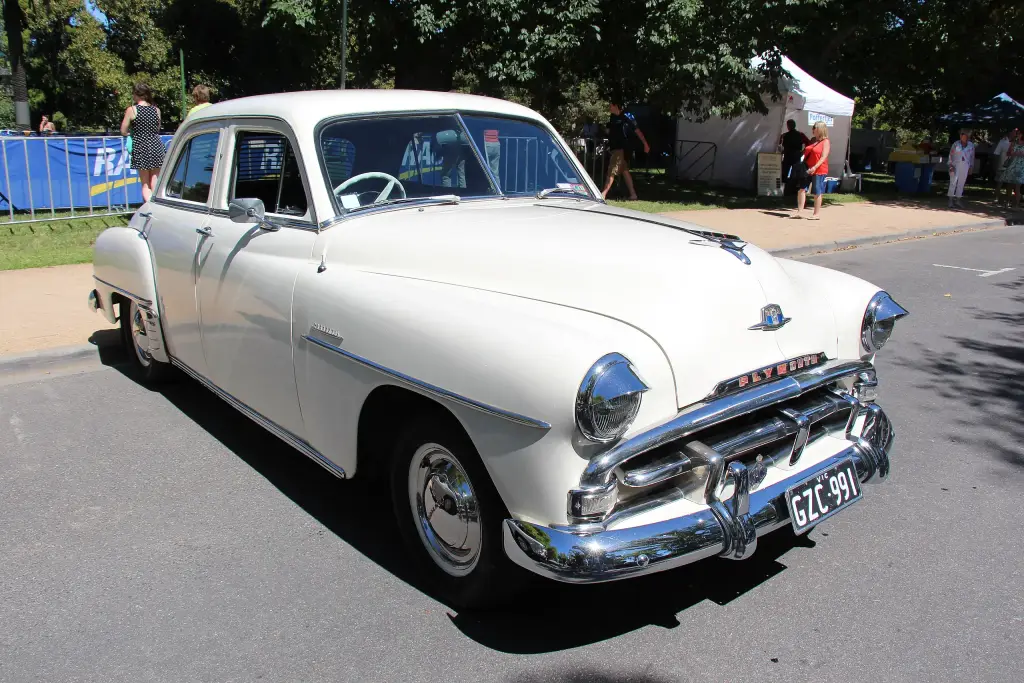
The Plymouth Cranbrook was an automobile built by Plymouth for the 1951 through 1953 model years. It replaced the Special DeLuxe when Plymouth changed its naming scheme and was essentially the same car as the Plymouth Concord and Cambridge.
Plymouth Cranbrook at a glance
| Maker | Plymouth (Chrysler Corporation) |
|---|---|
| Model years | 1951–1953 |
| Series | P-23 in 1951–1952, P-24-2 in 1953 |
| Sharing its body | Plymouth Concord and Cambridge |
| Engine, 1951–1952 | flathead six, 97 hp (72 kW) |
| Engine, 1953 | flathead six, 100 hp (75 kW) |
| Wheelbase, 1953 | 114 in (2,900 mm) |
| Replaced | Plymouth Special DeLuxe |
| Replaced by | Plymouth Belvedere, 1954 |
| Built in Australia | 4,382 cars, 1951–1953 |
History of the Plymouth Cranbrook
The Cranbrook replaced the Special Deluxe for 1951 and was one of three related Plymouth bodies, alongside the Cambridge and the Concord. The cars were conservatively styled to fit K. T. Keller’s notion that a car should be practical and let the driver sit upright in a hat, even though rivals were already favouring a lower, sleeker look. The differences from the 1950 Special Deluxe were modest: interchangeable glass and doors with different rubber seals, no woodgrain on the instrument panel, a plastic rather than chrome brake handle, and a hood release handle that also worked the overdrive. In period television commercials the cars were simply introduced as “the new Plymouth” followed by the model year, without naming the trim.
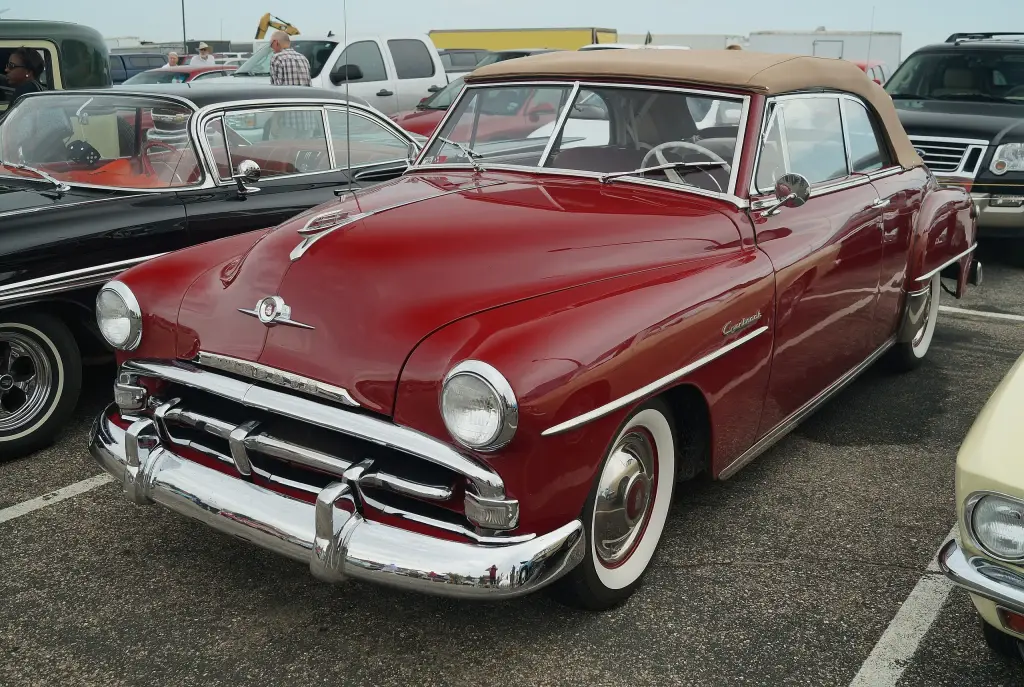
The Cambridge and Cranbrook shared the P-23 series number in 1951 and 1952, and both used the six-cylinder flathead engine of 97 hp.
1953 and the end
For 1953 the boxy shape gave way to straighter lines, a one-piece windshield and pull-out rather than twisting door handles; the glovebox moved to the centre for easier reach and the fuel filler went under the boot lid, which at first let petrol spill into the boot until baffles were added in mid-1953. The three-window coupe and the fastback sedan were dropped, and the long and short wheelbases were consolidated into a single 114-inch span, one inch shorter than Chevrolet’s and Ford’s but with much less overhang. Power rose to 100 hp and the series became P-24-2, while the lower-trim Cambridge was P-24-1.
For 1954 the Cranbrook name was replaced by the Belvedere, which had been its top trim level, and Plymouth names switched to those of upscale hotels.
Design and features
- Upright styling: a roomy, tall body in the K. T. Keller tradition rather than the low look of rivals.
- Shared bodywork: the same shell as the Cambridge and Concord, sold at different trim levels.
- 1953 modernisation: one-piece windshield, pull-out handles and a single 114-inch wheelbase.
- Australian assembly: the P-23 was also built in Australia, where 4,382 cars were made from 1951 to 1953.
Plymouth Cranbrook versions
- Cranbrook P-23 (1951–1952): the original body, sharing its series number with the Cambridge.
- Cranbrook P-24-2 (1953): the restyled car on the 114-inch wheelbase.
- Australian Cranbrook (1951–1957): locally assembled P-23 and P-24 cars, and from 1954 the P-25 range.
The Cranbrook shared its body with the Cambridge and gave way to the Belvedere. More cars are in the Plymouth collection.
Video: 1951 Plymouth Cranbrook
Video by Craig P on YouTube.
Sources
- Plymouth Cranbrook, English Wikipedia: series numbers, styling, engines, Australian production