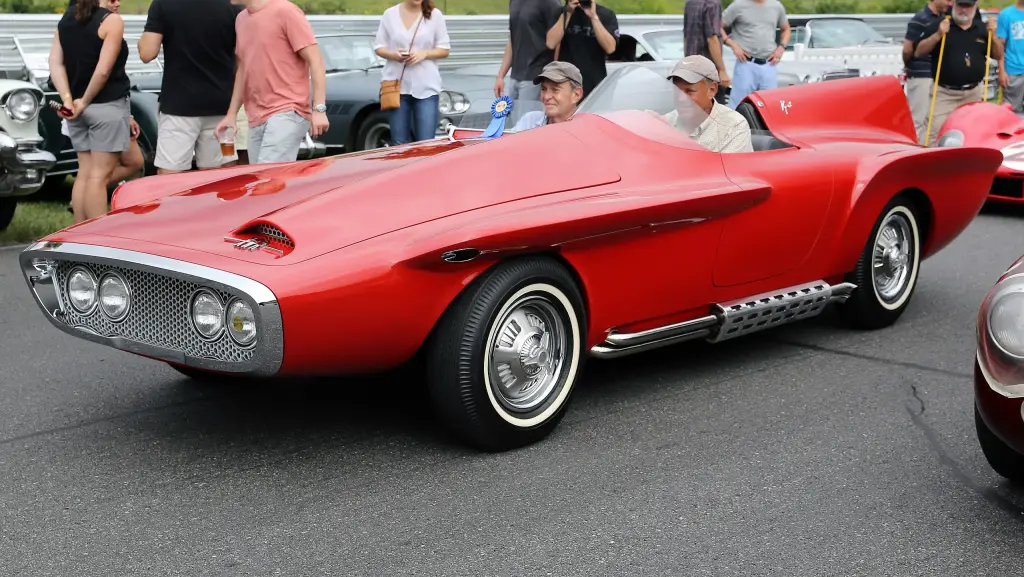
The Plymouth XNR, also called the XNR 500, is a concept car developed by Chrysler and designed by Virgil Exner, first shown in 1960. It is an open roadster with asymmetric features, proposed as a sporty addition to the Plymouth range and as competition for the Chevrolet Corvette.
Plymouth XNR at a glance
| Maker | Chrysler (Plymouth concept) |
|---|---|
| Designer | Virgil Exner |
| Shown | 1960 New York Auto Show |
| Body | open two-seat roadster, steel over a Ghia-built buck |
| Chassis | cut-down Plymouth Valiant unitary chassis |
| Engine | 170 cu in slant-six with Hyper Pak |
| Power often quoted | 250 hp |
| Top speed | 146 mph at first, 153 mph after modification |
| Production | none |
| Sold in 2012 | $935,000 at RM Sotheby’s Monterey |
History of the Plymouth XNR
Virgil Exner left Studebaker for Chrysler in 1949, when Chrysler’s previous designers favoured conservative, upright bodies and sales were falling; one of his first tasks was to win final say over design from the engineering department. He commissioned a series of concept cars built in Italy by Carrozzeria Ghia, among them several sporting open two-seaters including three of the four Dodge Firearrow cars and the Chrysler Falcon, all answers to the Ford Thunderbird and Chevrolet Corvette.
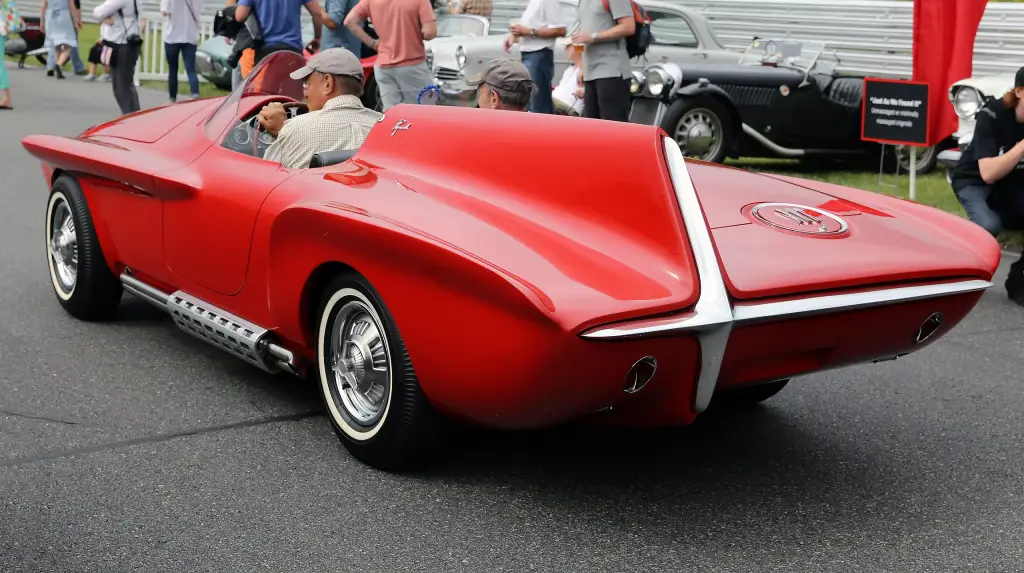
The XNR went through several names during development. Early drawings call it the Falcon, the name later used for the car that became the production Valiant until Ford registered it; it was then called the Asymmetrica and finally XNR, a pseudo-acronym made from the designer’s surname with the vowels removed. Its shape was influenced by a Studebaker Indianapolis racer Exner owned, by the later asymmetrical Watson Indy Roadster and by the Jaguar D-Type.
Engineering
The XNR used the chassis and the G-Series slant-six engine of the Valiant, both new for 1960. Only the 170 cu in LG version was low enough to fit under the car’s bonnet; it carried Chrysler’s Hyper Pak performance package, and the engine is one of just twelve slant-sixes built to NASCAR specifications, related to the engines that took the first seven places in the inaugural Cannonball Compact Car Division NASCAR race at Daytona in January 1960. A figure of 250 hp is often quoted. The Valiant chassis was cut down, its sills reinforced and the modified unit shipped to Ghia, which built an armature and formed the steel body over it.
As first built the car reached 146 mph on Chrysler’s test track, where Exner is said to have driven it at up to 142 mph himself; after a fibreglass nosecone by Dick Burke and further engine work it reached 153 mph. The XNR appeared on the covers of Road & Track and Motor Trend in May 1960 and of Today’s Motor Sports in May 1961, and made its public debut at the 1960 New York Auto Show.
After Chrysler
Chrysler did not put the XNR into production, and Exner’s attempt to buy it failed. The car was shipped back to Ghia to save it from being destroyed, then sold to a Swiss buyer, who passed it to Mohammad Reza Pahlavi, the Shah of Iran. It was later bought by the Kuwaiti dealer Anwar al Mulla and photographed in Kuwait for National Geographic in May 1969, and in the early 1970s it went to a Lebanese owner who kept it in underground storage. Karim Edde found it during the Lebanese Civil War, recognised it and moved it between locations to protect it, and in 2008 sent it to RM Restorations in Canada. The restoration was finished in March 2011 and the car reappeared at that year’s Amelia Island concours; in August it won the Gran Turismo Trophy at Pebble Beach, and on 18 August 2012 it sold for $935,000 at RM Sotheby’s in Monterey.
Design and features
- Asymmetric design: an offset bonnet scoop and a power bulge running into a tall headrest and fin on the driver’s side.
- Two-level cockpit: the passenger seat set back and four inches lower, with its own folding wind deflector and a steel tonneau cover that makes the car a single-seater.
- Proven running gear: a Valiant chassis and a 170 cu in slant-six in NASCAR specification.
- Camera details: glass over the gauges imitating camera lenses, and a glovebox insert that could be removed.
Plymouth XNR versions
- XNR (1960): the single car built, in its original form with 146 mph.
- XNR with nosecone: the later configuration with a fibreglass nose and a 153 mph top speed.
The XNR was built on the Valiant and sat alongside Plymouth’s other show cars such as the Belmont. More cars are in the Plymouth collection.
Video: 1960 Plymouth XNR Concept Car – Jay Leno’s Garage
Video by Jay Leno’s Garage on YouTube.
Sources
- Plymouth XNR, English Wikipedia: design, engine, speed, ownership history