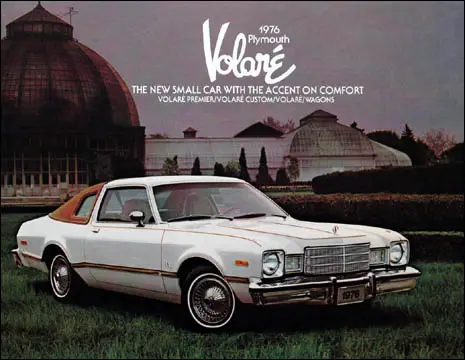
The Plymouth Volaré was sold for the 1976 through 1980 model years as the Plymouth version of the Dodge Aspen, and it replaced the Plymouth Valiant. The name means “to fly” in Italian.
Plymouth Volaré at a glance
| Maker | Plymouth (Chrysler Corporation) |
|---|---|
| Model years | 1976–1980 |
| Platform | Chrysler F platform, all-new |
| Bodies | two-door coupe, four-door sedan, five-door wagon |
| Replaced | Plymouth Valiant |
| Twin car | Dodge Aspen |
| Award | Motor Trend Car of the Year 1976 |
| Front suspension | Isolated Transverse Suspension System |
| Glass area increase | 25 percent on two-doors, 33 percent on sedans |
| Built at | Newark, Delaware, and Dodge Main, Hamtramck |
| Replaced by | Plymouth Reliant, 1981 |
Based on one source, the English Wikipedia article on the Dodge Aspen, which covers the Plymouth Volaré as the same model.
History of the Plymouth Volaré
The Volaré and the Dodge Aspen were introduced mid-way through the 1976 model year as successors to the Chrysler A-platform cars, the Plymouth Valiant and Duster and the Dodge Dart. During 1976, Valiant and Duster models were sold alongside the Volaré at Chrysler-Plymouth dealers, and the Valiant and Dart were dropped after that year. The cars marked the debut of the all-new Chrysler F platform, the first ground-up redesign of the company’s compact line since 1960: the two-door coupe lost the hardtop roofline of the Valiant, and a five-door wagon returned to the compact class for the first time since 1966. Chrysler conceived the pair as modern, fuel-efficient cars, more luxurious than their predecessors, and they were named Motor Trend Car of the Year for 1976, with Consumer Reports praising their modern design and performance. They nevertheless suffered quality problems, frequent recalls and early rust, which damaged their reputation and sales.
Engineering
The cars were extensively wind-tunnel tested to cut drag and improve fuel economy, crosswind stability, wind noise and ventilation, which led designers to soften the front-end contours and remove the roof-drip mouldings. Body engineering used computer-aided design and clear plastic stress models to find stress points before any sheet metal was formed, and thinner glass, lighter side door beams and high-strength low-alloy steel four times as strong as conventional mild steel saved weight. Fewer steel stampings gave better panel fits with fewer welds, and glass area rose by 25 percent on two-door models and 33 percent on sedans.
The F platform brought a new front suspension, marketed as the Isolated Transverse Suspension System, with crossed torsion bars mounted transversely beneath the engine in place of Chrysler’s long-used longitudinal torsion bars. It saved space and weight and let the wheels move rearward rather than straight up when they met an obstacle, for a softer “big car ride”. The two torsion bars were mounted with an anti-sway bar ahead of the front wheels in a spring-strut layout on a K-shaped crossmember isolated from the body by four rubber mounts, and the steering column was rubber-isolated too. The rear used conventional semi-elliptical leaf springs, also rubber-isolated to break the metal-to-metal path for road noise.
The end
The Volaré and Aspen were built at Chrysler’s Newark plant in Delaware and at Dodge Main in Hamtramck, Michigan; the end of production also closed Dodge Main, which shut the same day. After the 1980 model year the F-platform cars were replaced directly by the front-wheel-drive K-cars, the Dodge Aries and Plymouth Reliant.
The Volaré name lived on for a few more years as a trim package on the compact Plymouth, including a Road Runner version from 1976 that no longer offered any special performance.
Design and features
- New F platform: the first complete redesign of Chrysler’s compact range since 1960.
- Transverse torsion bars: a new isolated front suspension tuned for ride comfort.
- Weight-saving engineering: HSLA steel, thinner glass, computer-aided design.
- Wagon body: a five-door estate returned to Chrysler’s compact line after 1966.
Plymouth Volaré versions
- Volaré coupe (1976–1980): the two-door without the old hardtop roofline.
- Volaré sedan (1976–1980): the four-door volume model.
- Volaré wagon (1976–1980): the five-door estate.
- Volaré Road Runner (1976–1980): the appearance package that carried the muscle-car name.
The Volaré replaced the Valiant and the Duster, and it was replaced by the Reliant. More cars are in the Plymouth collection.
Video: 1976 Plymouth Volare Commercial with Sergio Franchi same as Dodge Aspen
Video by OsbornTramain on YouTube.
Sources
- Dodge Aspen, English Wikipedia: platform, engineering, production, reputation