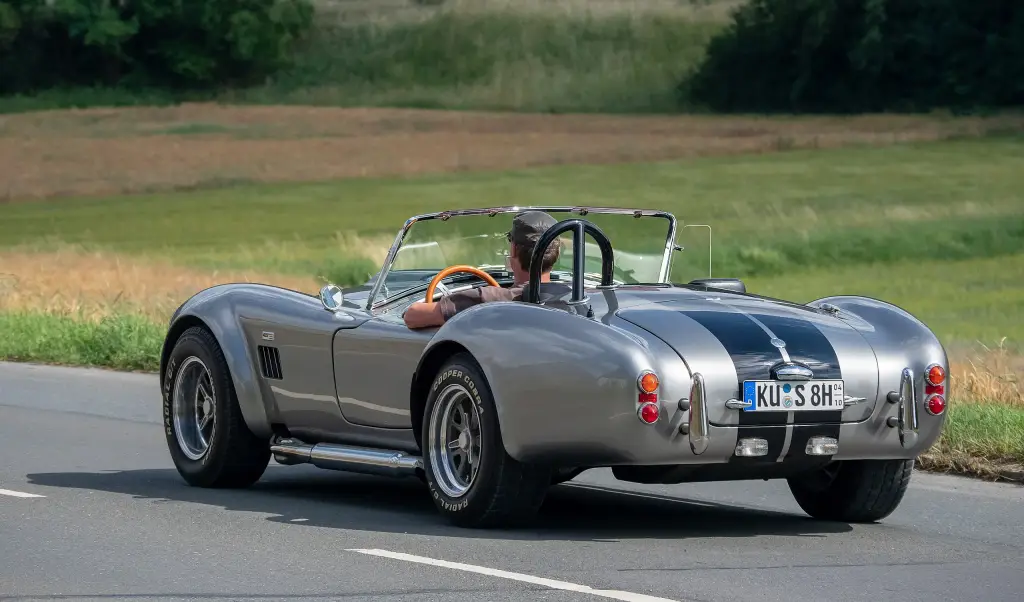
The Shelby Cobra is the sports car that Carroll Shelby created in 1961–1962 by putting a Ford V8 into the AC Ace, a light British roadster with an aluminium body. AC built and trimmed the cars at Thames Ditton in Surrey, and Shelby American installed the engine and gearbox in Los Angeles.
Shelby Cobra at a glance
| Also called | AC Cobra, Shelby AC Cobra |
|---|---|
| Built by | AC Cars, Thames Ditton; finished by Shelby American, Los Angeles |
| Production | 1962–1967 |
| Basis | AC Ace, steel ladder chassis with aluminium body |
| First engine | 4.3 L (260 cu in) Ford Windsor V8 |
| Second engine | 4.7 L (289 cu in) Ford Windsor V8 |
| 427 engine | 7.0 L (427 cu in) Ford FE ‘side oiler’ V8 |
| 427 power | 317 kW (425 hp) at 6,000 rpm |
| 427 torque | 651 N·m (480 lb·ft) at 3,700 rpm |
| 427 top speed | 264 km/h (164 mph); 298 km/h (185 mph) for the S/C |
| Cobra 427 built | 348 |
| Gearbox | four-speed manual |
History of the Shelby Cobra
From the AC Ace to the Cobra
AC had built small numbers of its two-seat Ace roadster since 1953. The car had a steel ladder chassis and a hand-formed aluminium body, and had used three different straight-six engines, ending with a 2.6-litre Ford Zephyr unit. In September 1961 Ford supplied Shelby with two of its new 3.6-litre small-block V8s, one of which went to AC. The prototype, chassis CSX2000, was completed at Thames Ditton in January 1962; the chassis was flown to Los Angeles on 2 February 1962 and Shelby’s team fitted the engine and transmission in less than eight hours at Dean Moon’s shop in Santa Fe Springs.
Mark I and Mark II
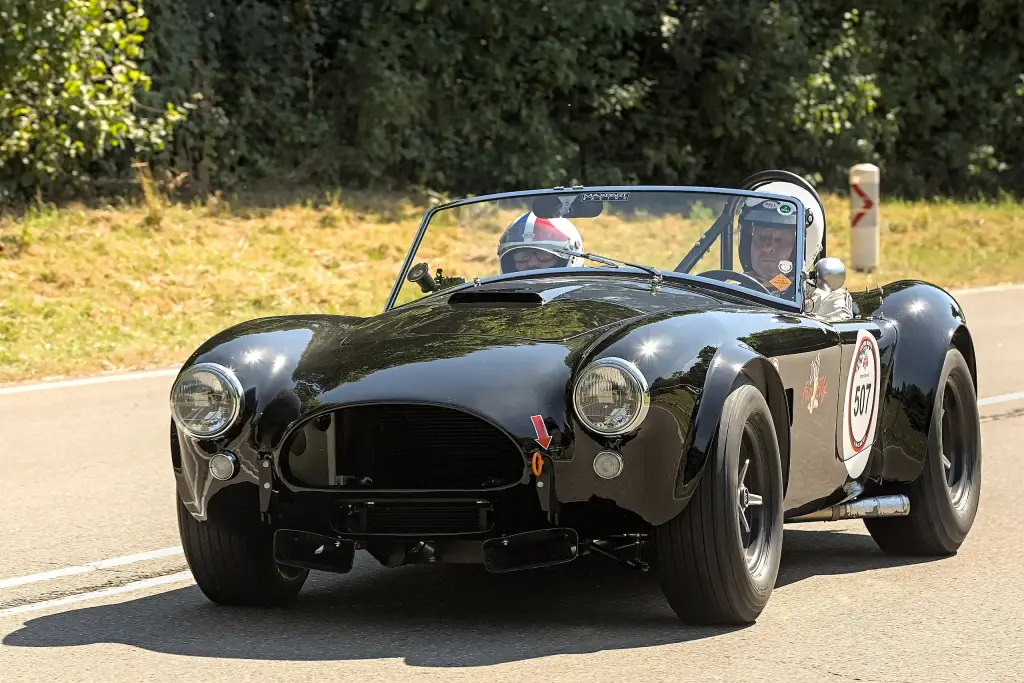
The production car differed from the prototype in small ways: the inboard rear brakes moved outboard to save cost and the fuel filler moved to the centre of the boot lid. AC shipped painted and trimmed cars without an engine to California, where Shelby finished them. The first 75 Mark I cars, including the prototype, used the 4.3-litre engine; the remaining 51 had the larger 4.7-litre unit, and most early cars were upgraded. In late 1962 AC’s chief engineer Alan Turner reworked the front end for rack-and-pinion steering, and the Mark II entered production in 1963. About 528 Mark II Cobras were built up to the summer of 1965.
The 427
The Mark III chassis was designed with Ford in Detroit, with main tubes grown from 3 to 4 inches and coil-spring suspension all round in place of the transverse leaf spring. It was powered by the 7.0-litre FE side-oiler V8 rated at 425 hp, giving a top speed of 264 km/h; the semi-competition S/C version was tuned to 485 hp and 298 km/h. Because the lightweight race engine was in short supply, many 427 Cobras were actually fitted with the milder 428. Of the 427, 348 cars were built; 50 S/C cars were made, 16 of which were further modified for racing. Shelby’s own Cobra production ended in 1966, while AC continued its coil-sprung 289 until 1968.
Design and features
- Light aluminium body: the Ace shell kept the weight low, quoted at 1,311 kg for the early car.
- Ford V8 power: from 260 and 289 small-blocks to the 7-litre 427.
- Racing hardware: a Salisbury limited-slip differential and inboard disc brakes came from the Jaguar E-Type.
- Side exhausts: the 427 S/C with side pipes and racing stripes became the classic Cobra image.
Shelby Cobra versions
- Cobra 260 (1962–1963): the first 75 cars with the 4.3-litre engine.
- Cobra 289 (1963–1965): the 4.7-litre Mark I and the rack-and-pinion Mark II.
- Cobra 427 (1965–1966): the big-block car on the new Mark III chassis.
- Cobra 427 S/C: semi-competition specification, 485 hp, 50 built.
- Daytona Coupe: a closed, aerodynamic body by Pete Brock that won the 1965 world championship for GT cars.
The Cobra led directly to the Shelby Mustang, and the big-block GT500 followed the same idea of a Ford V8 in a light body. More cars are in the Shelby collection.
Sources
- AC Cobra, English Wikipedia: development, production, 427 specification
- AC Cobra, German Wikipedia: production totals, market, later history
- AC Cobra, French Wikipedia: origins and model evolution
- AC Cobra, Italian Wikipedia: weight, Daytona Coupe, racing versions