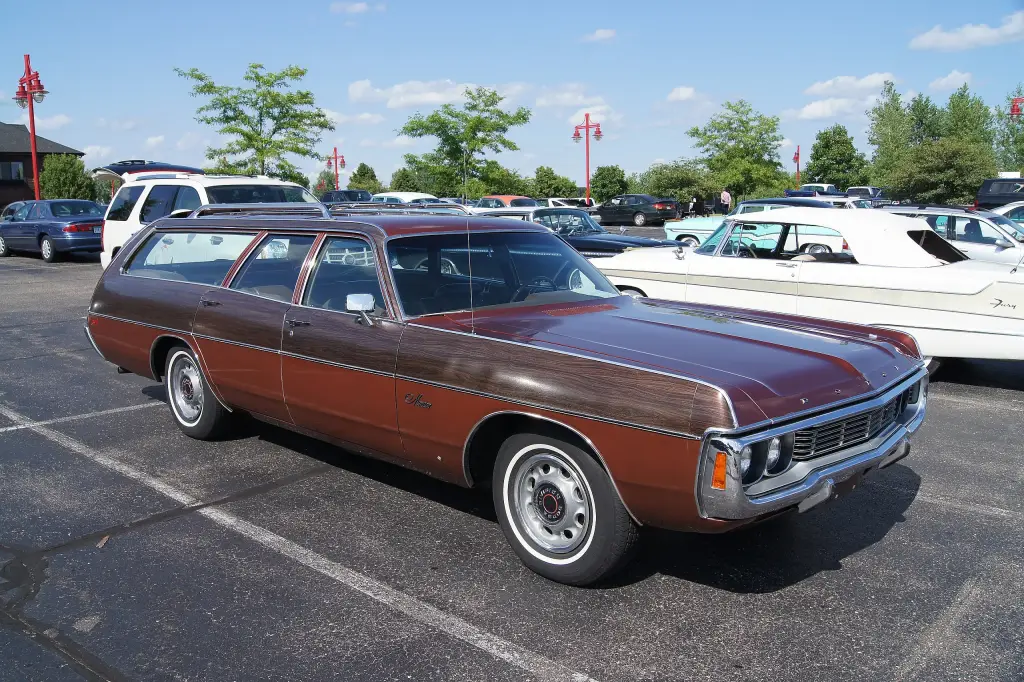
The Dodge Monaco is an automobile that Dodge marketed in several periods. It arrived for 1965 as the flagship of the full-size Dodge line, replacing the Custom 880, and later became a sub-model of the Polara before moving to the intermediate platform and, after a long pause, returning as a rebadged Eagle Premier in 1990.
Dodge Monaco at a glance
| First production | 1965-1978, Chrysler C and B platforms |
|---|---|
| Class | full-size car, then intermediate |
| 1965 engine | 383 cu in V8, 325 hp |
| 1965 gearboxes | TorqueFlite automatic or four-speed manual |
| Body styles | two- and four-door hardtops, sedans, convertible, wagon |
| Canadian version | based on the Plymouth Sport Fury |
| 1977-1978 | moved to the intermediate Chrysler B platform |
| 1979 | renamed Dodge St. Regis |
| Revival | 1990-1992, a rebadged Eagle Premier |
| Replaced by | Dodge Intrepid for 1993 |
Based on one source: the English Wikipedia article on the Dodge Monaco.
History of the Dodge Monaco
The Monaco was introduced on 25 September 1964 for the 1965 model year, intended to compete with the Pontiac Grand Prix in what became known as the personal luxury market. It was based on the Custom 880 two-door hardtop body and received special badging, a sportier interior with a full-length centre console and a 383 cu in V8 with 325 hp as standard. Transmissions were the TorqueFlite automatic or a four-speed manual, both with console shifters. Dodge marketed the car as the Limited Edition Dodge for the Man with Unlimited Taste, hoping to copy the halo effect the Grand Prix gave Pontiac.
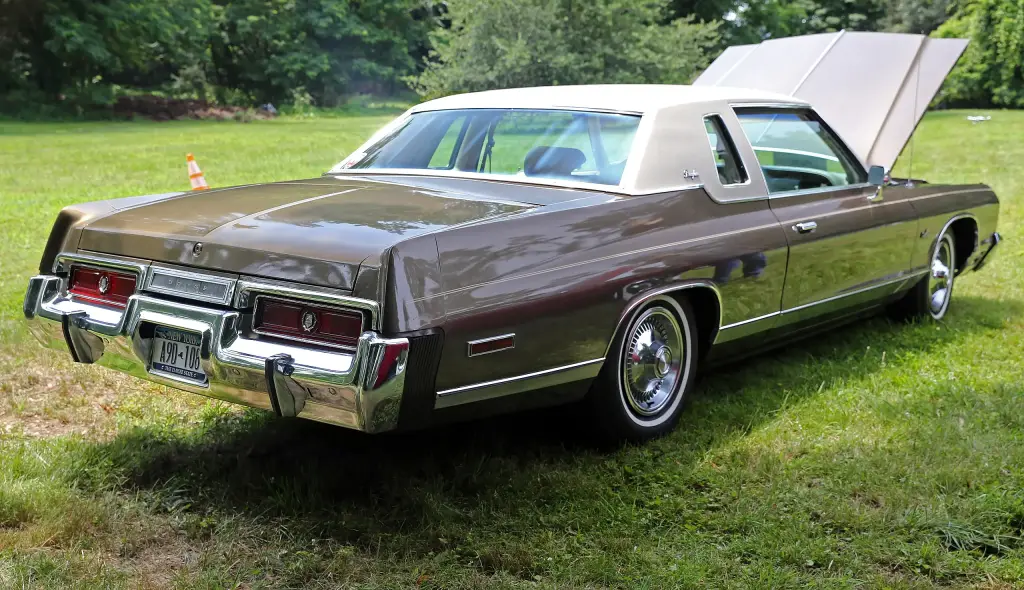
The Monaco’s exterior had a distinctive rear end, front wing-mounted turn indicators and wheel covers with simulated knock-off centres, while the body sides carried only a slim full-length moulding and ribbed rocker-panel trim. The interior received special attention, with bucket seats front and rear, a rear package tray contoured to the seat backs, unusual rattan wicker accents on the doors and quarter panels and a unique three-spoke steering wheel. The two-door competed with sporty models such as the Chrysler 300 non-letter series, Oldsmobile Starfire, Buick Wildcat and Mercury S-55, as well as with top full-size models like the Chevrolet Caprice and Plymouth Fury VIP. Lower pricing helped, but its front end looked similar to the cheaper Dodge Polara, and after one model year the Monaco became the full-size luxury line.
In Canada a version of the Plymouth Sport Fury was sold as the Dodge Monaco, available as a hardtop coupe or convertible and fitted with Plymouth dashboards in 1965 and 1966; unlike the American cars, the Canadian Monacos could be ordered with a 318 V8 or the slant-six. For 1966 the Monaco replaced the Custom 880 in the United States and the former Monaco became the Monaco 500, with the basic car available as a hardtop coupe, pillarless four-door hardtop, pillared sedan and station wagon. The 1967 cars received all-new sheet metal from chief designer Elwood Engel, with flat body planes, sharp accent lines and semi-fastback hardtop rooflines. Marker lights and full-width tail lights came in 1968, and the Monaco 500 was dropped in the United States at the end of that year.
For 1969 the wheelbase grew from 121 to 122 inches and the length to about 220 inches. All full-size Dodges adopted Chrysler’s new fuselage styling, in which the upper and lower body are melded into a uniformly curved unit, helped by curved side glass and the removal of the shoulder along the rear. A 500 option returned with front bucket seats and a centre armrest, and Canadian buyers could still order a Monaco convertible.
Three generations of the Monaco used the full-size Chrysler C platform from 1965 through 1977. For 1977 and 1978 Dodge shifted the Monaco to the intermediate Chrysler B platform, effectively downsizing the line, and for 1979 the model was redesigned and renamed the Dodge St. Regis. After a twelve-year pause the full-size Monaco returned for 1990 as the flagship Dodge sedan, replacing the Diplomat; it was a rebadged version of the Eagle Premier developed by Renault and American Motors. The Dodge Intrepid replaced it for 1993. The cars are named after the Principality of Monaco.
Design and features
- Personal luxury flagship: the 1965 Monaco was Dodge’s answer to the Pontiac Grand Prix.
- 383 V8: the standard engine in 1965, with 325 hp.
- Fuselage styling: Chrysler’s curved, unified body shape arrived on the 1969 Monaco.
- Three lives: full-size flagship, downsized intermediate and Premier-based sedan.
Dodge Monaco versions
- Monaco (1965): the original two-door hardtop with bucket seats.
- Monaco 500 (1966-1968): the top two-door version after the range expanded.
- Royal Monaco and Brougham: the later full-size and intermediate luxury versions.
- Monaco (1990-1992): the rebadged Eagle Premier flagship.
The Monaco replaced the Dodge Custom 880 and shared its market with the Dodge Polara, while its 1979 replacement was the Dodge St. Regis. More Dodge models are in the Dodge collection.
Sources
- Dodge Monaco, English Wikipedia: generations, 1965 model, Canadian versions, revival