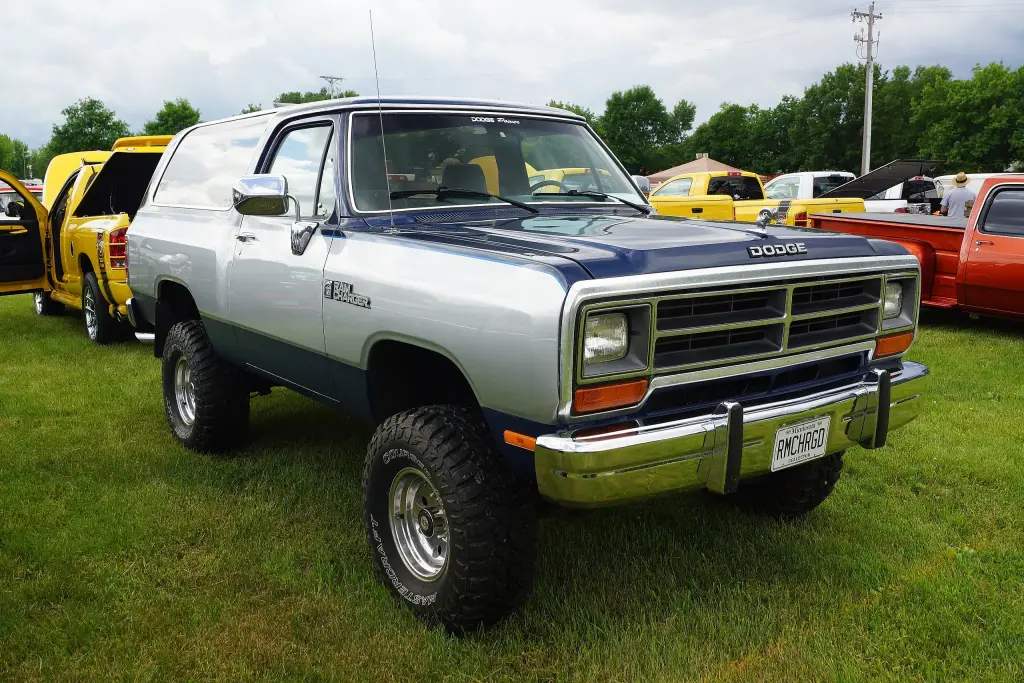
The Dodge Ramcharger is a large sport utility vehicle that Dodge built from 1974 to 1993 on a shortened-wheelbase version of the Dodge D series and Ram pickup chassis. A Plymouth version called the Trail Duster was offered from 1974 to 1981 and was Plymouth’s only SUV.
Dodge Ramcharger at a glance
| Production | 1974-1993 (Mexico to 1996) |
|---|---|
| Class | full-size two-door SUV |
| Platform | Chrysler AD, 9 inches shorter than the pickup |
| Drive | four-wheel drive at first; two-wheel drive from 1975 |
| Engines | 225 slant-six; 318, 360, 400 and 440 V8s |
| Early roofs | no roof, dealer fabric top or removable steel roof |
| Second generation | 1981-1993 with a fixed steel roof |
| Rivals | Chevrolet K5 Blazer and Ford Bronco |
| Mexican revival | 1999-2001, about 30,000 two-wheel-drive cars |
Based on one source: the English Wikipedia article on the Dodge Ramcharger.
History of the Dodge Ramcharger
During development the Ramcharger was known as the Rhino. The Ramcharger and Trail Duster used a version of the Dodge Ram’s Chrysler AD platform with a wheelbase nine inches shorter than the pickup’s. They were originally four-wheel drive only, with a rear-wheel-drive version available from 1975. The 1974 to 1980 models came without a roof, with a dealer-installed fabric top, or with an optional removable steel roof and a flip-up rear tailgate window. Early 1974 cars had door pillars attached to the removable roof, and half doors were used until 10 June 1974, after which the roof changed to use normal pickup-style doors. Marketed as a basic utility vehicle, only the driver’s seat was standard up to 1976, with the passenger seat optional; an insulated centre console that kept items cool when filled with ice was also available. The Ramcharger was entered in rallying and finished first in the 1975 Sno*Drift event.
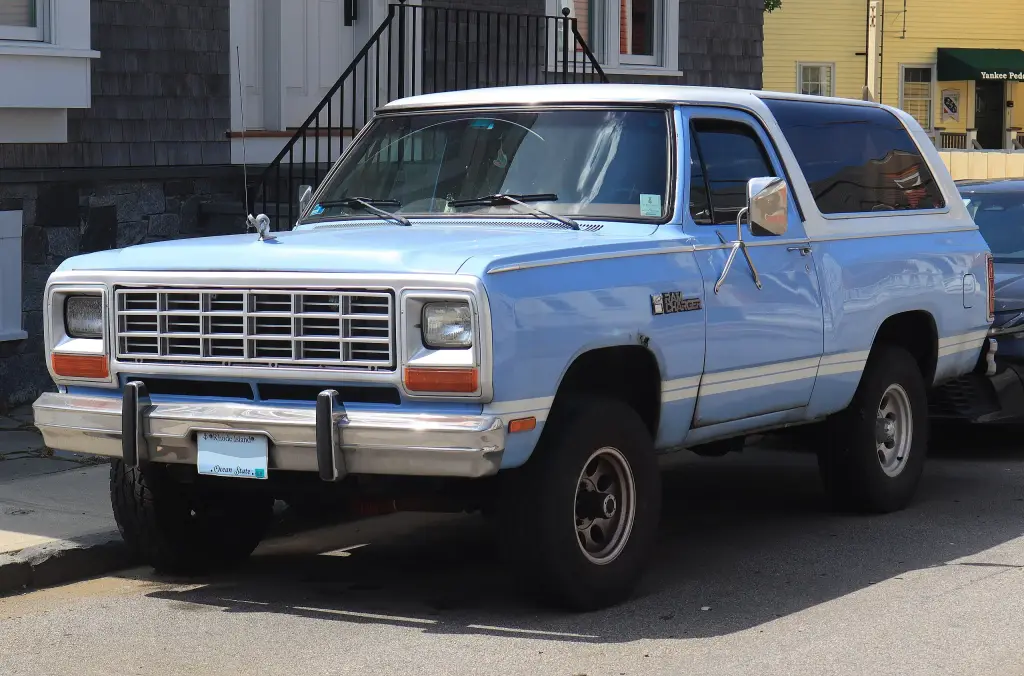
The standard engine was the 225 cu in slant-six, with 318 and 360 cu in Chrysler LA small-block V8s available along with the larger 400 and 440 cu in wedge engines. In 1978 the 360 produced 175 hp and in 1979 it was rated at 160 hp.
The second generation began in 1981 when the Ramcharger and Trail Duster followed the D series pickup’s redesign into the Ram. They had an egg-crate grille until 1986, when the front was redesigned with the crosshair grille that became common on Dodges, and there were further grille changes in 1991 that lasted until production ended in 1993. These models had a non-removable welded steel roof instead of the removable top. The Trail Duster lasted only one year with the Ram design and was dropped after 1981.
From 1981 to 1987 all models were carburetted, but in 1988 throttle-body fuel injection was added to the 318 V8 and in 1989 to the 360. The injected 318 produced 170 hp and 245 lb-ft and the injected 360 193 hp and 285 lb-ft. In 1992 the multiport-injected Magnum 318 became standard with the 360 still optional, and in 1993 the Magnum 360 replaced the LA engine. Many manual gearboxes were offered over the years, from the A-230 three-speed to the A-535 five-speed in 1992, with the NP435 granny-gear four-speed most common in four-wheel-drive models, and the clutch changed from mechanical to hydraulic in 1988. Automatic models used the LoadFlite TF-727 until the A-500 and A-518 four-speeds arrived in 1991. An all-wheel-drive NP-203 transfer case was standard until 1980, when it gave way to the part-time NP-208 and later the NP-241 in 1988, and axles were Dana 44 front and Chrysler 8.25 or 9.25 inch rear. The Ramcharger continued in Mexico until 1996, and a third generation based on the Ram pickup was produced there for the 1999 to 2001 model years, with about 30,000 two-wheel-drive cars built. In November 2023 Stellantis announced that the Ramcharger name would return on a plug-in hybrid Ram 1500.
Design and features
- Shortened pickup chassis: the Ramcharger used the D series platform with a shorter wheelbase.
- Removable roof: early cars could be ordered with a fabric or removable steel top.
- V8 choice: engines from the 225 slant-six to the 440 cu in wedge V8.
- Trail Duster twin: Plymouth’s only SUV, sold from 1974 to 1981.
Dodge Ramcharger versions
- First generation (1974-1980): the removable-roof SUV with four-wheel drive.
- Second generation (1981-1993): the fixed-roof version with the Ram front end.
- Plymouth Trail Duster (1974-1981): the Plymouth-badged version.
- Mexican Ramcharger (1999-2001): the later two-wheel-drive revival.
The Ramcharger was based on the Dodge D series and later Dodge Ram pickups, and it shared the large-SUV market with the Dodge Durango that followed. More Dodge models are in the Dodge collection.
Sources
- Dodge Ramcharger, English Wikipedia: generations, roofs, engines, transmissions