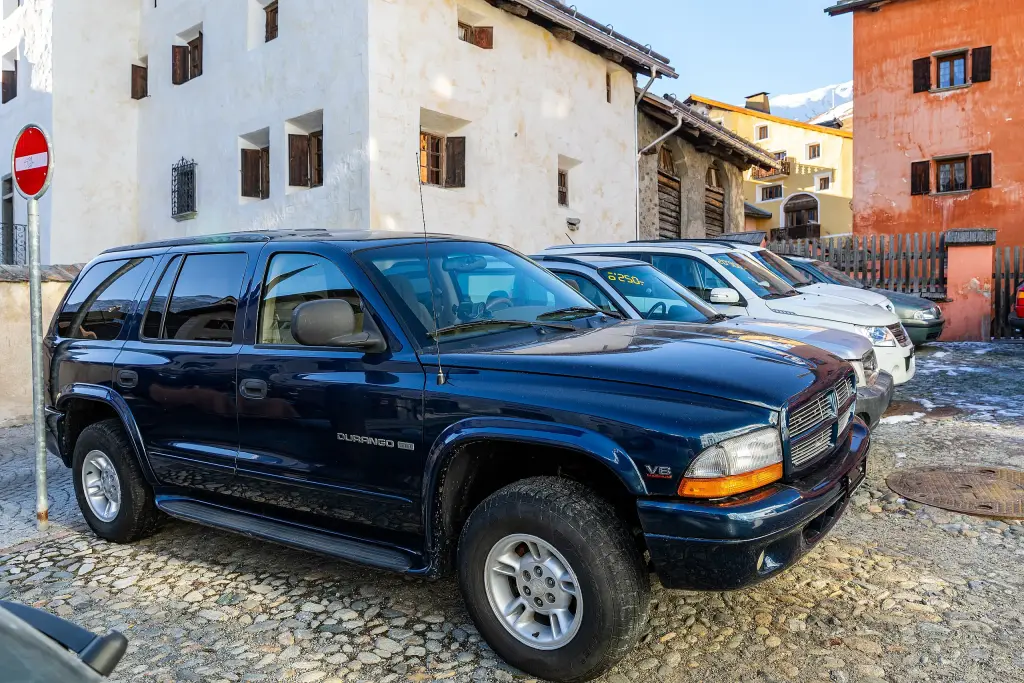
The Dodge Durango is a mid-size SUV that Dodge has produced since the 1998 model year. The first two generations were closely related, both based on the Dodge Dakota and Dodge Ram and both built with body-on-frame construction at Newark, Delaware, through 2009.
Dodge Durango at a glance
| Maker | Dodge, Chrysler |
|---|---|
| Production | from the 1998 model year |
| Class | mid-size SUV |
| First two generations | body-on-frame, based on the Dakota and Ram |
| Third generation | unibody on the Jeep Grand Cherokee platform, from 2011 |
| Seats | up to seven |
| Towing | up to 7,500 lb when properly equipped |
| Engines | 3.9 V6, 5.2 and 5.9 Magnum V8s, 4.7 PowerTech V8 |
| Notable version | Shelby S.P.360 with a supercharged 5.9 V8, 360 hp |
| Twin model | Chrysler Aspen (2007-2009) |
| Sales | over two million since 1998 |
Based on one source: the English Wikipedia article on the Dodge Durango.
History of the Dodge Durango
The Durango was marketed as a sturdy truck-based SUV designed to hold up to seven passengers and tow up to 7,500 lb when properly equipped. It shared its front end, instrument panel and front seats with the Dakota pickup on which it was based, and its tail lights and tailgate handle with Chrysler’s minivans of the time, the Dodge Caravan, Plymouth Voyager and Chrysler Town & Country. Early designs of the eight-passenger Durango had a rear-facing third row like older station wagons; to make room for a more practical forward-facing third row, Dodge shortened the front doors and raised the roof two inches behind the front seats to allow stadium seating, with the roof rack designed to disguise the raised roof.
The 4.7-litre PowerTech V8 replaced the 5.2-litre Magnum V8 for 2000, although the 5.2 was still available in early 2000 models. That year also brought a special all-wheel-drive performance version called the R/T with a 5.9-litre Magnum V8. In 1999 and 2000 a limited-edition Shelby S.P.360 was offered with a supercharged 5.9-litre Magnum producing 360 hp and 412 lb-ft, with unique wheels, tyres, suspension and bumpers, Viper blue paint and two racing stripes; it reached 60 mph in 7.1 seconds and a top speed of 142 mph.
For 1999 the Durango became available with two-wheel drive and with a 3.9-litre Magnum V6, though few were sold. Leather seats became standard on SLT Plus models, body-colour wheel arches became standard on SLT Plus and four-wheel-drive models, and heated mirrors and steering-wheel radio controls were added to the options list. For 2000 the 4.7-litre V8 replaced the 5.2 as the standard engine for four-wheel-drive models and the 3.9 V6 was dropped, leaving only V8s for the rest of the run. The 2001 models received a redesigned interior, a dash-mounted transfer case switch instead of a console lever, an electronic vehicle information centre, dual-zone climate control and six-speaker sound systems. A new entry-level SXT trim arrived in 2002 with optional side curtain airbags, and the 2003 models gained four-wheel disc brakes.
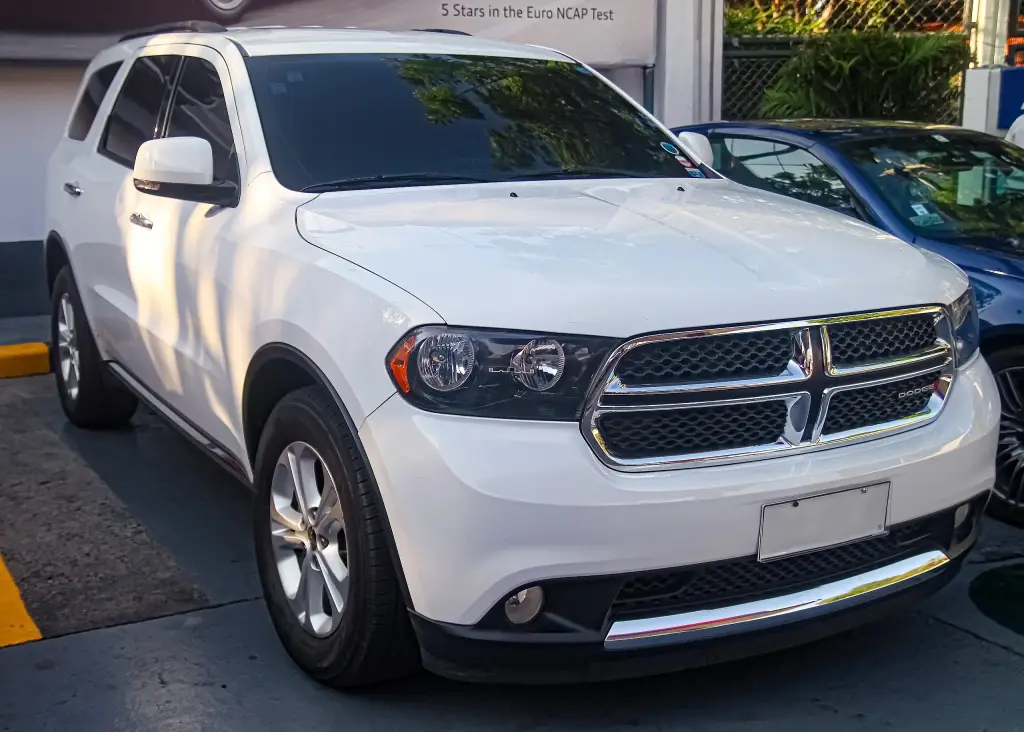
Trim levels ran from the SLT and the more luxurious SLT Plus, which added fog lamps, leather, a power driver’s seat, a security alarm and an Infinity sound system, to the Sport and SXT of 2000-2003 and the high-performance R/T based on the SLT Plus. A hybrid variant was introduced in 2009 but ended quickly with the second generation, and from 2007 to 2009 the Durango was also sold as the Chrysler Aspen. The third-generation Durango began with the 2011 model year on the same platform as the Jeep Grand Cherokee, with unibody construction, and has been assembled at Jefferson North in Detroit since late 2010. Over two million Durangos have been sold since 1998.
Design and features
- Three rows: up to seven seats, with a raised roof and stadium seating in the first generation.
- Truck base: the first two generations used Dakota and Ram mechanicals.
- Shelby S.P.360: a supercharged 360 hp version sold in 1999 and 2000.
- Unibody third generation: the 2011 car moved to the Jeep Grand Cherokee platform.
Dodge Durango versions
- SLT and SLT Plus: the volume trims of the first generation.
- Sport and SXT (2000-2003): the cheaper trims with decals rather than badges.
- R/T (2000-2003): the 5.9-litre V8 performance model with all-wheel drive.
- Shelby S.P.360 (1999-2000): the supercharged limited edition.
The Durango was based on the Dodge Dakota and Dodge Ram at first, and it replaced the Dodge Nitro as Dodge’s family SUV role in later years. More Dodge models are in the Dodge collection.
Sources
- Dodge Durango, English Wikipedia: generations, engines, trims, Shelby version