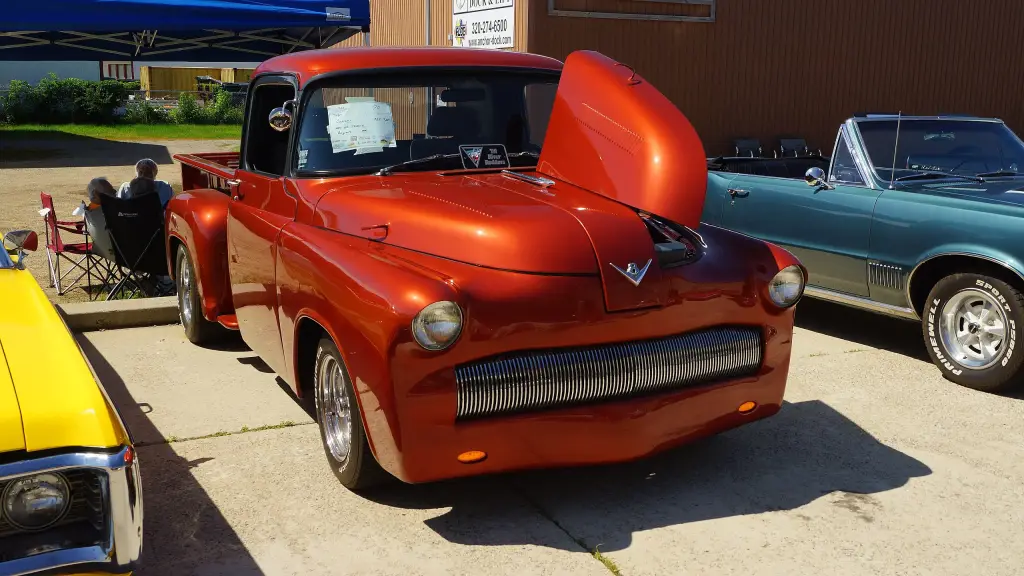
The Dodge C series is a line of pickup trucks that Dodge sold from 1954 until 1960. It replaced the Dodge B series, was a complete redesign rather than an update of the pre-war trucks, and was itself replaced by the Dodge D series in 1961.
Dodge C series at a glance
| Maker | Dodge, Chrysler Corporation |
|---|---|
| Production | 1954-1960 |
| Class | light and medium-duty pickup trucks |
| Predecessor | Dodge B series |
| Successor | Dodge D series (1961) |
| Early names | C-1-B (half-ton), C-1-C (three-quarter ton), C-1-D (one ton) |
| Later names | C-3 (1955), C-4 (1956) |
| Engines | 230 cu in flathead six; 315 and 331 cu in V8s; 318 cu in V8 from 1959 |
| Automotive first | two-speed PowerFlite automatic available in 1955 |
| Related bodies | Town Panel and Town Wagon |
Based on one source: the English Wikipedia article on the Dodge C series.
History of the Dodge C series
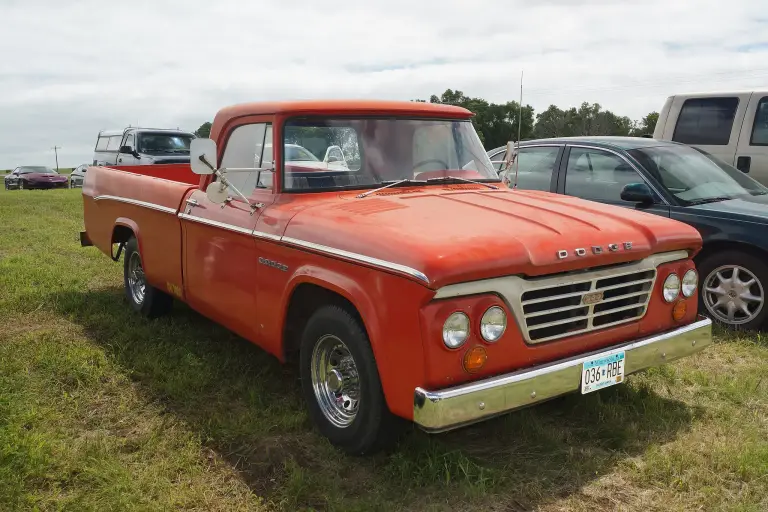
Unlike the B series, which was closely related to Dodge’s pre-war trucks, the C series was a complete redesign. Dodge kept the “pilot house” tradition of high-visibility cabs and added a wrap-around windscreen in 1955, the same year that a two-speed PowerFlite automatic transmission became available. The Dodge Town Panel and Town Wagon also used the new design. The early models continued the naming convention of the predecessor: 1954 half-ton trucks were C-1-B, three-quarter-ton trucks C-1-C and one-ton trucks C-1-D, while 1955 models were named C-3 and 1956 models C-4.
In 1957 Chrysler called its Hemi-powered Dodge trucks “Power Giant” and introduced power steering and brakes, a three-speed automatic and a 12-volt electrical system. From 1957 to 1959 Dodge offered the Sweptside pickup, a rival to the Chevrolet Cameo Carrier with a car-like rear wing over the cargo box, but it never became a bestseller. A flat-sided and therefore wider “Sweptline” cargo box arrived in 1959. In 1957 the company also adopted the standard pickup numbering scheme already used by Ford and General Motors, so the half-ton Dodge became the D100, the three-quarter-ton the D200 and the one-ton the D300. The traditional separate-fender “Utiline” body remained available, with a gross vehicle weight rating of up to 9,000 lb on one-ton models.
The C-series engine list ran from the 230 cu in flathead six of 120 hp to a series of V8s: the 315 cu in Red Ram with 204 hp from 1957 to 1959, the 331 cu in FirePower with 172 hp in 1959 and the 318 cu in A-type V8 with 200 hp, also in 1959. After an agreement between Dodge and Studebaker, the C-series pickup bed was also used on the Studebaker Champ.
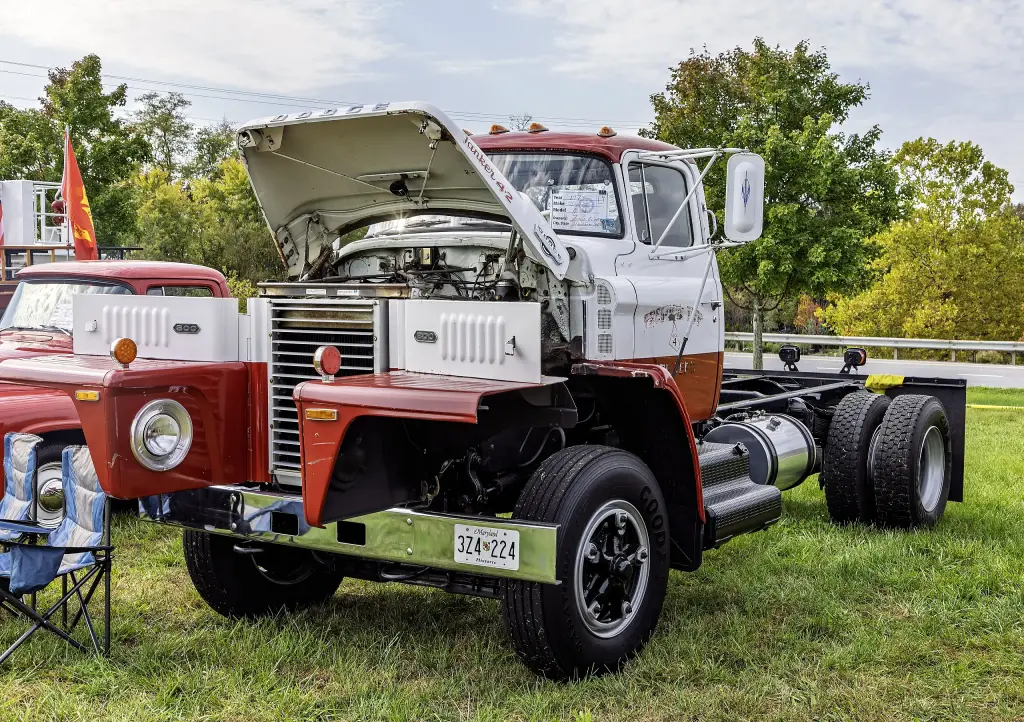
From the 1957 model year Dodge built factory four-wheel-drive versions of the C series and sold them as the W-100, W-200, W-300 and W-500, alongside the older WDX and WM-300 “Military Style” Power Wagon, which carried the Power Wagon badge on the fender. The heavy-duty four-wheel-drive W-300 and W-500 trucks were marketed as “Power Giants”. Because the C series still used the older cab design, the name continued on Dodge’s medium- and heavy-duty trucks, better known as the LCF series, through the 1975 model year. From 1962 those later C-series cabs, built for both Dodge and Four Wheel Drive, were outsourced to Checker in Kalamazoo, Michigan.
Design and features
- Pilot-house cab: the high-visibility cab tradition, with a wrap-around windscreen from 1955.
- PowerFlite automatic: a two-speed automatic offered from 1955.
- Sweptside and Sweptline: a Cameo-style bed in 1957-1959 and the wider flat-sided box from 1959.
- Power Giant: the 1957 name for Hemi-powered Dodge trucks, with power steering and a 12-volt system.
Dodge C series versions
- C-1 series (1954): half-, three-quarter- and one-ton models named C-1-B, C-1-C and C-1-D.
- Utiline: the traditional separate-fender body, up to 9,000 lb GVWR.
- W-100 to W-500 (1957-1960): factory four-wheel-drive versions.
- C series LCF (to 1975): medium- and heavy-duty trucks that kept the older cab.
The C series replaced the earlier Dodge B series trucks, was itself replaced by the Dodge D series, and its four-wheel-drive versions were related to the Dodge Power Wagon. More Dodge trucks are in the Dodge collection.
Sources
- Dodge C series, English Wikipedia: models, engines, Sweptside, W-series, LCF