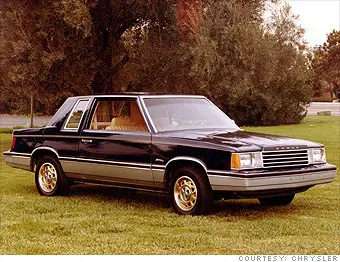
The Dodge Aries was one of the first Chrysler K-cars, introduced for the 1981 model year together with its Plymouth twin, the Reliant. A front-wheel-drive family car with room for six on two bench seats, it replaced the Dodge Aspen and became the car that helped pull Chrysler back from the edge of collapse.
Dodge Aries at a glance
| Maker | Dodge, Chrysler Corporation |
|---|---|
| Production | 1981-1989 |
| Class | mid-size car (marketed as a compact family car) |
| Platform | Chrysler K |
| Layout | front-wheel drive |
| Engines | 2.2 L four; 2.6 L Mitsubishi four as an option |
| Body styles | 2-door coupe, 4-door sedan, 4-door station wagon |
| Trims | base, Custom, SE |
| Twin model | Plymouth Reliant |
| Built | Newark (Delaware), Detroit, Toluca (Mexico) |
| Award | Motor Trend Car of the Year 1981 |
| Replaced | Dodge Aspen |
Based on one source: the English Wikipedia article on the Plymouth Reliant, the Dodge Aries’ twin model.
History of the Dodge Aries
The Aries and the Reliant were introduced for 1981 as the first K-cars, the front-wheel-drive platform on which Chrysler staked its future. They were the smallest cars to offer the traditional six-passenger, two-bench-seat layout with a column gearshift that American buyers liked, and Chrysler marketed the car as being able to seat “six Americans”. The package was similar in spirit to larger rear-wheel-drive cars such as the Dodge Dart and to front-wheel-drive rivals such as the Chevrolet Celebrity.
Power came from a then-new 2.2-litre four-cylinder overhead-cam engine, with a Mitsubishi “Silent Shaft” 2.6-litre four as an option. That engine had hemispherical combustion chambers, and every 1981 car fitted with it carried HEMI badges on the front wings. The Aries came as a two-door coupe, a four-door sedan or a four-door station wagon in base, Custom and SE trims, with wagons offered only in Custom or SE form.
The car arrived during the gravest crisis in Chrysler’s history. The company had been losing money since the early 1970s, its compact Aspen and Volare had been rushed into production and become among the most recalled cars in the United States, and the 1978 Omni had not sold as hoped. The K-platform had been designed in 1978, but the company could not afford to put it into production. Lee Iacocca, who became chairman in 1978, won a federal loan guarantee from Congress after arguing that thousands of jobs depended on Chrysler’s plan for a new front-wheel-drive platform, and the first K-cars left the Jefferson Avenue plant in Detroit in late 1980.
The formula worked. Sales were brisk from the start, with the Aries and Reliant each selling more than 150,000 units in 1981, and the Aries reached about a million cars over its nine-year run while the Reliant reached 1.1 million. The Aries was sold as the Dart K in Mexico and as the Michigan in Japan. It was replaced in 1990 by the Dodge Spirit and Plymouth Acclaim on the newer AA platform, though the basic K-car layout had by then underpinned a whole family of Chrysler products.
Design and features
- K-platform: the front-wheel-drive base that Chrysler used for a decade of models.
- Six-seat packaging: two bench seats and a column shift in a compact body.
- 2.2-litre four: Chrysler’s new overhead-cam engine, with a Mitsubishi 2.6 option.
- Three body styles: coupe, sedan and a station wagon added to the range.
Dodge Aries versions
- Aries coupe: the two-door version.
- Aries sedan: the four-door family model.
- Aries wagon: four-door estate in Custom or SE trim.
- Dart K (Mexico) and Michigan (Japan): export names for the same car.
The Aries replaced the Dodge Aspen and was followed by the Dodge Spirit, while its close relative was the Dodge Omni generation of smaller front-wheel-drive cars. More Dodge models are in the Dodge collection.
Sources
- Plymouth Reliant, English Wikipedia: K-car history, engines, trims, sales