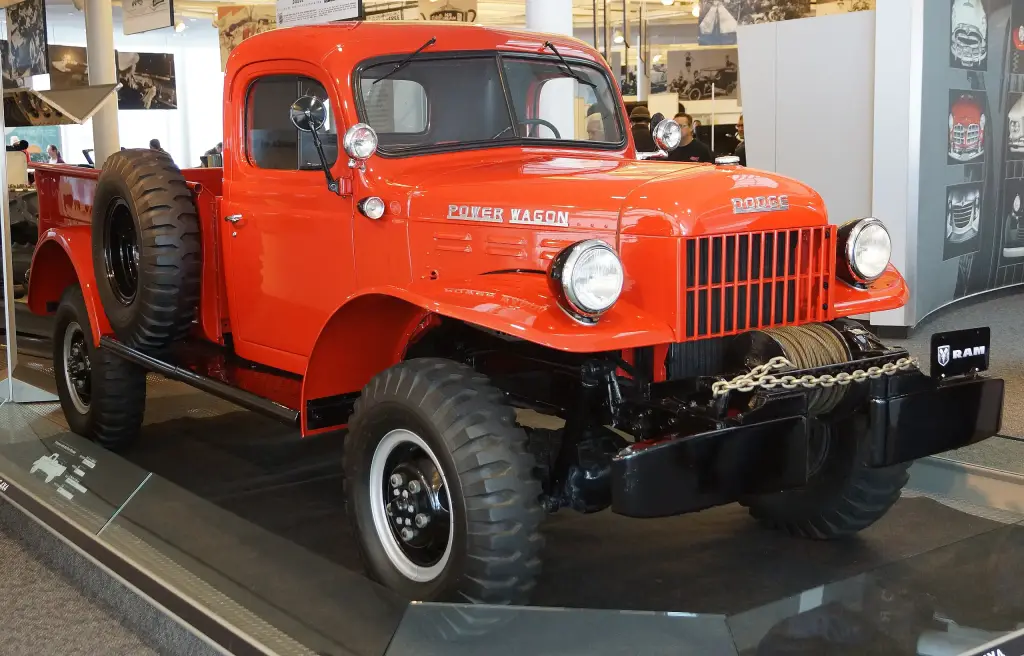
The Dodge Power Wagon is a four-wheel-drive medium-duty truck that Dodge built in several series from 1945 to 1980. The original civilian version, commonly called the flat-fender Power Wagon or Military Type, was mechanically based on Dodge’s three-quarter-ton WC series of the Second World War and was the first 4×4 medium-duty truck offered in civilian form by a major manufacturer.
Dodge Power Wagon at a glance
| Production | 1945-1980, several series |
|---|---|
| Class | four-wheel-drive medium-duty truck |
| Military base | Dodge WC series of 1942-1945 |
| Original name | WDX General Purpose Truck |
| Engine | 230 cu in flathead six (T137); 251 cu in from 1961 |
| Wheelbase | 126 to 147 in |
| Body | enclosed civilian cab with an 8 ft cargo box |
| Gross weight | 8,700 lb; payload 3,000 lb |
| Tyres | 9.00 x 16, 8 ply |
| Badges abroad | Fargo and DeSoto |
| Later use | Power Wagon badge on W100 and W200 pickups from 1957 |
Based on one source: the English Wikipedia article on the Dodge Power Wagon.
History of the Dodge Power Wagon
The civilian Power Wagon continued a line of limited-production Dodge four-wheel-drive trucks from the 1930s that had proved the basic ideas of four-wheel drive for military use. It was introduced in 1946 as the first civilian production 4×4 truck, having been developed as the WDX General Purpose Truck before sales began in March 1946. The W stood for the 1941-1947 model series, the D replaced a C because the civilian truck was rated at one ton rather than the Army’s three-quarters, and the X indicated four-wheel drive. It was meant to compete with military-based Ford/Marmon-Herrington and GMC trucks.
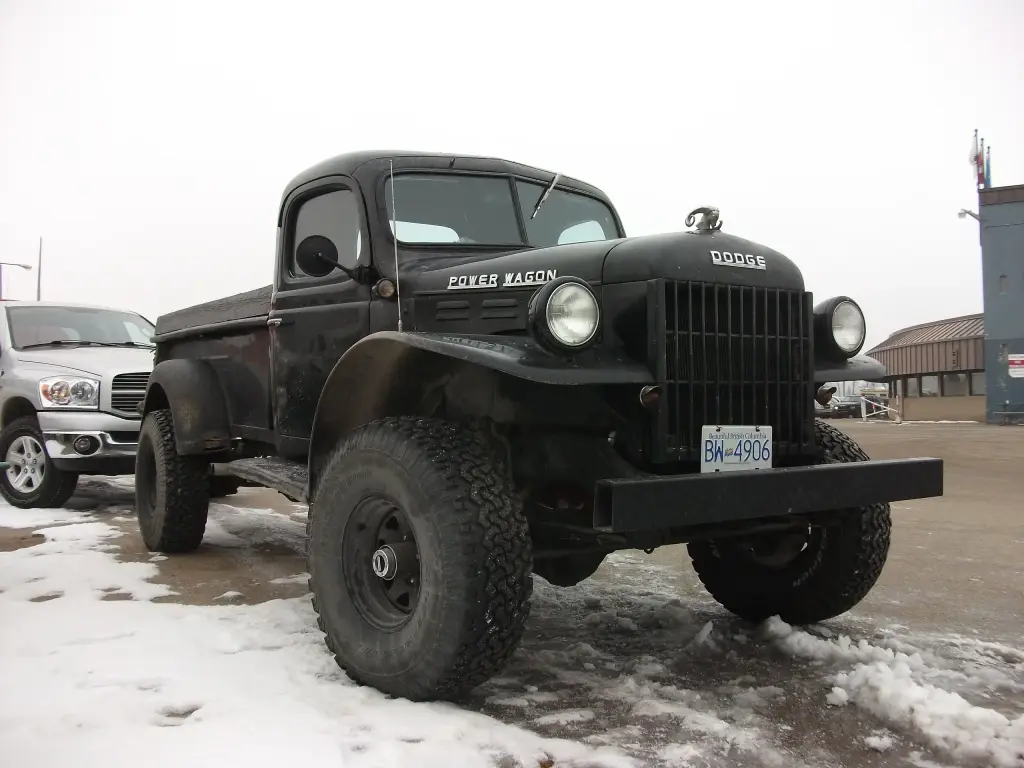
The Power Wagon had an enclosed all-weather civilian cab and a purpose-designed 8-foot cargo box, a 126-inch wheelbase that could be extended to 147 inches, the 230 cu in flathead inline-six, a four-speed manual gearbox and a two-speed transfer case with a 1.96:1 low range for part-time four-wheel drive. A power take-off could send power to the front or rear for auxiliary equipment, and the truck ran on 9.00/16 eight-ply tyres on 16 x 6.50 inch five-stud split-ring steel rims. In 1961 the 230 was replaced by a 251 cu in flathead six. The nominal one-ton model had a gross vehicle weight rating of 8,700 lb and a maximum payload of 3,000 lb, with United States sales ending in 1968 because the vehicle did not meet new federal light-duty truck regulations; export sales continued until 1978.
The Military Type went through three series. The first, from late 1945 to 1950, covered the WDX, B-1-PW and B-2-PW with four rectangular stake pockets per bed side and a round speedometer with rectangular gauge clusters. The second, from 1951 to 1956, had three slightly curved stake pockets and stamped bed sides, with a group of four gauges in the centre of the dash. The third, from late 1956 to 1971, had three square stake pockets, a flat-topped bed and four black-faced gauges, and used the NP420 synchronised transmission. Export versions of the third series, built from 1957 to 1978, included the M601 open-cab flat-faced cowl models and the M615 ambulance.
Starting in 1957 Dodge also built factory four-wheel-drive versions of the C series trucks and sold them as the W-100, W-200, W-300 and W-500 alongside the older Power Wagon, with the Power Wagon badge on the fender. The older design was then marketed as the Military Type, later given the series numbers W-300M and finally WM-300. The heavy-duty four-wheel-drive W-300 and W-500 were marketed as Power Giants, and the four-wheel-drive Dodge Town Wagon also carried the Power Wagon badge. The Power Wagon options continued on the Dodge D series through 1980, and for 1981 Power Ram became the marketing name for four-wheel-drive Ram pickups. Apart from a 1999 concept, the name was not used again until the 2005 revival as a four-wheel-drive version of the Ram 2500.
Design and features
- First civilian 4×4: the original flat-fender Power Wagon of 1946.
- WC-based mechanics: a 230 cu in flathead six and a two-speed transfer case.
- Power take-off: the transfer case could drive auxiliary equipment.
- Power Giant: the heavy-duty W-300 and W-500 versions of the late 1950s.
Dodge Power Wagon versions
- WDX and B-series (1945-1950): the first series of Military Type trucks.
- B-3-PW to C-3-PW (1951-1956): the second series with curved stake pockets.
- W300, W300M and WM300 (1956-1971): the third series, exported until 1978.
- W100 and W200 (1957-1980): the light-duty styled Power Wagon pickups.
The Power Wagon grew out of the Dodge WC series and was sold alongside the Dodge C series and Dodge D series pickups that later carried its badge. More Dodge trucks are in the Dodge collection.
Sources
- Dodge Power Wagon, English Wikipedia: origins, specifications, series, later use