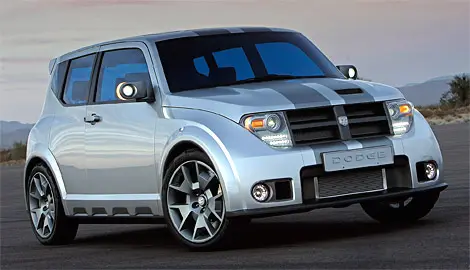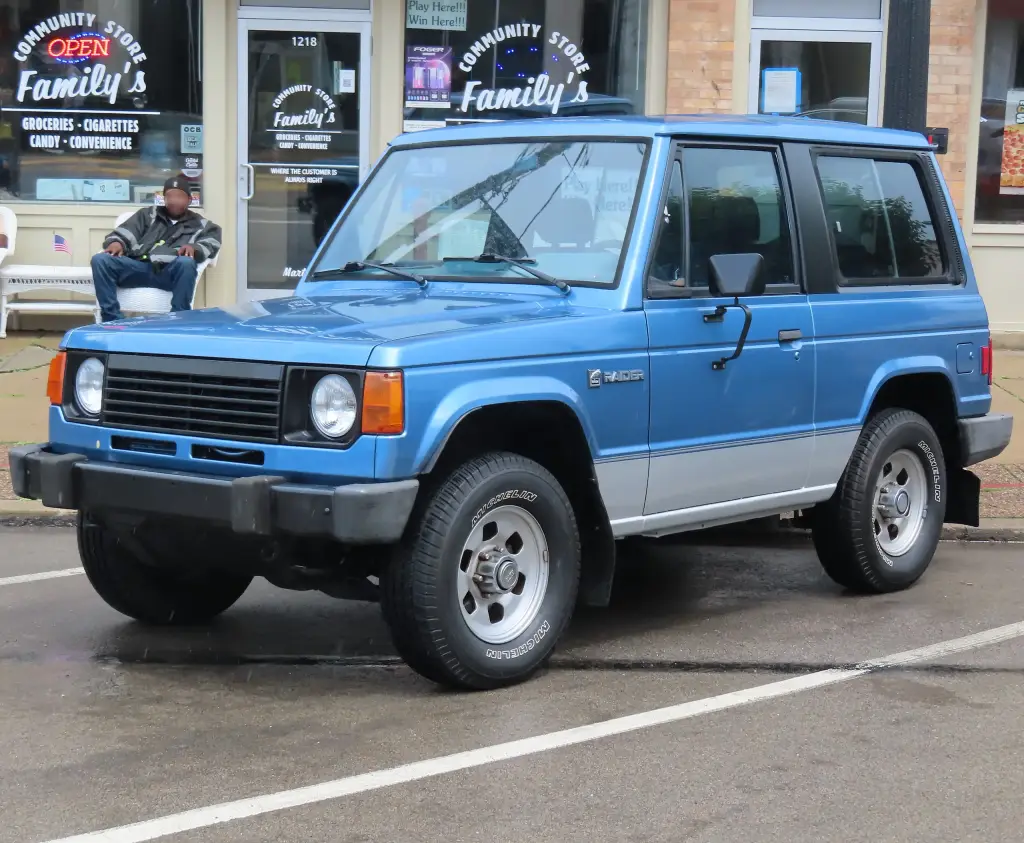
The Dodge Raider was Dodge’s version of the Mitsubishi Pajero, the full-size off-road SUV that Mitsubishi has built since 1981. It was a short-wheelbase two-door model sold in the United States for the late 1980s, and it shared the Pajero’s body-on-frame construction and four-wheel-drive system.
Dodge Raider at a glance
| Maker | Mitsubishi Motors, sold by Dodge |
|---|---|
| Class | two-door off-road SUV |
| Base car | Mitsubishi Pajero, short wheelbase |
| Pajero production | since 1981 |
| Also known as | Mitsubishi Montero (North America), Mitsubishi Shogun (UK) |
| Four-wheel drive | Mitsubishi Super-Select |
| Dakar Rally wins | 12 overall victories |
| Pajero sales | more than 3.3 million over 40 years |
Based on one source: the English Wikipedia article on the Mitsubishi Pajero, the car Dodge sold as the Raider. The article covers the Pajero line rather than the Raider itself.
History of the Dodge Raider
Mitsubishi’s SUV was introduced at the 1981 Tokyo Motor Show, with sales beginning in 1982, and was marketed as a luxurious but rugged rival to the Range Rover and Toyota Land Cruiser. Because the Spanish word pajero is derogatory, the car was sold as the Montero in North America, Spain and Latin America, and as the Shogun in the United Kingdom. The Pajero was one of four Mitsubishi models to use the company’s heavy-duty Super-Select four-wheel-drive system rather than its lighter all-wheel-drive system.
The Dodge Raider was the badge-engineered two-door version of the first-generation Pajero sold through Dodge dealers in the United States. It was a short-wheelbase off-roader with a separate body and chassis, and it remained in the Dodge range only briefly before the brand’s compact SUV slot stayed empty until the Nitro of 2007.
The Pajero became famous for its Dakar Rally record. In 1983 a Pajero driven by Andrew Cowan won its class on the Paris-Alger-Dakar, with a teammate second in class and 14th overall after more than 11,000 km, beginning a long rally career. Mitsubishi competed mainly in the T2 modified production class, and its cars took multiple podium finishes from 1983 until its final wins in 2007, with 12 overall victories in the cars class and 150 stage wins. The company earned a Guinness World Record as the manufacturer with the most Dakar Rally wins.
In the late 1990s Mitsubishi built a Pajero intended solely to win the T2 class, adding independent rear suspension and a modified 6G74 engine. Because the class required road-going versions, the company produced the Pajero Evolution, of which only 2,693 were made and which is now a collector’s item. From 2002, rule changes allowed full prototypes, and Mitsubishi ran Evolution vehicles coded MR10 to MR14 with engines built only for the rally. The Pajero was discontinued globally in 2021 after more than 3.3 million sales over 40 years, and the name returned on a fifth-generation model in late 2026.
Design and features
- Pajero base: the same body-on-frame off-roader Mitsubishi sold as the Montero and Shogun.
- Short wheelbase: the two-door body of the Raider.
- Super-Select: Mitsubishi’s heavy-duty four-wheel-drive system.
- Dakar pedigree: the Pajero won the Dakar Rally 12 times overall.
Dodge Raider versions
- Dodge Raider: the two-door, short-wheelbase version sold in the United States.
- Mitsubishi Montero and Shogun: the same car under Mitsubishi names in other markets.
- Pajero Evolution: the 2,693-car road version built for rally homologation.
The Raider was Dodge’s only small off-roader until the Dodge Nitro, and it shared its market with the Dodge Ramcharger at home. More Dodge models are in the Dodge collection.
Sources
- Mitsubishi Pajero, English Wikipedia: history, names, four-wheel drive, Dakar Rally