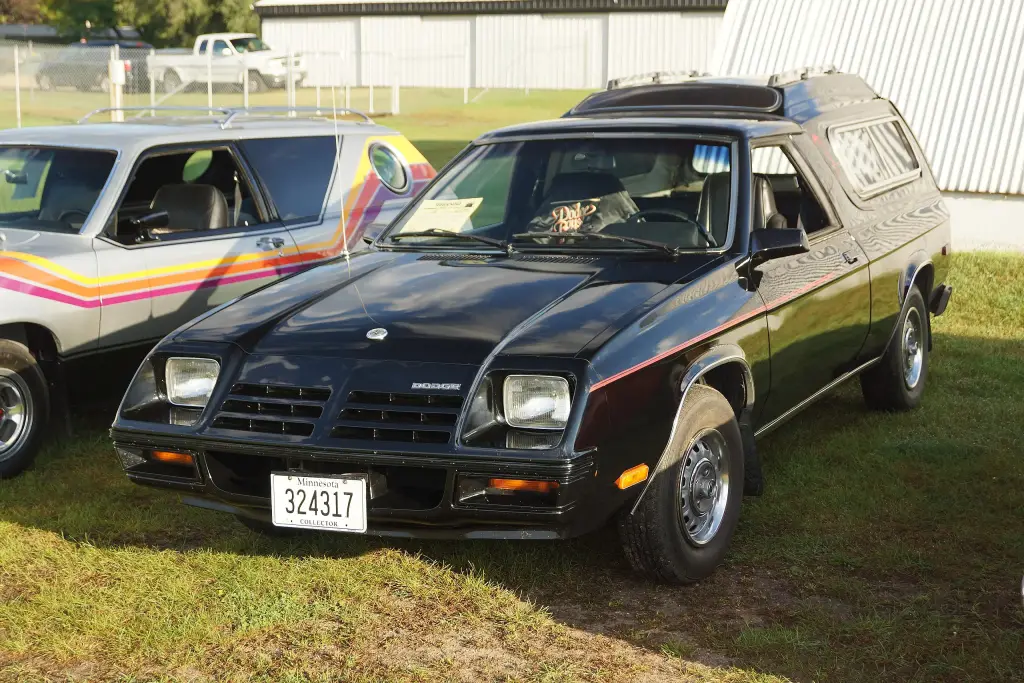
The Dodge Rampage was a subcompact unibody coupe utility based on Chrysler’s L platform and built for the 1982 to 1984 model years. Plymouth sold a rebadged version for 1983 as the Scamp, and the Rampage combined the handling of a passenger car with the open bed of a small pickup.
Dodge Rampage at a glance
| Production | 1982-1984 model years |
|---|---|
| Class | subcompact coupe utility |
| Platform | Chrysler L, unibody |
| Base car | Dodge Omni 024 |
| Engine | 2.2 L carburetted four, 84-99 hp |
| Gearboxes | four-speed manual, three-speed automatic; five-speed from 1983 |
| Payload | 1,145 lb |
| Curb weight | about 2,400 lb |
| Plymouth version | Scamp, 1983 only |
| Sales | 17,636 in 1982, 8,033 in 1983, 11,732 in 1984 |
Based on one source: the English Wikipedia article on the Dodge Rampage.
History of the Dodge Rampage
The Rampage combined the handling and passenger carrying of a traditional car with the open-bed versatility of a small pickup, competing with the Volkswagen Rabbit Sportruck and Subaru BRAT. It was Chrysler’s first unibody car-based pickup since the Dodge A100 Pickup of the 1960s. In the Dodge range it was similar in size to the Dodge Ram 50, which was body-on-frame and carried a larger payload and which outlived the Rampage until 1993.
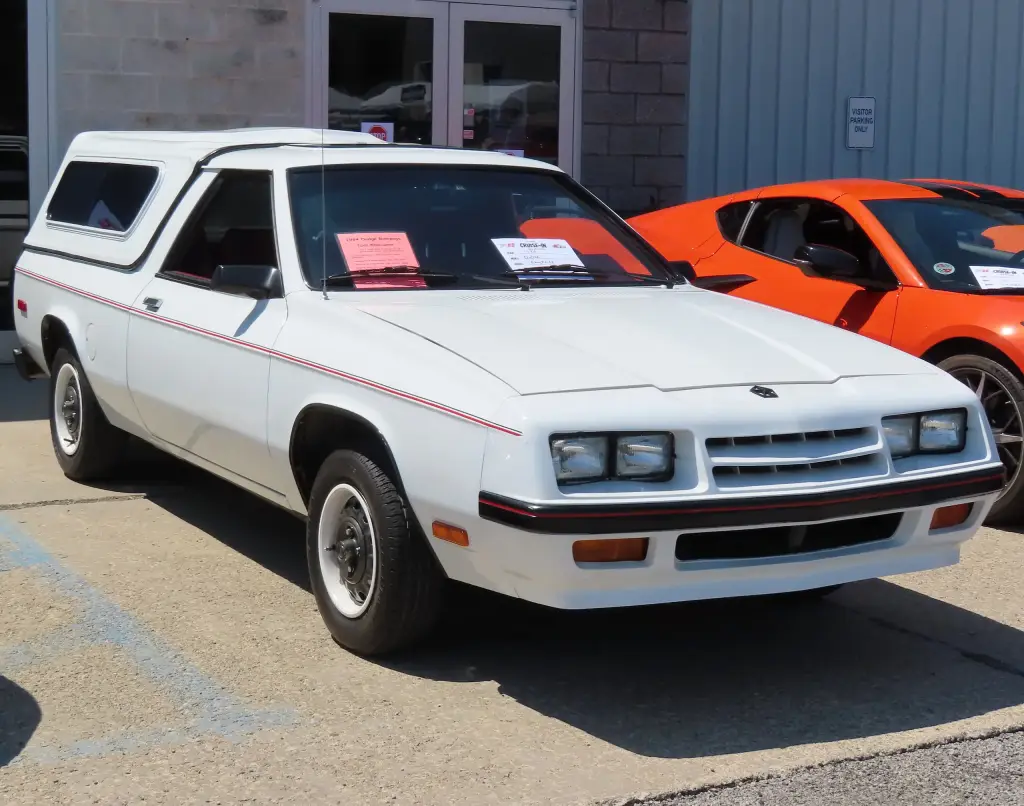
The Rampage borrowed its unibody construction and front panels from the Dodge Omni 024, later renamed Charger, and used the parent car’s suspension with coil struts and a linkless anti-roll bar at the front and leaf springs with Rampage-specific shock absorbers at the rear. It was powered by a Chrysler 2.2-litre carburetted four producing 84 to 99 hp depending on the year, weighed about 2,400 lb and used a four-speed manual or three-speed automatic, which gave limited performance. A five-speed manual arrived in 1983 and improved matters. The truck had a payload of 1,145 lb, a true half-ton rating and about 90 per cent of the Chevrolet El Camino’s 1,250 lb.
For 1984 the Rampage received a facelifted front shared with the Charger, with quad sealed-beam headlights instead of dual units, a grille changed from a six-slot to a vertically split design and a lower bumper with revised indicators, a horizontally split air intake and an impact strip wrapping around the front. The Plymouth Scamp was sold only for 1983, and the Rampage lasted three years before being dropped after 1984. A Shelby Rampage was reportedly built by Chrysler and Shelby engineers in their spare time for Carroll Shelby, although there is no official record of it. A special California-market Direct Connection Rampage was built in 1984 and sold only at certain California Dodge dealers, with the Shelby Charger front, 15-inch alloy wheels and a ground-effects package; 218 were built, a third each in black, Garnet Red and Santa Fe Blue. Dodge brought the name back at the 2006 Chicago Auto Show with a front-wheel-drive concept as large as the full-size Ram, powered by the 5.7-litre Hemi V8 and fitted with Stow ‘n Go seating from the Chrysler minivans.
Design and features
- Car-based pickup: unibody construction and Omni 024 front panels.
- Half-ton payload: 1,145 lb in a vehicle weighing about 2,400 lb.
- 1984 facelift: quad headlights and a vertically split grille.
- Direct Connection: a 218-car California special with Shelby Charger styling.
Dodge Rampage versions
- Rampage (1982-1984): the Dodge version with the 2.2-litre four.
- Plymouth Scamp (1983): the Plymouth-badged twin.
- Direct Connection Rampage (1984): the California-market special edition.
- Rampage concept (2006): the Hemi-powered show truck.
The Rampage was based on the Dodge Omni and its 024 coupe, and it shared the small-pickup market with the Dodge Dakota that followed. More Dodge models are in the Dodge collection.
Sources
- Dodge Rampage, English Wikipedia: design, engine, sales, special editions