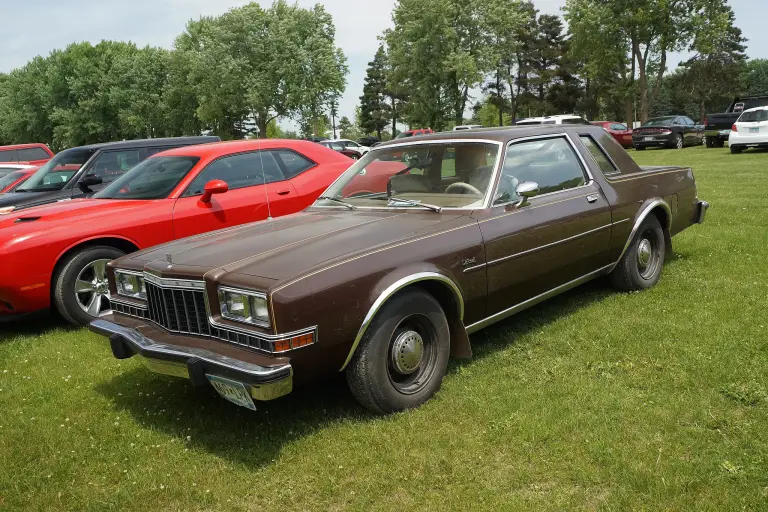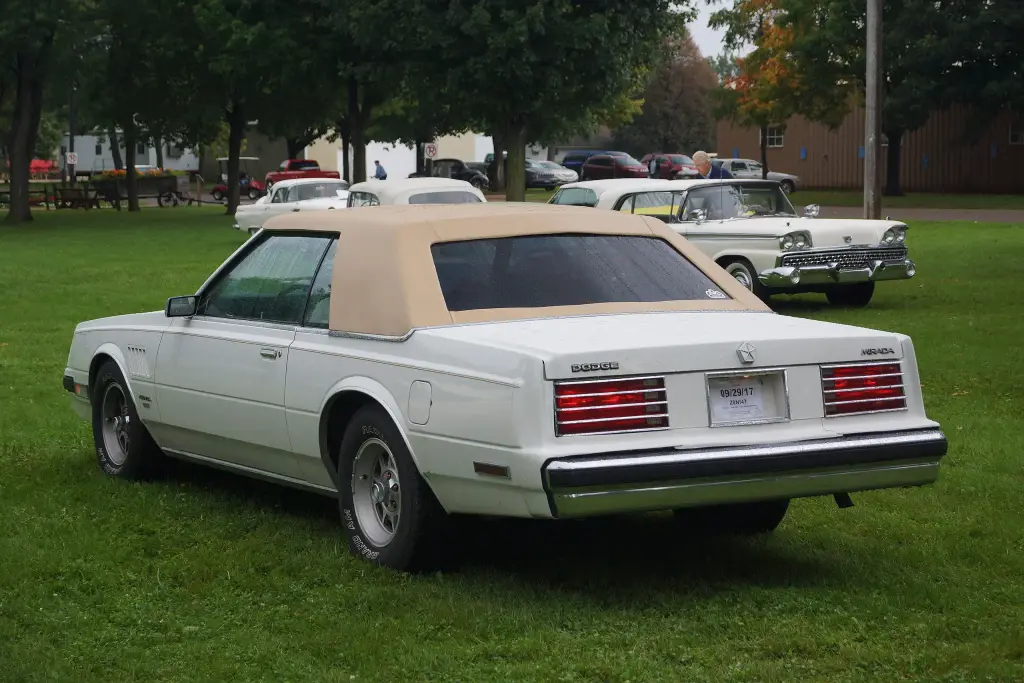
The Dodge Mirada is a mid-sized rear-wheel-drive coupe that Dodge built for the 1980 to 1983 model years. It shared the Chrysler J platform with the second-generation Chrysler Cordoba and the Imperial, and production reached just under 53,000 cars.
Dodge Mirada at a glance
| Production | 1980-1983 model years |
|---|---|
| Class | mid-size personal luxury coupe |
| Platform | Chrysler J (Aspen-based, 112.7 in wheelbase) |
| Engines | 3.7 L slant-six; 5.2 L V8; 5.9 L 360 V8 in the 1980 CMX |
| Top output | 185 hp for the 1980 360 |
| Gearboxes | A904 automatic; A727 for the 360 |
| Trims | base, S (SE), CMX |
| Roof options | sunroof, T-top, landau, cabriolet roof |
| Suspension | transverse torsion bars front, leaf springs rear |
| Built | just under 53,000 cars |
Based on one source: the English Wikipedia article on the Dodge Mirada.
History of the Dodge Mirada
To help Chrysler meet stricter corporate average fuel economy standards, the Mirada and Cordoba were downsized considerably from their predecessors. They sat on a modified version of the Dodge Aspen and Plymouth Volaré platform with the sedan and wagon’s 112.7-inch wheelbase. The Mirada was designed after the Cordoba’s design was locked in, with changes made to distinguish it and make it more sporting. Chief designer Ernie Barry had to include the landau roof even though the design team would have preferred not to, because such classic features were favoured by chairman Lee Iacocca. The front end was made of flexible plastic, with a grille inspired by the coffin-nosed Cord 810 and 812.
Base models had a metal roof with a chrome strip running from the bottom of the opera windows across the roof. A power sunroof or a glass T-top were offered for a sportier look, while a vinyl landau roof or a cabriolet roof, effectively a mock convertible top with a blanked-out quarter window, were offered for a more luxurious one. T-tops and the landau were available every year except 1983, and the cabriolet top every year; the sunroof was offered in 1980 and 1981. Wheels were 15-inch steel with turbine-like hubcaps or polished ten-spoke aluminium wheels. The trim levels were base, S (also called SE) and CMX.
The interior had a brushed aluminium instrument panel with faux woodgrain as an option. Base seats were cloth Sport buckets, with vinyl buckets, cloth and vinyl 60/40 split benches and leather and vinyl buckets available; since the car could be ordered with a column or floor shift, the bench came only with the column shifter. Buyers could choose an AM/FM stereo, an AM/FM/cassette unit, an AM/FM/8-track or a Chrysler CB radio, and steering wheels ranged from two-spoke base wheels to the three-spoke Mopar Tuff Wheel and a four-spoke sport wheel. Manual windows were standard on the base model, but the CMX’s power windows could be ordered.
The 3.7-litre slant-six was available in the base Mirada with the 5.2-litre V8 as an option, while the code E58 360 5.9-litre V8 was offered in the CMX in 1980 only; for unexplained reasons the 360 was not available in any Chrysler car from 1981. All engines used the A904 automatic except the 360, which had the stronger A727. With 185 hp the 360 made the Mirada one of the fastest American cars of 1980, on a par with the Chevrolet Corvette. The suspension used transverse torsion bars at the front and leaf springs with an anti-roll bar at the rear, and a sport handling package added heavy-duty shock absorbers, torsion bar bushings, springs and anti-roll bars at both ends. Brakes were power-assisted discs at the front and drums at the rear.
Dodge hoped the Mirada would reopen the door to NASCAR success, as the nameplate had not won since November 1977. Lee Iacocca personally called Richard Petty in late October 1980 and asked him to build and test a race-spec Mirada, with Chrysler supplying sheet metal and engine parts. Petty, who had left Dodge for General Motors in 1978, agreed, and Junior Johnson’s team also built a car. A test session at Daytona on 17 January 1981 drew about 15,000 Petty fans, but the Mirada was 8 mph slower than the GM and Ford cars and its body had a very high drag coefficient, making speeds over 185 mph impossible. Petty’s team passed the sheet metal to Buddy Arrington and switched to GM bodies, ending Chrysler’s attempt to return to NASCAR.
Design and features
- J platform: a downsized personal luxury coupe related to the Chrysler Cordoba and Imperial.
- Cord-style grille: a flexible plastic front end inspired by the 1930s Cord.
- 360 V8: 185 hp in the 1980 CMX, making it one of America’s quickest cars that year.
- Roof choice: T-top, sunroof, landau or cabriolet roof depending on the year.
Dodge Mirada versions
- Base: the standard coupe with the slant-six or 5.2 V8.
- S (SE): the mid-range trim.
- CMX: the sporty trim, with the 360 V8 in 1980 only.
- Roof options: T-top and landau (except 1983), cabriolet roof, sunroof (1980-1981).
The Mirada followed the Dodge Magnum coupe and shared its platform family with the Dodge Aspen, while it was sold alongside the Dodge Diplomat. More Dodge models are in the Dodge collection.
Sources
- Dodge Mirada, English Wikipedia: design, trims, engines, NASCAR