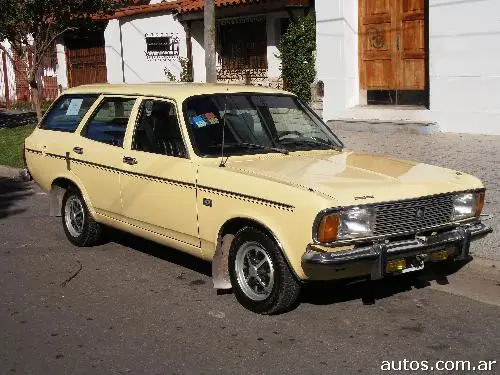
The Dodge 1500 and Dodge 1800 were South American versions of the Hillman Avenger, the small family car that Rootes engineered in Britain and launched in 1970. Argentina sold the car as the Dodge 1500 and Brazil as the Dodge 1800, both keeping the Avenger’s front-engine, rear-wheel-drive layout.
Dodge 1500 and 1800 at a glance
| Based on | Hillman Avenger, engineered by Rootes in Britain |
|---|---|
| British production | 1970-1981, 790,000 cars |
| Argentine model | Dodge 1500, saloon and Rural estate |
| Brazilian model | Dodge 1800, 1971-1980, later Dodge Polara |
| Bodies | two- and four-door saloon, five-door estate |
| Layout | front engine, rear-wheel drive |
| Engine | 1.5-litre four-cylinder, all-iron overhead valve |
| Suspension | coil-sprung live axle at the rear |
| Design | styling by Roy Axe, project begun in 1963 |
| Related | Plymouth Cricket (USA), VW 1800 (Argentina) |
Based on one source: the English Wikipedia article on the Hillman Avenger. The Argentine Dodge 1500 is covered only briefly there, so this page keeps to what the source says about the car itself.
History of the Dodge 1500 and 1800
The Avenger was a completely new design and the first and last car developed by Rootes after the Chrysler takeover of 1967. Its styling brief went to design director Roy Axe in 1965 and engineering began in 1966. It was a conventional, straightforward and economical car: a five-passenger saloon with a front engine, rear-wheel drive and a coil-sprung live axle, and it was one of the first cars whose unibody was engineered with computer-aided design. It also addressed the safety requirements of the time with a rigid passenger compartment, a front crumple zone, strengthened windscreen glass and a heavily padded instrument panel.
After its press introduction in Malta in early 1970, the Avenger was built at the former Rootes plant in Ryton-on-Dunsmore near Coventry, with bodies and panels brought by train from Linwood in Scotland and powertrains from Stoke. From 1976 all manufacturing moved to Linwood. In Britain the car was sold as the Hillman Avenger from 1970 to 1975, as the Chrysler Avenger from 1976 to 1978 and as the Talbot Avenger from 1979 to 1981.
The Avenger was marketed around the world and spawned a family of badge-engineered versions. The best known were the Plymouth Cricket in North America from 1971 to 1973, the Dodge 1800 built by Chrysler in Brazil from 1971 to 1980 and later sold there as the Dodge Polara, and the VW 1800 assembled in Argentina by Volkswagen. In Argentina the same car was also sold as the Dodge 1500, with the estate version marketed as the Rural.
Under the bonnet the Avenger used an all-iron overhead-valve four-cylinder engine in 1250 or 1500 cc form. British buyers could choose DL, Super and GL trim, and a twin-carburettor GT was added in October 1970; a basic fleet model followed in 1972 and the GT was replaced by the GLS the same year. The five-door estate arrived in March 1972 with heavy-duty springing and a load capacity of 1,040 lb against 840 lb for the saloon, and a two-door saloon joined the range in March 1973. The Avenger was praised for its handling and was successful in motorsport, and by the end of British production in 1981 some 790,000 had been built.
Design and features
- Modern body engineering: one of the first cars with a computer-designed unibody, a rigid passenger cell and a front crumple zone.
- Simple mechanical layout: front engine, rear-wheel drive and a coil-sprung live axle, praised for road manners.
- Two engine sizes: 1250 and 1500 cc overhead-valve fours, with a twin-carburettor GT version.
- Three body styles: two- and four-door saloons and a five-door estate with heavier springing.
Dodge 1500 and 1800 versions
- Dodge 1500 (Argentina): saloon and Rural estate built on the Avenger.
- Dodge 1800 (Brazil, 1971-1980): the Brazilian version, later renamed Dodge Polara.
- Plymouth Cricket (1971-1973): the North American version of the same car.
- VW 1800 (Argentina): the Avenger assembled and sold by Volkswagen.
The Avenger was a rival of the Dodge Colt in export markets, and its South American career ran alongside the Argentine Dodge GTX. More Dodge models are in the Dodge collection.
Sources
- Hillman Avenger, English Wikipedia: design, production, engines, badge-engineered versions