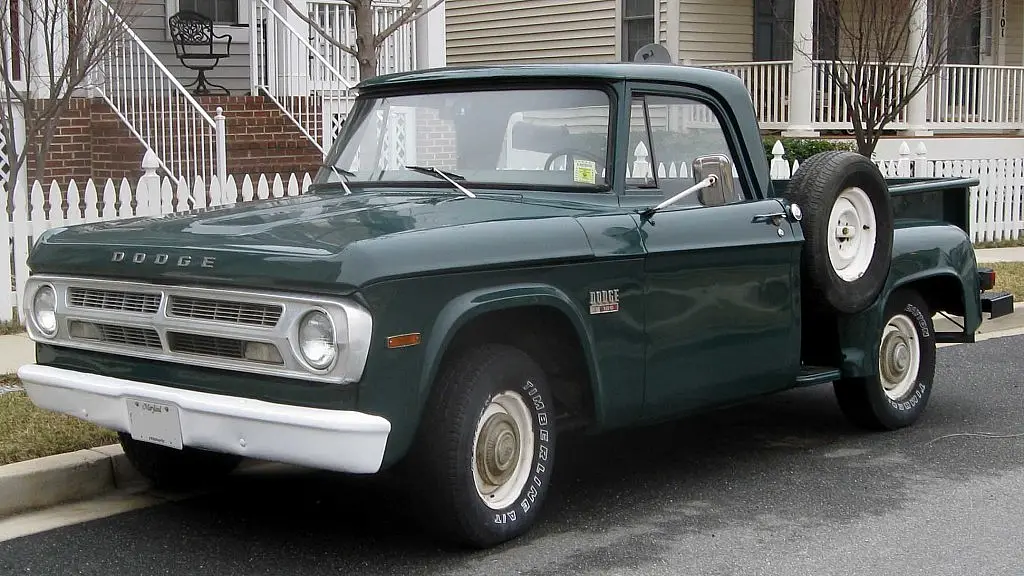
The Dodge 100 Commando was a range of trucks of 7.5 to 28 short tons gross weight that Dodge built in England, mainly in the 1970s and 1980s. The design began at Commer and was sold under several badges, including Renault, before the Dodge name disappeared from British trucks.
Dodge 100 Commando at a glance
| Maker | Chrysler Europe, ex-Rootes factory, England |
|---|---|
| Production | about 15 years in most markets, 1970s-1980s |
| Class | medium and heavy trucks, 7.5-28 short tons |
| Predecessor | Commer VC and VE range |
| Engines | Perkins four- and six-cylinder diesels; Mercedes-Benz OM352; Valmet 611 CS |
| Gearboxes | Rootes four-, five- and six-speed synchromesh |
| Axles | Rootes hypoid and Eaton single- and two-speed |
| Chassis | special alloy, for strength and lower weight |
| Gross weight | 7.5-16 short tons as a vehicle; 24/28 tons GCW as a tractor |
| Sold as | Commer, Dodge, DeSoto, Fargo, Renault |
| Earlier Dodge 100 | the 1950s “parrot-nose” or “Kew Dodge” |
| Later name | Renault Commando, by 1987 |
Based on one source: the English Wikipedia article on the Dodge 100 Commando.
History of the Dodge 100 Commando
The truck was originally developed by Commer. A concept was built in 1965-66 to replace the Commer VC and VE range, which covered 8 to 24 short tons gross vehicle weight. When Chrysler Europe acquired a controlling interest in Commer’s owner, the Rootes Group, the design and the name were changed so that the new truck would complement the larger Dodge 500.
The name Dodge 100 had been used before in Britain. A previous Dodge 100, known informally as the “parrot-nose” or “Kew Dodge”, was produced in the 1950s at a factory in Kew, London. The Commando of the 1970s was a different vehicle, but it kept the same model number.
The Dodge 100 was meant to use a Rootes diesel engine, but noise regulations ruled out the reliable yet noisy Rootes units. In the end naturally aspirated and turbocharged four- and six-cylinder Perkins diesels, made locally in the UK, were used for the lighter weights, with the Mercedes-Benz OM352 offered as a premium engine because of the reputation of Mercedes in Europe, where Perkins was relatively unknown. Valmet 611 CS diesels were fitted for some limited market areas. Rootes supplied four-, five- and six-speed synchromesh gearboxes, while the rear axles were a mixture of Rootes’ own hypoid design and Eaton single- and two-speed units. The chassis used a special alloy to save weight without losing strength.
The 100 Series stayed in production for around fifteen years in most parts of the world, though not in the United States, where meeting local regulations would have been too expensive. It was sold as a Commer, a Dodge, a DeSoto, a Fargo and a Renault. A Mark 2 version brought an upgraded engine and minor refinements. In the end the Dodge 100 was eliminated by Renault, which had acquired the former Rootes truck operations after the car business was bought by Peugeot; a Renault version was built for a time and by 1987 the truck was marketed simply as the Renault Commando. Renault later switched production at the former Rootes factory to its own bus and truck engines.
Design and features
- Chrysler-era design: a Commer project renamed and restyled to sit below the Dodge 500 in the British range.
- Mixed engine supply: Perkins as standard, Mercedes-Benz OM352 as the premium choice, Valmet for some markets.
- Light alloy chassis: a weight-saving measure unusual in this class of truck.
- Long career under other badges: the same vehicle was sold as a Commer, DeSoto, Fargo and Renault.
Dodge 100 Commando versions
- Dodge 100 Commando: the standard range, 7.5-16 short tons as a vehicle.
- Tractor units: 24 and 28 tons gross combination weight.
- Mark 2: upgraded engine and minor refinements later in production.
- Renault Commando: the Renault-badged version sold up to 1987.
The smaller Dodge 50 Series was the last British Dodge van, and the American Dodge D series covered the same years on the other side of the Atlantic. More Dodge commercial vehicles are in the Dodge collection.
Sources
- Dodge 100 “Commando”, English Wikipedia: development, engines, badges, end of production