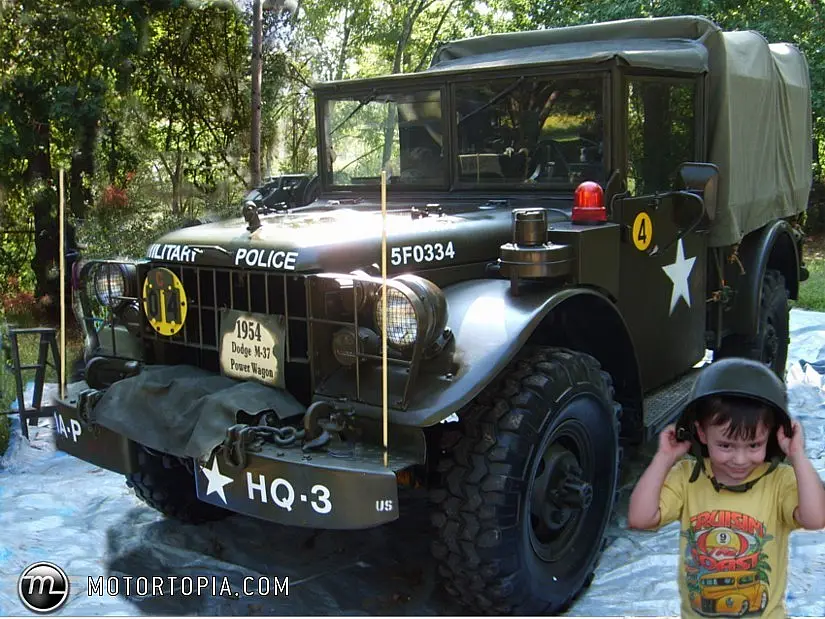
The Dodge M37 was a three-quarter-ton 4×4 truck developed for the United States military as the successor to the Dodge WC series of the Second World War. It entered service in 1951 and served in many configurations in Korea and Vietnam before being replaced by lighter commercial-based trucks.
Dodge M37 at a glance
| Maker | Dodge, Chrysler Corporation |
|---|---|
| Service | 1951-1968, with later use abroad |
| Class | three-quarter-ton 4×4 military truck |
| Military designation | G741 |
| Engine | 230 cu in flathead six, 78 hp at 3,200 rpm |
| Gearbox | four-speed manual, two-speed transfer case |
| Wheelbase | 112 in (cargo and command); 126 in (ambulance and telephone) |
| Weight | 5,687 lb without winch, 5,987 lb with winch |
| Tyres | 9.00 x 16 military |
| Winch | Braden LU-4, 7,500 lb capacity |
| Built | about 115,000 in the United States, plus 4,500 Canadian |
Based on one source: the English Wikipedia article on the Dodge M37.
History of the Dodge M37
Many components of the M37 were similar or identical to those of the Dodge WC series, and many WC deficiencies were corrected in the new truck. Most notably, a conventional pickup-style bed replaced the platform of the wartime vehicle, which simplified production. There was significant drivetrain and engine commonality with the postwar WDX series civilian Power Wagons, but no sheet metal was shared. Six WC-based prototypes called W37 were built in 1950, and the first pre-production pilot vehicle left the line on 14 December 1950.
Manufacture began in earnest in January 1951, with about 11,000 vehicles built by the end of that year and 63,000 by mid-1954. In 1958 a series of modifications produced the M37B1, of which 47,600 were built from mid-1958 to the end of production. About 4,500 Canadian M37CDN vehicles were also made between 1951 and 1955, and M37s continued in service in the Israeli and Greek armies.
The engine was the flathead Chrysler straight-six carried over from the wartime WC line, model T245, with 230 cu in and 78 bhp at 3,200 rpm; the Canadian version used a larger 250.6 cu in engine. Behind it were a four-speed New Process gearbox and a two-speed transfer case with high and low ranges, Dodge full-floating axles with a 5.83:1 ratio, 24-volt electrics, hydraulic drum brakes and a 24-gallon fuel tank vented through the engine air intake for fording. The cargo and command models had a 112-inch wheelbase and the ambulance and telephone maintenance models 126 inches, and a Braden LU-4 power take-off winch with 7,500 lb capacity was optional.
From 1968 the United States military replaced the M37 with the heavier one-and-a-quarter-ton Kaiser Jeep M715, a militarised commercial truck that was considered underpowered and fragile compared with the M37; after service in Vietnam the M715 was itself replaced in 1976 by the Dodge M880 series. Many M37s were sold or given to allied countries, transferred to civilian agencies or sold at government auctions, and they became a common sight in government and private use in the 1970s and 1980s. The M37 was built in many variants, including the M42 command truck, M43 ambulance, M53 cab-chassis, M56 tool truck, MB2 fire and rescue truck, M152 Canadian utility truck, M201 telephone maintenance vehicle and M283 long-wheelbase cargo truck.
Design and features
- Flathead six: the 78 hp 230 cu in engine inherited from the wartime WC series.
- Pickup-style bed: a simpler body than the WC platform, easier to build.
- Military equipment: 24-volt electrics, fording ventilation and an optional 7,500 lb winch.
- Many variants: command, ambulance, tool, fire and rescue, telephone and cargo bodies.
Dodge M37 versions
- M37: the standard cargo truck on a 112-inch wheelbase.
- M42 and M43: command truck and ambulance.
- M37B1: the modified version built from mid-1958.
- M37CDN: the Canadian version with a larger engine.
The M37 followed the Dodge WC series and was replaced in US service by the Dodge D series trucks that included the M880, while its engine family also powered the Dodge Power Wagon. More Dodge trucks are in the Dodge collection.
Sources
- Dodge M37, English Wikipedia: history, production, specifications, variants