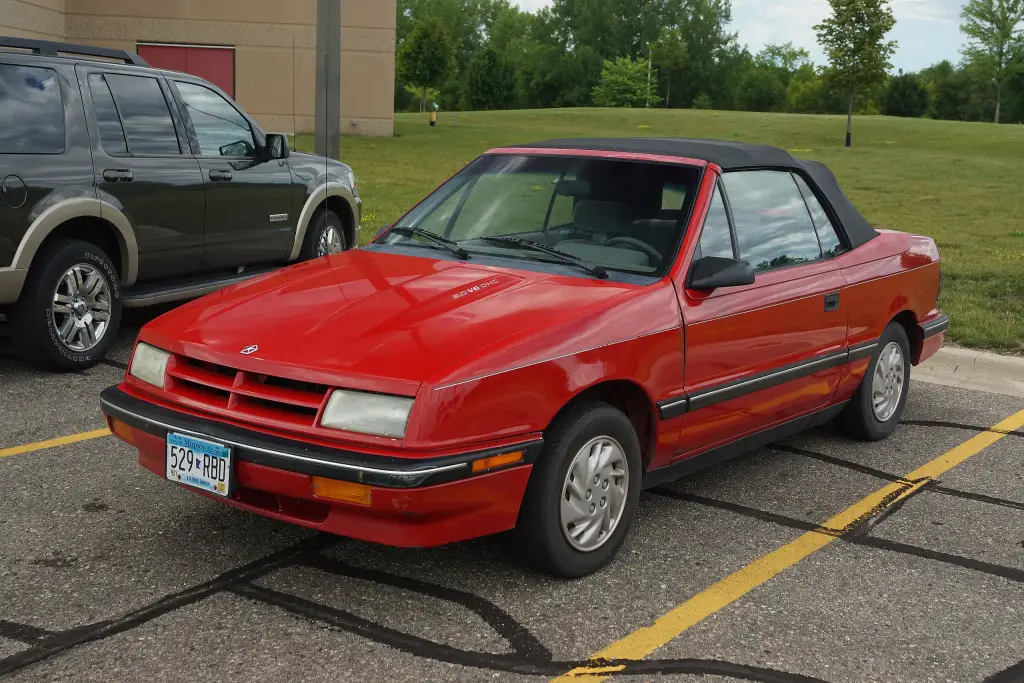
The Dodge Shadow, together with the Plymouth Sundance, is a compact three- and five-door hatchback introduced for the 1987 model year by Chrysler. A two-door convertible joined the Shadow range for 1991, a body style Plymouth did not offer, and the pair replaced the Omni and Horizon.
Dodge Shadow at a glance
| Production | 1987-1994 |
|---|---|
| Class | compact hatchback and convertible |
| Platform | Chrysler P-body, a cut-down K platform |
| Bodies | three- and five-door hatchback; two-door convertible from 1991 |
| Engines | 2.2 and 2.5 L fours, some turbocharged; 3.0 L Mitsubishi V6 from 1992 |
| Gearboxes | five-speed manual, three- or four-speed automatic |
| Trims | base, America/S, Highline, ES; convertible in ES and Highline |
| Built | Sterling Heights from 25 August 1986 |
| Also sold as | Chrysler Shadow (Mexico), Chrysler ES (Europe) |
| Replaced by | Dodge Neon |
Based on one source: the English Wikipedia article on the Dodge Shadow.
History of the Dodge Shadow
The first Shadow rolled out of Sterling Heights Assembly on 25 August 1986, and in late 1988 production of the Mexican version, called the Chrysler Shadow, began at Toluca. From 1988 to 1991 the car was sold in Europe as the Chrysler ES. Production ended on 9 March 1994, with the Shadow and Sundance replaced by the Dodge and Plymouth Neon.
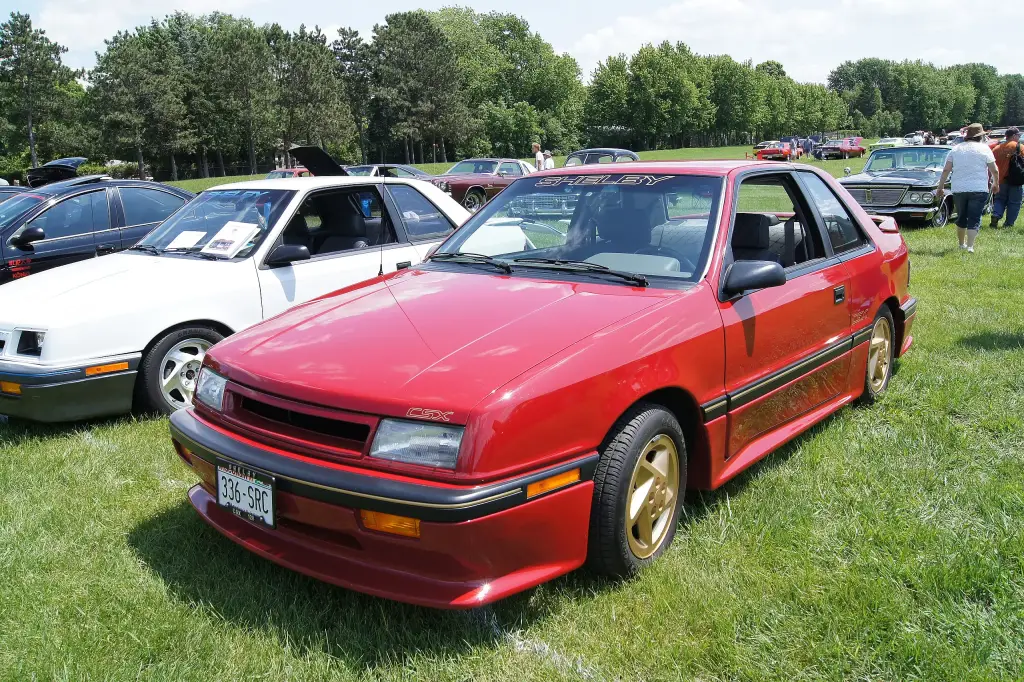
The Shadow and Sundance used the P-body, a variant of the K-car platform that combined the Dodge Daytona’s suspension and some of its interior styling with a shortened Dodge Lancer body. It had originally been intended as a direct replacement for the Omni and Horizon, but with the economy segment becoming more crowded after Hyundai and Yugo entered the United States, Chrysler made the car a little more substantial. The P platform, being a cut-down K platform, was heavier than the competition, and the range carried more equipment than expected for the class, at least until the stripped America model arrived in 1991.
Although the cars looked as if they had a boot, they were hatchbacks, which Chrysler called hidden hatchback versatility and which gave a large storage area that was a major selling point. Mechanically identical, the Shadow and Sundance were distinguished by their grilles, Dodge using a crosshair design and Plymouth an egg-crate one, and by different tail lights. In its final year the Shadow wore the new Dodge ram’s head emblem on the bonnet in place of the corporate pentastar. In the original line-up the three-door-only Shadow ES was the sportiest model, available only with the turbocharged engine and with wider wheels and tyres.
At launch the car was offered with 2.2 and 2.5-litre four-cylinder engines, some turbocharged, with naturally aspirated versions fuel injected except in Mexico, where they were carburetted. The engines were tuned for torque rather than horsepower, so their power and torque figures looked reversed compared with rivals such as the Honda Civic. A Mitsubishi-built 3.0-litre V6 was added later, replacing the turbocharged engines. All engines could be had with a five-speed manual, with a three-speed automatic on four-cylinder cars and a four-speed automatic on the V6.
The Shadow and Sundance were the lowest-priced cars on the market with a standard driver’s side airbag, which became standard on all United States-market Chrysler cars in 1990 and gave them a strong crash test rating for their size. For 1989 the cars were facelifted with composite headlamps instead of sealed-beam units and new grilles and tail lights. The driver’s airbag became standard in 1990, the convertible arrived in 1991 with the base model split into the America and Highline, the Mitsubishi V6 came in 1992 and a low-pressure Bendix ABS was available in 1993. A motorised passenger seat belt was added to United States-market cars in 1994 to meet passive restraint rules, which made those cars impossible to import legally into Canada until they were old enough.
Design and features
- Hidden hatchback: a boot-like rear that opened as a hatch for extra load space.
- Turbo engines: 2.2 and 2.5-litre fours with turbocharged versions in the ES.
- Standard airbag: the cheapest car on the market with a driver’s airbag from 1990.
- Convertible: a Shadow-only body style from 1991.
Dodge Shadow versions
- Base (1987-1990, 1993-1994): the original entry model.
- America and Highline (1991-1992): the split entry and mid-range trims.
- ES (1987-1994): the sporty trim, with the turbo engine at first.
- Convertible (1991-1993): ES and Highline open-top versions.
The Shadow replaced the Dodge Omni and was itself replaced by the Dodge Neon, while it shared its platform family with the Dodge Daytona. More Dodge models are in the Dodge collection.
Sources
- Dodge Shadow, English Wikipedia: design, engines, safety, model year changes