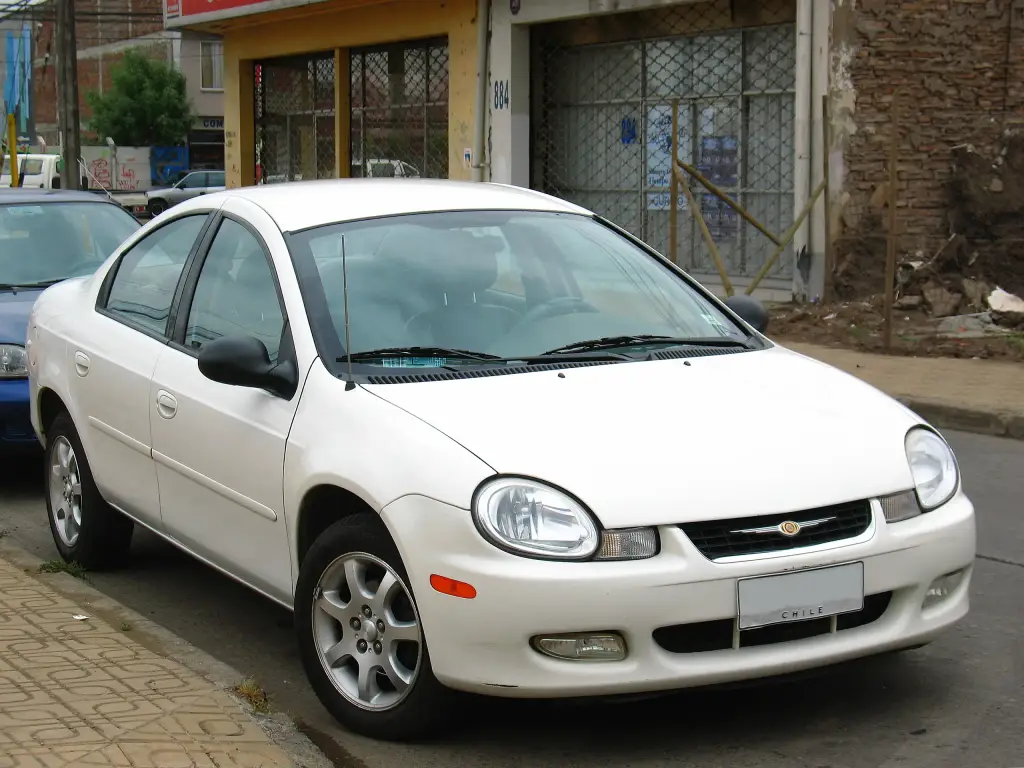
The Neon is a compact car that Chrysler built from the 1995 to 2005 model years and sold under the Dodge and Plymouth names in North America. In Europe, Mexico, Japan, Australia, South Africa and South America it was badged as a Chrysler, and it was the first compact car to become profitable for an American automaker.
Dodge Neon at a glance
| Production | 1995-2005 model years |
|---|---|
| Class | compact car |
| Platform | Chrysler PL, front-wheel drive |
| Bodies | four-door sedan, two-door coupe |
| Engines | 2.0 L SOHC, 132 hp; 2.0 L DOHC, 150 hp |
| Gearboxes | five-speed manual or three-speed automatic |
| Replaced | Omni/Horizon, Shadow/Sundance and Colt |
| Built | Belvidere, Illinois and Toluca, Mexico |
| Concept | 1991 Dodge Neon, recyclable with a 1.1 L two-stroke |
| Later use | Fiat Tipo-based Dodge Neon in Mexico, 2016-2020 |
Based on one source: the English Wikipedia article on the Chrysler Neon, the car sold as the Dodge Neon.
History of the Dodge Neon
Development began in the mid-1980s at American Motors, whose designers started work on a replacement for the Renault Alliance. When Chrysler bought AMC in 1987 it combined the AMC design team with Chrysler engineers from the L platform programme. The PL project was codenamed Counterattack, a reference to Lee Iacocca’s statements that the Big Three could no longer build cars with the innovation, quality and efficiency of their Japanese rivals. The goal was a car that was lightweight, economical, powerful and comfortable in an American way, costing just under 4,000 dollars to build and selling for no more than 8,000. Led by Tom Gale, the design kept a three-box layout but followed the cab-forward ideas first shown on the Lamborghini Portofino and Eagle Optima.
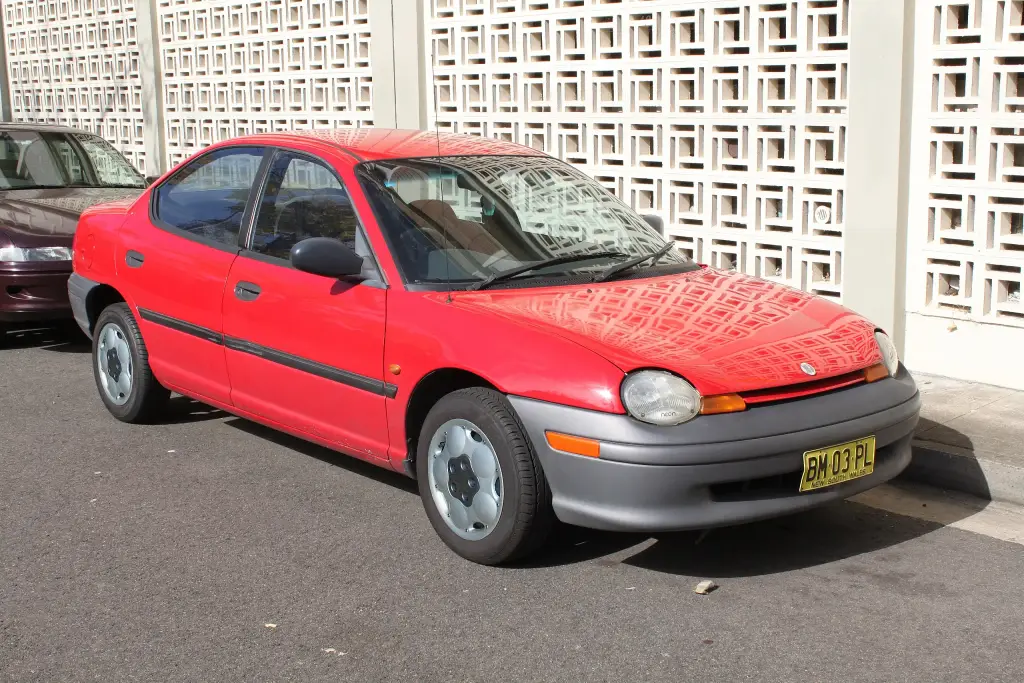
Chrysler showed the Neon as a Dodge concept at the 1991 Frankfurt Motor Show. It was built with recycled components and designed to be almost completely recyclable, and it even had an onboard trash compactor to deal with litter inside the car. It previewed the production car with cab-forward design in a compact package: all four doors slid open from the centre, there was no B-pillar, and a full-length retractable fabric roof made it effectively a four-door convertible. The concept used a 100 hp 1.1-litre three-cylinder two-stroke engine from Mercury Marine and a three-speed automatic, and it won a gold IDEA91 award from the Industrial Designers Society of America. The sliding doors, fabric roof, compactor and two-stroke engine were dropped for production, but the rounded roofline, circular headlights and minimalist grille were carried over.
The first-generation Neon was introduced at the 1993 Frankfurt Motor Show and went on sale in January 1994 for the 1995 model year. It came as a four-door notchback sedan and a two-door notchback coupe, with SOHC and DOHC versions of Chrysler’s 2.0-litre four producing 132 hp and 150 hp respectively, and a three-speed Torqueflite automatic or a five-speed manual. It replaced three sets of cars: the Omni and Horizon, the Shadow and Sundance, and the Mitsubishi-based Colt.
In the United States and Canada the car was sold as both a Dodge and a Plymouth, while in Mexico and the Gulf states it was sold as a Dodge and a Chrysler, and in Europe, Australia and other export markets as the Chrysler Neon. At the launch Chrysler president Bob Lutz said that the old Detroit saying was good, fast or cheap, pick any two, and that Chrysler refused to accept it. The Japanese press called the Neon a Japanese car killer, but only 994 were sold in Japan between June and December 1996, partly because its width put it in a higher tax bracket; had it been 19 mm narrower it would have qualified for a lower category. Car and Driver tested a DOHC five-speed Neon R/T at 0-60 mph in 7.6 seconds and 16.0 seconds for the quarter mile, and first-generation Neons were competitive in SCCA Solo autocross and showroom-stock racing. Options were unconventional, including the lack of power windows in the rear doors of some cars, and some base models had bumper covers moulded in colour rather than painted. From 2016 to 2020 the Dodge Neon name returned in Mexico and the Middle East on a rebadged Fiat Tipo sedan.
Design and features
- PL platform: front-wheel drive, replacing the Omni, Shadow and Colt lines.
- Two 2.0 engines: a 132 hp SOHC and a 150 hp DOHC unit.
- 1991 concept: a recyclable show car with sliding doors and a retractable fabric roof.
- Export badging: sold as a Chrysler in Europe and many other markets.
Dodge Neon versions
- Neon sedan: the four-door notchback.
- Neon coupe: the two-door version.
- Neon R/T: the DOHC five-speed model tested by Car and Driver.
- Chrysler Neon: the export version of the same car.
The Neon replaced the Dodge Omni and Dodge Shadow, and it was itself replaced in the compact class by the Dodge Caliber. More Dodge models are in the Dodge collection.
Sources
- Chrysler Neon, English Wikipedia: development, concept, engines, markets