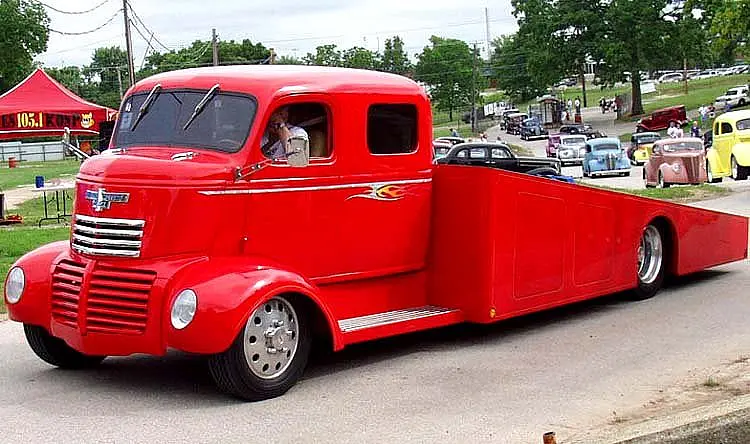
The Dodge LCF, short for Low Cab Forward, was a series of medium and heavy-duty trucks that Dodge built from 1960 until 1976. The trucks replaced the Dodge cab-over range of the 1950s and were sold in Canada as Fargos and in some export markets with DeSoto badges.
Dodge LCF series at a glance
| Maker | Dodge, Chrysler Corporation |
|---|---|
| Production | 1960-1976 |
| Class | medium and heavy-duty trucks |
| Cab | from the 1956-1960 Dodge pickups, with a unique front section |
| Cab body built by | Checker Motors, Kalamazoo, Michigan |
| Weight classes | 500-700 medium duty; 800-1000 heavy duty |
| Petrol engines | Dodge and International Harvester V8s, badged C |
| Diesel engines | Perkins, Cummins, Caterpillar, Detroit Diesel |
| Biggest diesel | Cummins V-903, 903 cu in, 289 hp |
| Most powerful | Detroit Diesel 8V-71N, 300 hp |
| End | 1975 in the US; CKD kits to Latin America in 1976 |
Based on one source: the English Wikipedia article on the Dodge LCF series.
History of the Dodge LCF series
The LCF cabin section came directly from the 1956-1960 range of Dodge pickup trucks, with its panoramic windscreen, but was fitted with a unique front section. One of the truck’s main selling points was accessibility: the sides of the engine compartment and the wings were arranged to swing open, so a mechanic could stand between the engine and the front wheel while working. Chrysler outsourced production of the cab body to Checker Motors and assembly took place on Checker line 2 in Kalamazoo, Michigan.
The 500 through 700 series were medium-duty trucks only, while the 800 through 1000 series were reserved for heavy-duty versions. The range was sold in Canada with the Fargo badge, and following Chrysler’s policy of badge engineering to reach more sales outlets overseas, LCFs were also marketed in some countries as De Sotos.
A wide range of engines was available: Dodge and International Harvester petrol engines and diesels from Perkins for the lighter variants, Cummins, Caterpillar and Detroit Diesel for the heaviest, in both six-cylinder and V8 form. Petrol versions were simply called the C series followed by a numeral for the weight class and were all V8-powered, Perkins diesel units were called PC, inline diesels CN and V-type diesels CV, and a T after the letters meant a tandem rear axle. On LCFs with inline-six diesels the engine intruded into the cabin and was covered by a removable panel for maintenance. The range of engines, transmissions and rear axles available was almost unlimited because these were usually built-to-order trucks.
The biggest diesel was the Cummins V-903, a 903 cu in unit of 14,794 cc with a modest maximum output of 289 hp, while the smaller 567 cu in Detroit Diesel 8V-71N was the most powerful engine with 300 hp. With Dodge pulling out of the heavy truck business, the C series’ last year in the United States market was 1975. A few hundred more CNT800 and CNT900 trucks were exported in 1976 as CKD kits to Latin American countries, where the last units were assembled until 1978.
Design and features
- Low cab forward layout: a cab-over design with the engine under and beside the driver.
- Swing-open sides: the engine compartment and wings opened for easy servicing.
- Built to order: a wide choice of petrol and diesel engines, gearboxes and axles.
- Checker-built cabs: cab bodies were made by Checker in Kalamazoo.
Dodge LCF series versions
- 500-700 series: medium-duty LCFs.
- 800-1000 series: heavy-duty versions.
- PC, CN and CV: the diesel versions by engine layout, with T for tandem axle.
- C series petrol trucks: V8-powered models named by weight class.
The LCF shared its cab with the Dodge C series pickups and replaced the earlier cab-over Dodges, while the light-duty side of the range was covered by the Dodge D series. More Dodge trucks are in the Dodge collection.
Sources
- Dodge LCF series, English Wikipedia: cab, engines, badges, end of production