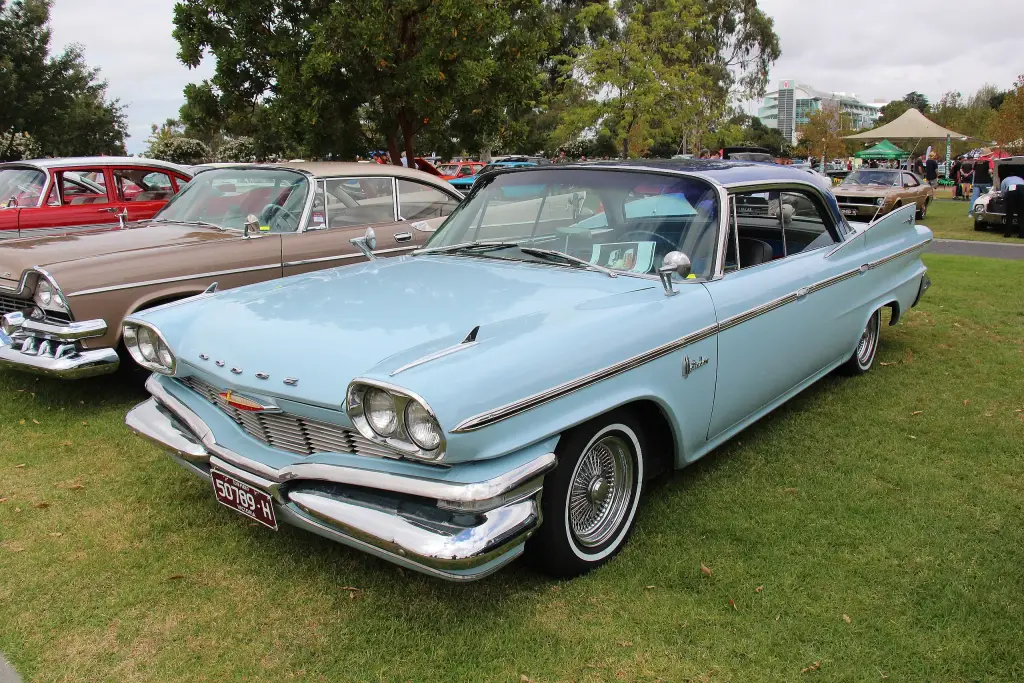
The Dodge Matador is a full-size automobile that Dodge produced for the 1960 model year only. It was the base model, positioned below the top-trim Dodge Polara, and both used the 122-inch wheelbase platform of the Chrysler Windsor and Chrysler Newport.
Dodge Matador at a glance
| Production | 1960 model year only |
|---|---|
| Class | full-size car |
| Wheelbase | 122 in |
| Position | base full-size Dodge, below the Polara |
| Standard engine | 361 cu in Super Red Ram V8, 295 hp |
| Optional engine | 383 cu in D-500 with Ram Induction |
| Gearbox | three-speed TorqueFlite automatic with pushbuttons |
| Body styles | sedan, hardtop, convertible, six- and nine-passenger wagons |
| Built | 27,908 cars |
| Dropped | after 1960, leaving the Polara as the full-size Dodge |
Based on one source: the English Wikipedia article on the Dodge Matador.
History of the Dodge Matador
The Matador was one of two new models Dodge produced for 1960, when the marque dropped its long-running Coronet, Custom, Custom Royal and Lancer models. It shared the new unibody platform of the slightly smaller Dodge Dart but was designated Dodge’s full-size base trim, with the Polara as the premium full-size model. The Matador was intended to be a lower-priced alternative to the Polara and to sit above the new and successful 118-inch wheelbase Dart range. However, full-size cars in the United States were at their lowest sales level since the Second World War, and 1959 was not the best moment to launch a new nameplate in that segment.
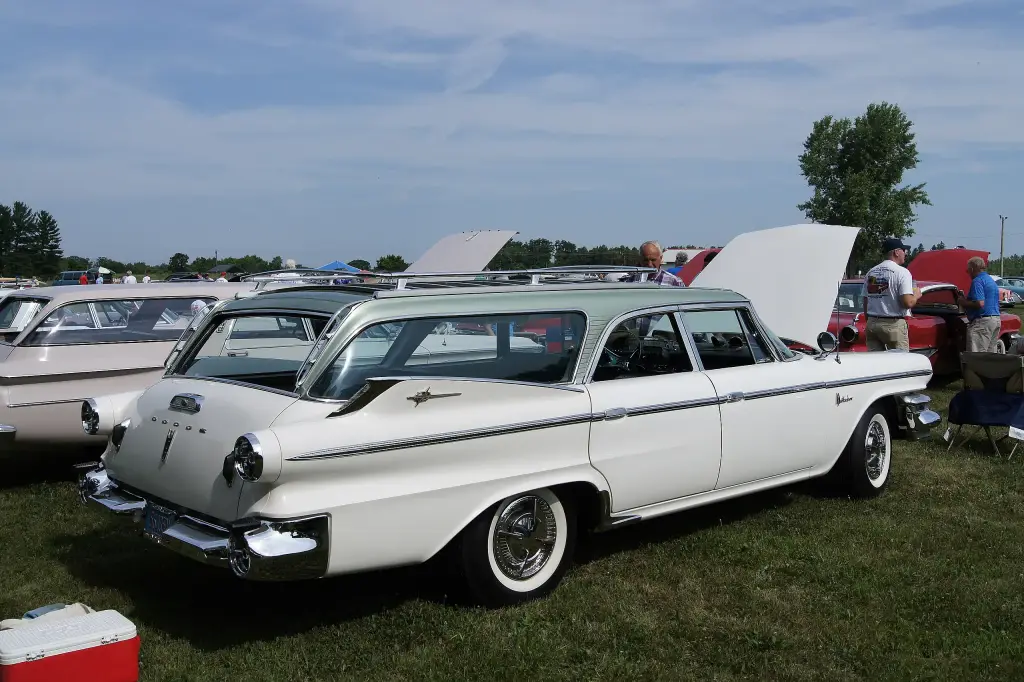
The 1960 Matador and Polara were built on a wheelbase four inches longer than before, shared with the 1960 DeSoto and Chrysler models. All Matadors had the Super Red Ram 361 cu in V8 with 295 hp as standard, with the D-500 383 cu in engine with dual four-barrel carburettors and Ram Induction as an option, along with a three-speed TorqueFlite automatic controlled by pushbuttons on the left of the instrument panel.
The styling carried over cues from the 1959 models, themselves an evolution of Virgil Exner’s Forward Look cars of 1957. The 1960 Dodge has been described as a rocket-age design. On the new unibody chassis the Matador kept Dodge’s stacked jet-pod tail lights, but their size was greatly exaggerated, with the lower light set into the rear bumper. The design also used Dodge’s shortened tail fins, with small vertical tail light lenses on the back of each fin, the shortened fin exaggerating the length of the jet pods. The front had a small grille of six stacks of aluminium rectangles nested in a massive and complex bumper assembly.
The interior had cloth and vinyl bench seats with premium trim and an X-within-an-X four-spoke steering wheel. The dashboard was space-age styled, with a bridged-over sweep speedometer flanked by gauge pods and an optional revolving turret clock whose stationary pointer read against rotating dials for hours and minutes and an orbiting red dot for seconds. Options included vacuum door locks on four-door models and front swivel seats with a folding centre armrest that rotated out when the door opened. All 1960 Dodge wagons used the 122-inch wheelbase with 98.5 cubic feet of cargo space, and the Matador wagon came in six- or nine-passenger form with a rear-facing third bench and a roll-down rear window in the tailgate. The Matador had less chrome and plainer interiors than the Polara.
Most Dodges sold in 1960 were the smaller and cheaper Dart, which came in Seneca, Pioneer and Phoenix sub-series. A total of 27,908 Matadors were built, and the combination of low Matador sales, the continuing popularity of the Dart and the launch of the 1961 Lancer compact meant the nameplate was dropped for 1961, leaving only the Polara as the full-size Dodge. The Matador name was later used by AMC from 1971 to 1978, and Chrysler went on to buy American Motors in 1987.
Design and features
- One-year model: the base full-size Dodge for 1960 only.
- 295 hp standard: every Matador had the Super Red Ram 361 V8.
- Jet-pod styling: exaggerated stacked tail lights and shortened fins.
- Space-age interior: a sweep speedometer and an optional revolving turret clock.
Dodge Matador versions
- Matador sedan and hardtop: the standard four-door and two-door bodies.
- Matador wagon: six- or nine-passenger estate with a rear-facing third row.
- D-500 option: the 383 cu in engine with Ram Induction.
The Matador was the base version of the Dodge Polara and was replaced by it in 1961, while the cheaper Dodge Dart outsold both. More Dodge models are in the Dodge collection.
Sources
- Dodge Matador, English Wikipedia: design, engines, interior, production