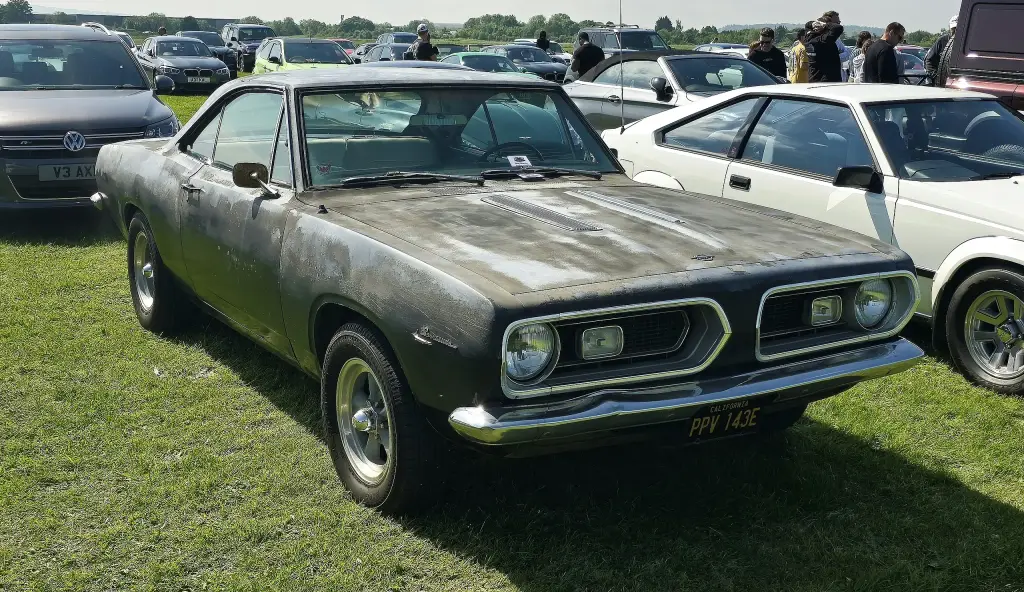
The Plymouth Barracuda is a two-door pony car built by Chrysler Corporation for the 1964–1974 model years. Its first version reached showrooms on 1 April 1964, two weeks before the Ford Mustang, which has ever since been credited with inventing the class.
Plymouth Barracuda at a glance
| Maker | Plymouth (Chrysler Corporation) |
|---|---|
| Production | 1964–1974 |
| Class | two-door pony car |
| First generation | 1964–1966, Chrysler A-body fastback |
| Second generation | 1967–1969, fastback, notchback and convertible |
| Third generation | 1970–1974, Chrysler E-body |
| Wheelbase, 1964 | 106 in (2,692 mm) |
| 1964 engines | 170 and 225 cu in six, 273 cu in V8 |
| 1964 price | US$2,512 |
| Rear window, 1964 | 14.4 sq ft (1.34 m²), the largest on a production car then |
Based on one source, the English Wikipedia article on the Barracuda. The older records titled Cuda and HemiCuda are versions of this car and now redirect here.
History of the Plymouth Barracuda
First generation (1964–1966)
Chrysler stylist Irv Ritchie sketched a fastback version of the compact Valiant while the company watched Ford prepare a sporty compact of its own. Budgets were tight because of work on the Chrysler Turbine Car, and Plymouth executives first wanted to call the car Panda before John Samsen’s suggestion, Barracuda, won. The new model used the Valiant’s 106-inch wheelbase along with its hood, headlamp bezels, windshield, vent windows, quarter panels, doors, A-pillar and bumpers; the trunk and part of the glass were new. The greatest effort went into the wraparound rear window, a collaboration between Pittsburgh Plate Glass and Chrysler designers that at 14.4 square feet was the largest ever fitted to a standard production car.
Powertrains were the Valiant’s. The standard engine was the 170 cu in slant six with 101 bhp, the optional 225 cu in six made 145 bhp, and the new 273 cu in LA V8 with a two-barrel carburettor produced 180 bhp. The car cost US$2,512. The abbreviated 1964 season brought 23,443 sales against 126,538 Mustangs in the same period.
For 1965 the 225 six became the base engine in the United States while the 170 stayed standard in Canada, and a four-barrel Commando version of the 273 V8 raised output to 235 bhp. A Formula ‘S’ package added that engine, suspension work, larger wheels and tyres, special emblems and a tachometer, and disc brakes and factory air conditioning became available during the year. The 1966 cars received new taillamps, new front sheet metal and a new instrument panel, and a centre console became optional for the first time. The Valiant script on the boot lid was dropped at the end of 1965 and replaced by the Barracuda fish logo.
Second and third generations (1967–1974)
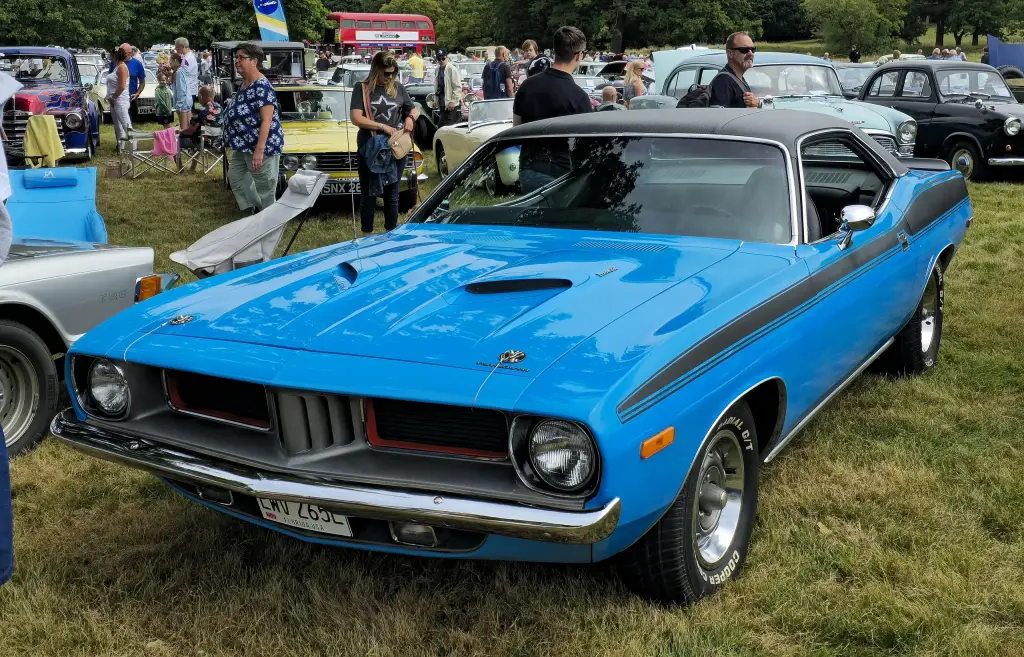
The second-generation Barracuda, still Valiant-based, was heavily redesigned for 1967 and came as a fastback, a notchback and a convertible. The third generation arrived for 1970 on the new Chrysler E-body, shared with the slightly larger Dodge Challenger, and the two-door was offered as a hardtop and a convertible until production ended in 1974.
Design and features
- The first pony car: on sale two weeks before the Mustang, though it sold far fewer cars.
- Valiant bones: the 1964 car shared most of its bodywork and all of its engines with the compact Valiant.
- Wraparound glass: a 14.4 sq ft rear window, the largest on a production car at the time.
- Growing power: from a 101 bhp six to the 235 bhp Commando V8 within two years.
Plymouth Barracuda versions
- 1964–1966 fastback: the original A-body two-door hardtop with the wraparound rear glass.
- Formula ‘S’ (1965–1966): the sporting package with the Commando V8 and uprated chassis.
- 1967–1969 range: fastback, notchback and convertible on the second-generation body.
- 1970–1974 range: hardtop and convertible on the E-body platform.
The Barracuda was built on the Valiant, and its smaller stablemate was the Duster. More cars are in the Plymouth collection.
Video: Test Driving 1970 Plymouth Cuda 572 Hemi Convertible and Walkaround
Video by RamblinAround on YouTube.
Sources
- Plymouth Barracuda, English Wikipedia: development, generations, engines, 1964 sales