
The numbers on a muscle car’s fender, 327, 396, 426, 454, are cubic inches. Behind each one sits a bore, a stroke and a rating measured by rules that changed in 1972. This guide decodes all of it and introduces the three engine families that defined the era.
The short version
Cubic inches are the volume of all cylinders together. Pre-1972 horsepower is “gross”, measured on a bare engine; from 1972 it is “net”, measured as installed. Chevrolet’s small-block is the compact V8, the big-block is the large one, and Chrysler’s Hemi is defined by its hemispherical combustion chambers.
What “426” and “454” actually mean
American makers of the 1960s named engines by displacement in cubic inches. Displacement is the swept volume of one cylinder multiplied by the number of cylinders. Swept volume depends on two measurements: the bore (the cylinder’s diameter) and the stroke (how far the piston travels). So the same block can become a different engine just by changing the crankshaft: Chevrolet’s 302 is a 327 with the shorter-throw crank of the 283, giving a bore of 4.0 in and a stroke of 3.0 in.
The formula is displacement = π ÷ 4 × bore² × stroke × number of cylinders. For the 327, with its 4.000 in bore and 3.25 in stroke, that is 326.7 cubic inches, which is exactly the 326.7256 that Wikipedia lists.
Cubic inches of the engines in this guide. Blue-grey: small-block; red: big-block; black: Hemi.
Try it yourself: displacement calculator
The calculator needs JavaScript; the formula above gives the same result.
Bore and stroke figures come from English Wikipedia: 283 3.875 × 3.0; 327 4.0 × 3.25; 350 4.0 × 3.48; 396 4.094 × 3.76; 426 Hemi 4.25 × 3.75; 454 4.25 × 4.0.
Gross horsepower, net horsepower, and the 1972 reset
Before 1972 American makers quoted SAE gross horsepower: the engine ran on a test stand without the air cleaner, exhaust system or accessories such as the alternator and water pump, and the tester could tune the ignition for the best result. From late 1972 they switched to SAE net, measured as installed, with the stock ignition, carburettor, exhaust and accessories. Same dynamometer type, different rules.
Two things changed at once: the way power was counted, and the engines themselves. Compression ratios dropped, engines were tuned for unleaded fuel and fitted with smog-control devices. Where a manufacturer published both numbers, as Chrysler did for the 1971 Hemi, you can see the difference directly.
Ratings from English Wikipedia: Hemi 425 hp gross and 350 hp net in Chrysler’s 1971 literature; the Chevrolet 396/402 at 300 hp gross in 1971 with 260 hp net (dual exhaust) or 206 hp (single exhaust), and 240 hp net in 1972.
Net or gross, neither number is what reaches the road.
Horsepower at the wheels is lower again.
Horsepower measured at the rear wheels, on a chassis dynamometer, includes the losses of the gearbox, driveshaft and differential, so it is lower than either rating. In 2011 Super Chevy magazine tested a well-documented, stock, well-tuned L72 “COPO” Camaro and recorded a peak of 287 hp at the rear wheels, against the 425 hp the engine was rated at.
The small-block: Chevrolet’s compact V8
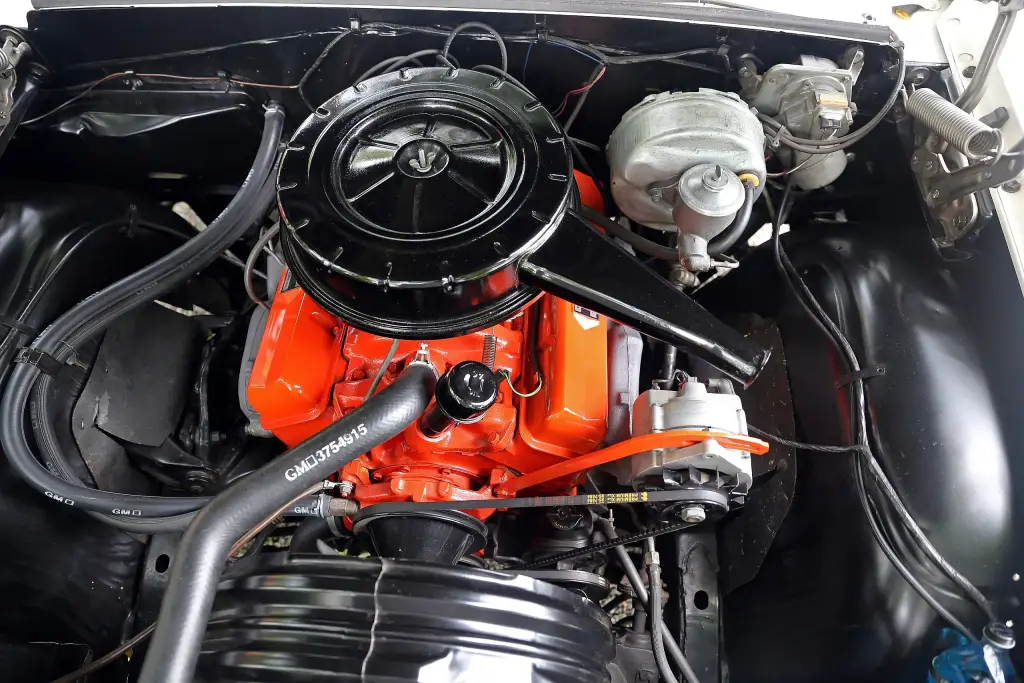
Chevrolet’s small-block began production in late 1954 for the 1955 model year at 265 cubic inches. Ed Cole’s group designed it to give the 1955 Corvette more power than its inline six, and the first version went from drawings to production in about 15 weeks. It was soon nicknamed the “Mighty Mouse”, and its 4.4 in bore spacing would stay in use for decades.

| Engine | Bore × stroke (in) | Debut | Power (SAE gross) |
|---|---|---|---|
| 265 | 3.750 × 3.000 | 1955 | 162 hp (2-barrel); 195 hp (Corvette) |
| 283 | 3.875 × 3.000 | 1957 | 188 to 283 hp; fuel-injected 1957 version 283 hp |
| 302 | 4.000 × 3.000 | 1967 Z/28 Camaro | built to fit the 305 cu in Trans-Am class limit |
| 327 | 4.000 × 3.250 | 1962 | 225 to 375 hp; L84 fuel injection 375 hp in 1964 |
| 350 | 4.000 × 3.480 | 1967 Camaro (L48) | L48 300 hp; L46 350 hp (1969) |
| 400 | 4.125 × 3.750 | 1970 | 245 to 265 hp gross; torque, not power, was its strength |
The 283 with Rochester mechanical fuel injection reached one horsepower per cubic inch in 1957, which Wikipedia describes as the third US production V8 to do so after the 1956 Chrysler 300B and DeSoto Adventurer. The overbored 283 had thin cylinder walls, so later blocks were cast to take the larger bore. In 1962 the 327 arrived as a performance block, and in 1964 the fuel-injected L84 became the most powerful naturally aspirated single-camshaft production small-block until 2001. The 350 appeared as the 300 hp L48 option in the 1967 Camaro and became the best-known small-block; the 400, unusual among small-blocks for its siamesed cylinders, was never meant as a performance engine.

The big-block: Chevrolet’s large V8
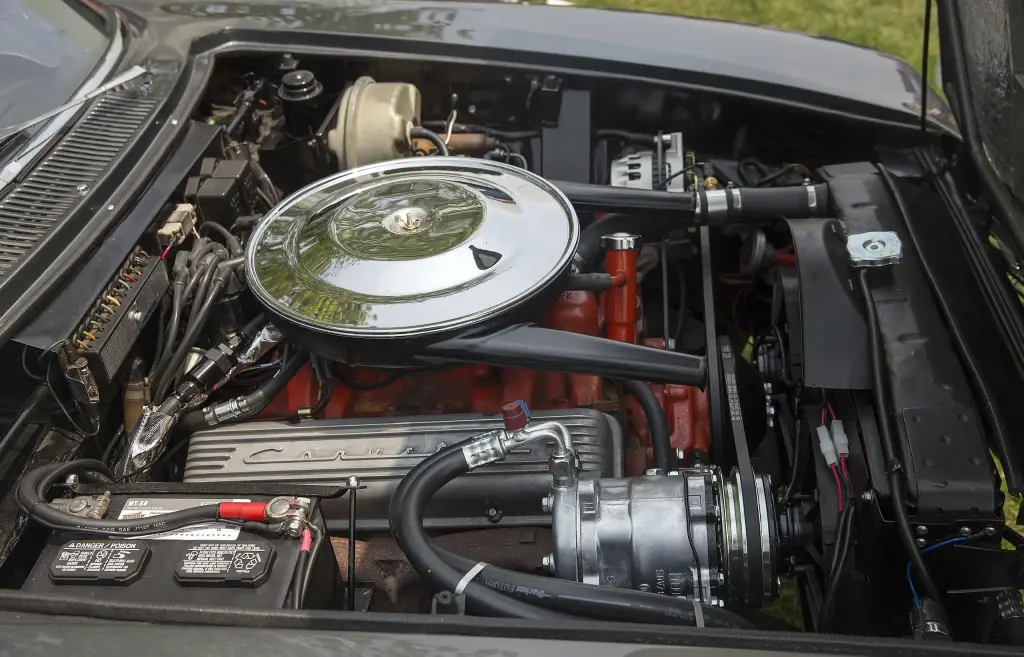
Chevrolet needed something larger than the small-block for medium-duty trucks and heavier cars, and the big-block debuted in 1958 at 348 cubic inches. The first family, the W-series (1958–1965), put its combustion chambers in the upper part of the cylinder rather than the head, which gave a broad torque curve. Its higher-output versions were the 409 and the 427 of 1962–63; the 1963 Impala RPO Z11 427 was a special package for drag racers and NASCAR, rated at 430 hp gross, and 50 were built.
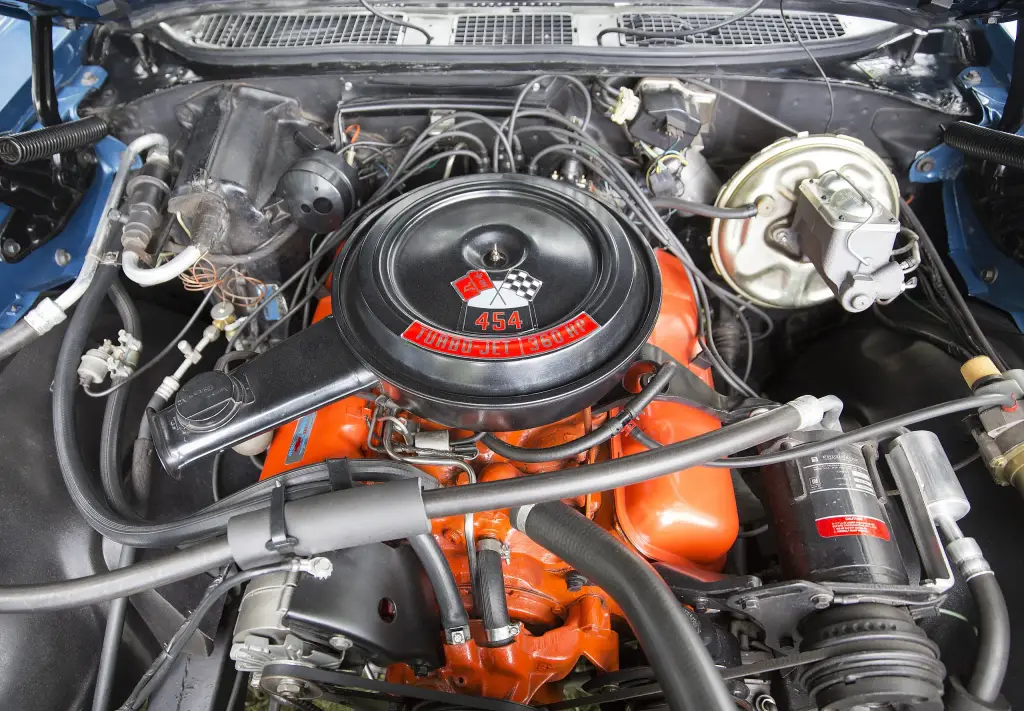
The Mark IV followed in 1965 with a conventional wedge chamber in the head and valves canted so they open away from the chamber, which the press called the “porcupine” design. The 396 arrived in the 1965 Corvette (L78, 375 hp at 5,600 rpm, with a solid-lifter version rated at 425 hp). The 427 followed in 1966 with a bore of 4.25 in. In 1970 the engine grew to 454 cubic inches, with bore and stroke of 4.25 in and 4.0 in.

| Engine and code | Years | Rating (SAE gross) | What it was |
|---|---|---|---|
| 396 L78 | 1965 | 375 hp at 5,600 rpm, 415 lb-ft | Corvette option (the Chevelle Z-16 got it as L37); solid-lifter Corvette rated 425 hp |
| 427 L72 | 1966–1969 | 425 hp | solid-lifter, single four-barrel; rough-idling, high-revving |
| 427 L71 | 1967–1969 | 435 hp at 5,800 rpm, 460 lb-ft | L72 with three two-barrel carburettors (“Tri-Power”); Corvette and Iso Grifo |
| 427 ZL1 | 1969 | specifications nearly identical to the L88 | all-aluminium block and heads, built for Can-Am racing; an engine-dyno test of a production ZL1 showed 376 hp net or 524 hp gross when tuned for it |
| 454 LS5 | 1970 | 390 hp, 500 lb-ft | Corvette big-block of the 454 generation |
| 454 LS6 | 1970 | 450 hp at 5,600 rpm, 500 lb-ft | single 800 cfm Holley four-barrel |
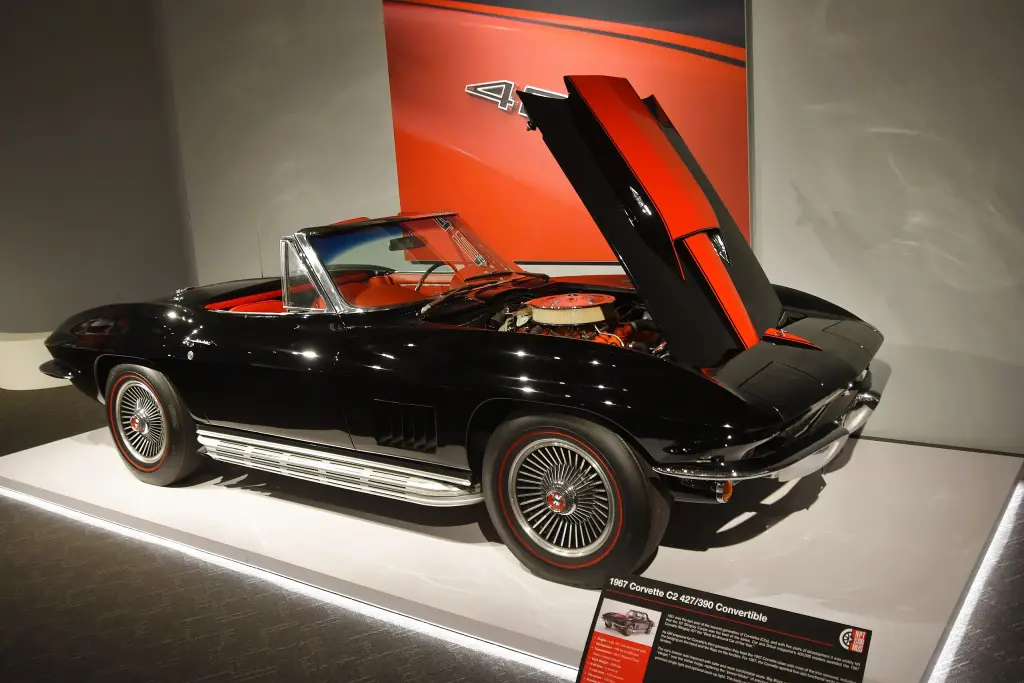

These engines were physically big. The W-series weighed about 665 lb dry and the Mark IV about 685 lb dry, both with 4.84 in bore centres, compared with 4.4 in on the small-block.
The Hemi: Chrysler’s hemispherical heads
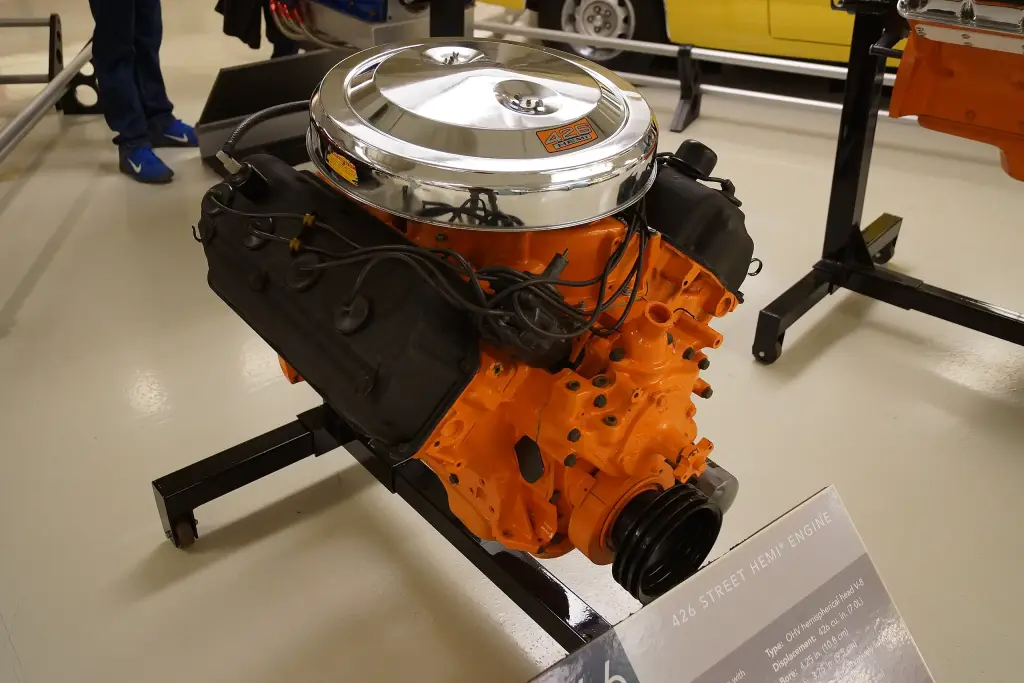
“Hemi” is Chrysler’s name for engines whose combustion chambers are partly spherical. The shape is efficient, with a good surface-to-volume ratio, minimal heat lost to the head and room for two large valves set on opposite sides of the chamber. The price is size and cost: the valves point in different directions, so the head is wide and the rocker gear complex, and the design is more sensitive to fuel octane than wedge or bathtub chambers.
Chrysler had built Hemis from 1951 to 1958. In December 1962 engineers were asked for an engine to win stock-car races and a version for drag racing; design began in January 1963 with the Daytona race of 23 February 1964 as the first target, and the first engine ran on 6 December 1963. The 426 was nicknamed the “elephant” for its power, weight and size: a deck height of 10.72 in and bore spacing of 4.80 in made it the biggest engine in racing at the time. Its bore and stroke of 4.25 × 3.75 in are the same as the 426 Wedge.
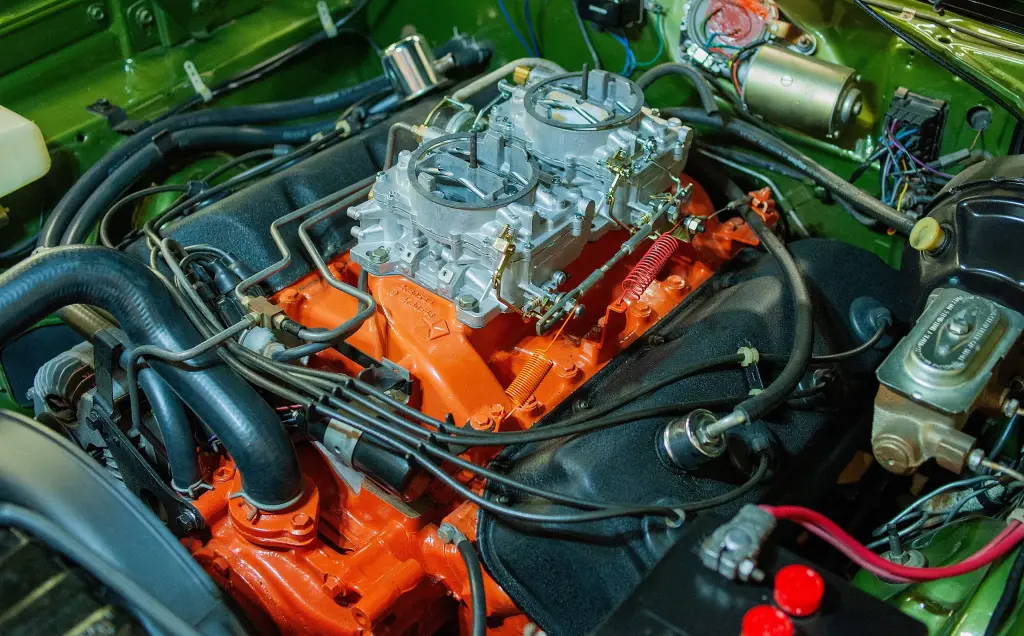

Ford’s complaints about its power led NASCAR to ban the race Hemi for 1965 because it was not available in production cars. Chrysler’s answer was the Street Hemi in 1966: compression lowered from 12.5 to 10.25:1, cast-iron exhaust manifolds, a milder camshaft, a heated intake manifold and two Carter four-barrel carburettors. It was rated at 425 hp at 5,000 rpm and 490 lb-ft at 4,000 rpm; in a stock dynamometer test it made 433.5 hp and 472 lb-ft. It was optional in the Coronet, Belvedere, Satellite, Charger, GTX, Super Bee, Road Runner, Barracuda and Challenger families, among others, until 1971.
The name lives on: a supercharged crate engine called the “Hellephant”, a play on the original’s nickname, makes 1,000 hp and 950 lb-ft.
Putting the numbers side by side
Factory ratings for the engines above, all SAE gross. They are marketing numbers as much as measurements, which is why the differences between neighbouring engines are small.
| Chevy small-block | Chevy big-block (Mark IV) | Chrysler 426 Hemi | |
|---|---|---|---|
| Combustion chamber | wedge | wedge, valves canted (“porcupine”) | hemispherical |
| Bore spacing | 4.4 in | 4.84 in | 4.80 in |
| Bore × stroke (largest here) | 4.125 × 3.75 (400) | 4.25 × 4.0 (454) | 4.25 × 3.75 |
| Dry weight | not stated in our sources | about 685 lb | not stated in our sources |
| Nickname | “Mighty Mouse” (265) | “Porcupine” | “Elephant” |
Reading an engine code
Chevrolet sold engines as Regular Production Options, or RPO codes, which is why enthusiasts say “L72” or “LS6” rather than a displacement. The ones in this guide: L48 (the 300 hp 350), L46 (the 350 hp 350), L78 (the 375 hp 396), L72 (the 425 hp 427), L71 (the Tri-Power 435 hp 427), L89 (an L71 with aluminium heads, about 75 lb lighter), Z11 (the 1963 drag-racing 427), LS5 and LS6 (the 454s) and ZL1 (the all-aluminium 427). Chrysler instead sold the Hemi as a named option.
Muscle car engine questions and answers
What does 426 mean on a Hemi?
Its displacement in cubic inches, about 7.0 litres.
Is a small-block always smaller than a big-block?
Chevrolet uses the names for two engine families. The small-block spans 262 to 400 cubic inches and the big-block starts at 348 and reaches 496, so there is overlap in size; the real difference is the block, with 4.4 in bore spacing on the small-block and 4.84 in on the big-block.
Why do 1970 horsepower numbers look higher than 1973 ones?
Partly because the engines changed (lower compression, emissions equipment) and partly because ratings switched from gross, measured on a bare engine, to net, measured as installed.
Which is the most powerful engine here?
Among factory ratings in this guide, the 454 LS6 at 450 hp gross in 1970; the real figures depend on how they were measured.
Sources
- Chevrolet small-block engine (1954–2003), English Wikipedia: displacements, bore and stroke, ratings, history
- Chevrolet big-block engine, English Wikipedia: W-series and Mark IV, 396, 427, 454, codes and ratings
- Chrysler Hemi engine, English Wikipedia: design, 426 development, Street Hemi, ratings
- Muscle car, English Wikipedia: definition and context
- History of the small-block Chevrolet, EngineLabs: 265, 283, 327 and 350 timeline
- Horsepower ratings: gross versus net, Chevy Hardcore: how the two ratings were measured and when the switch happened
- 426 Hemi engine, Muscle Cars Illustrated: 1966 street version specifications