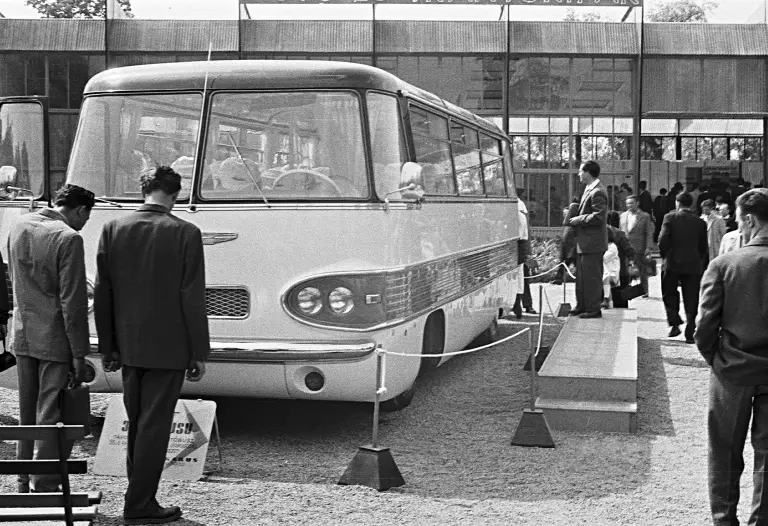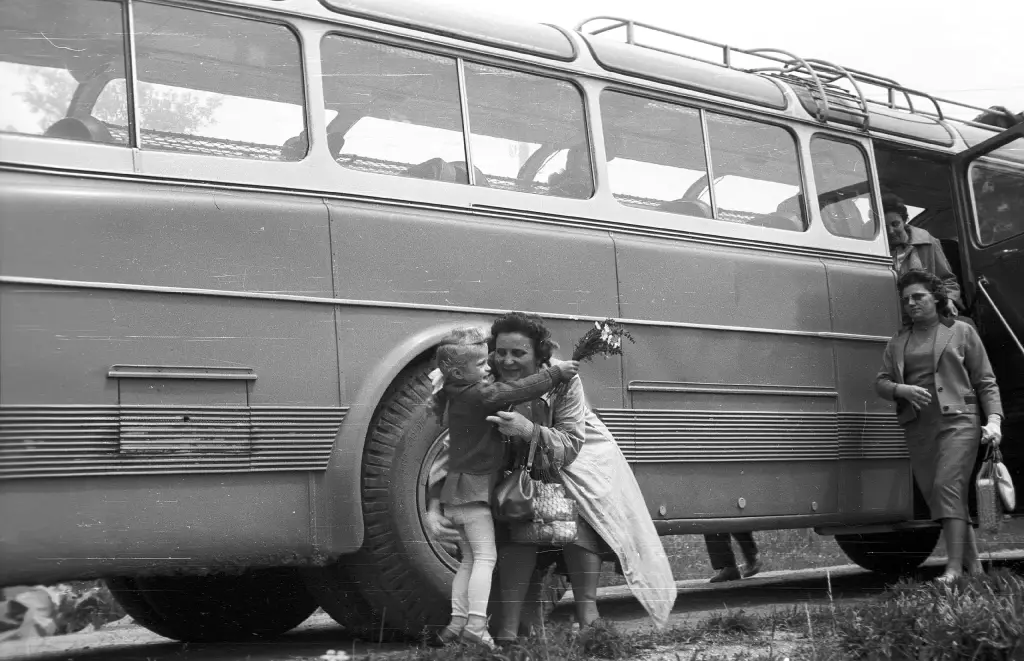
The Ikarus 55 was the coach that turned the engine round. Its Csepel diesel sat behind the rear seats in a bulbous compartment that gave the bus its nicknames — “Faros” and “Bözsi” — and with 7,466 built it became one of the most successful tourist coaches of the Eastern Bloc.
Ikarus 55 at a glance
| Maker | Ikarus, Budapest-Mátyásföld |
|---|---|
| Type | high-floor long-distance and interurban coach |
| Production | 1954–1973 (English Wikipedia: 1952–1973) |
| Built | 7,466 |
| Engine | Csepel D-614, 8.3 litres, 145 PS (107 kW), rear-mounted |
| Gearbox | five-speed, partly synchronised |
| Suspension | leaf-sprung beam axles, planetary rear axle |
| Top speed | 78–98 km/h depending on gearing |
| Soviet Union | 3,762 |
| East Germany | 2,306 |
| Hungary | 1,191 |
| Sibling | Ikarus 66 city bus |
The Hungarian article dates production from 1954, the English one from 1952; both years are given above.
History of the Ikarus 55
In the 1950s the factory’s chief engineer, Zerkovitz Béla, turned with a small group against the central production doctrine that favoured front-engined buses on chassis, the so-called trambuses such as the Ikarus 60. The aim was a modern vehicle with a self-supporting body, no chassis, the engine at the rear, a large capacity and the ability to serve both long-distance and city work. It also helped that Hungarian industry could not then build chassis in large numbers. Noise could not be reduced further at the front, because the engine sat in the passenger compartment and the Csepel engines were loud; a large unused space formed around it; and the first passenger door could not be placed ahead of the front axle, which ruled out a realistic three-door layout. Putting the engine under the floor, as the 200 family would later do, was impossible because the industry could not yet make a horizontal engine.
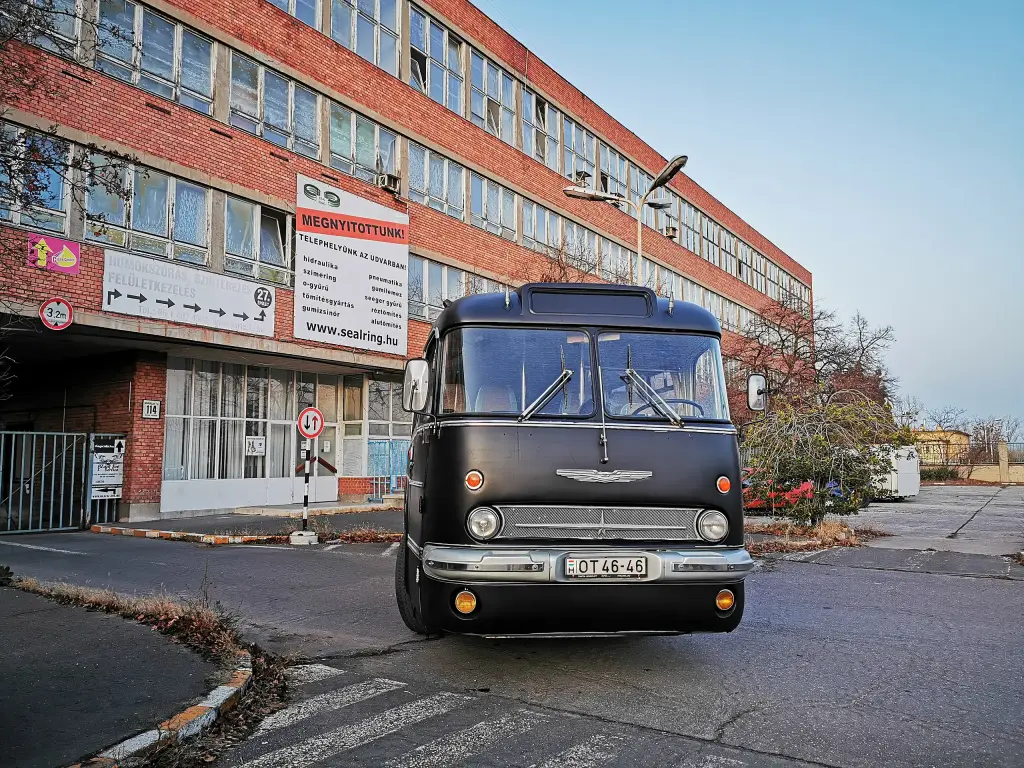
The styling was P. Horváth György’s work, created in several steps, and the rear-engined body became Németh Aladár’s diploma project in 1955. The first prototype was the A58, the Ikarus 66 of 1952, still with a rounded rear like the Ikarus 60. The first prototype with the classic rear was the A60 of 1953, the direct predecessor of the 55, in which Deák László played a large part; the engine had to be easy to maintain, so the pre-series buses had engine hatches opening on both sides. When the type was shown officially it came under heavy attack and practically every innovation was criticised, but Zerkovitz’s expertise and determination, together with the fact that the Soviets were experimenting with a similar bus, the ZIS-154, were enough for the type to survive.
The new coach made its international debut in 1954, first in Geneva and then in Paris, where it won a diploma. Production started slowly: the buses were built with great precision, foreign one-off orders had priority, and the factory had also been ordered to make consumer goods, including 30,000 prams. The first series had only a central double-leaf door on the right, easy for boarding with big luggage, with no front door so as not to lose seats, and a separate door on the left for the driver; between 1955 and 1962 the centre had a single door leaf, and from 1962 the doors followed the customer’s wishes. Roof-arch windows were standard until 1957 and optional afterwards, and the only air-conditioned example was built for MáVAUT in 1964. Hungary took 1,191 buses, of which 1,048 served state road transport companies and the rest went to MALÉV and the IBUSZ and Expressz travel agencies. Abroad the Soviet Union took 3,762 with LiAZ front axles, mostly 55.12 and 55.13, and East Germany 2,306 that formed the backbone of its long-distance services until the late 1980s. Czechoslovakia took 110, Romania 41, China 21, Bulgaria 13, Poland 10 and Greece 5, Egypt ordered five in 1956 with a destination board above the rear window, and Yugoslavia and Cuba each had a demonstration bus. The type was also the first for which Ikarus used the “dot number” system, adding a point and two digits to show the variant.
Design and features
- Rear engine: the first Ikarus bus with the engine behind the rear seats, which gave the type its “Faros” nickname.
- Csepel D-614: an 8.3-litre straight six derived from the Steyr WD 613, rated at 145 PS (107 kW).
- Self-supporting body: no chassis, which also solved the shortage of frames in Hungary.
- Easy engine access: pre-series buses had hatches that opened on both sides.
- Export career: 3,762 to the Soviet Union and 2,306 to East Germany.
Ikarus 55 versions
- Early series (1954–1955): a central double-leaf door and no front door.
- 1955–1962: a single door leaf in the centre.
- From 1962: door layouts built to the customer’s order.
- 55.12 and 55.13: the versions most often supplied to the Soviet Union, with LiAZ front axles.
- Air-conditioned example: a single bus built for MáVAUT in 1964.
- Ikarus 66: the city sibling on the same mechanical basis.
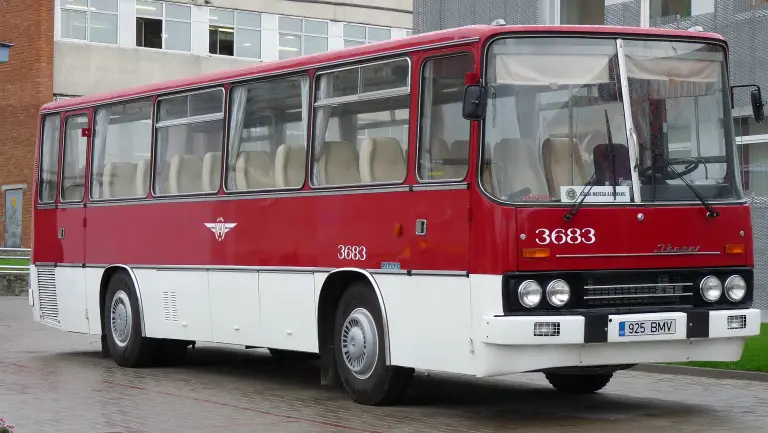
The 55 shared its rear-engined layout with the city Ikarus 66 and was gradually replaced by the Ikarus 255; its front-engined contemporary was the Ikarus 60. More buses are in the Ikarus collection.
Sources
- Ikarus 55, Hungarian Wikipedia: origins, styling, production, doors, operators, exports
- Ikarus 55, English Wikipedia: technical description, engine, gearbox