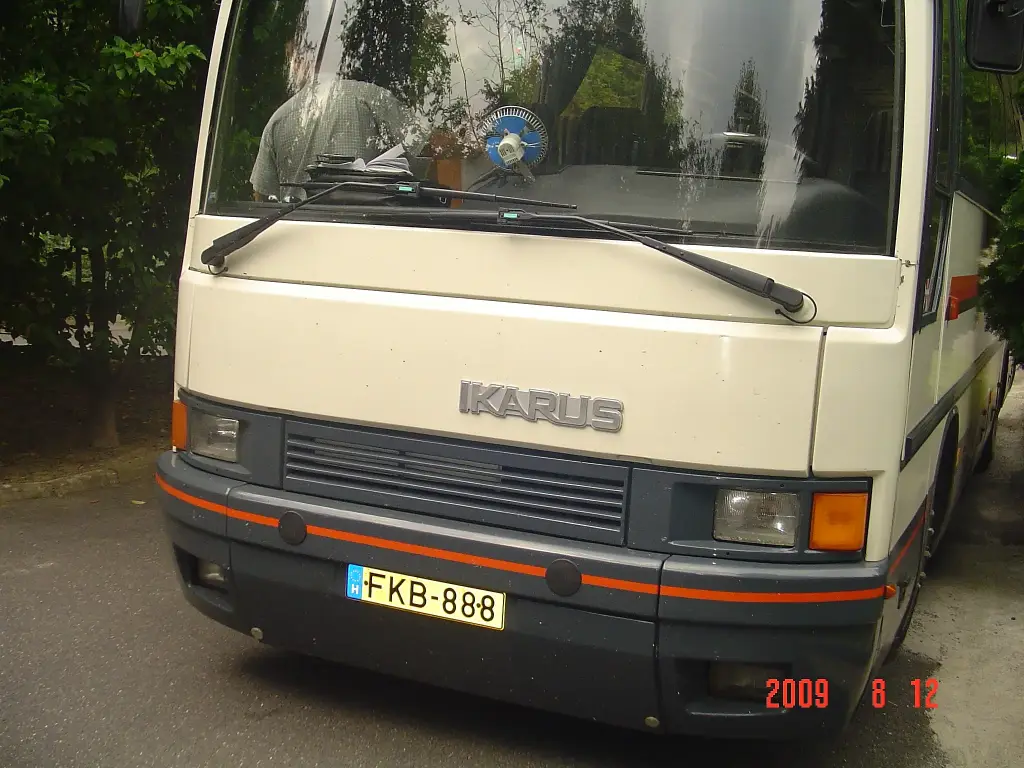
The Ikarus 365 was the compact member of the 300 family of tourist coaches. At 11 metres it was a metre shorter than the Ikarus 350, 386 and 396, and it was built from 1985 to 1993 in 133 examples, including a luxury version.
Ikarus 365 at a glance
| Maker | Ikarus, Budapest-Mátyásföld and Székesfehérvár |
|---|---|
| Type | long-distance tour coach |
| Production | 1985–1993; series from 1986 |
| Built | 133 |
| Length | 11 m |
| Width | 2.5 m |
| Height | 3.5 m |
| Capacity | 46 |
| Top speed | 110 km/h |
| Engine | Rába D2156 MT6U turbo diesel, 184 kW (250 hp) |
| Gearbox | ZF S6-90U, six-speed |
| Suspension | air springs with double shock absorbers |
| Luggage space | 6.5 m³ |
Based on one source: the Hungarian Wikipedia article on the Ikarus 365.
History of the Ikarus 365
The Western bus boom ended in 1977 as the market filled up, and Ikarus again built mainly for the Comecon countries. It was then that the Ikarus 300 family of tourist coaches, associated with the industrial designer Örsi Ferenc, was developed. Series production began in 1986, the year in which two further Ikarus types were presented, the articulated version of the Ikarus 415 and the Ikarus 435.
The 365 was the shortest member of the family. At 11 metres it was a metre shorter than the 350, 386 and 396, and its standard equipment was modest compared with its long-distance relatives, though a luxury version was also built. A few Volán companies had the type — Kisalfóld Volán three, and Jászkun, Bakony and Alba Volán one each — and it could also be seen with public utilities and state bodies.
Mechanically the coach used a Rába D2156 MT6U, a water-cooled, in-line six-cylinder, direct-injection turbocharged diesel mounted horizontally, producing 184 kW at 2,200 rpm and 898 N·m at 1,400 rpm, with a fully synchronised ZF S6-90U six-speed gearbox. Suspension was by air springs with double shock absorbers. The brakes were a two-circuit air system with an air dryer and automatic slack adjusters, plus an automatic exhaust brake, and steering was a Bendeberica ball-and-nut hydraulic system. The frame was welded from square-section steel tubes with tensioned side panels and riveted top plates, protected against corrosion, and there were roll bars at both ends. Inside there were textile and leatherette linings, adjustable passenger seats and a fully adjustable driver’s seat with a companion seat. Heating used hot water, the windscreen was demisted with warm air, and ventilation came from air vents and hand-operated roof hatches. Electrical equipment included a 110 A / 28 V generator, two 182 Ah batteries and fluorescent ceiling lighting, with individual air vents carrying reading lamps and a call button.
The option list was long for its time: DAF, MAN, Mercedes or Cummins engines, ABS/ASR, an automatic gearbox, tinted and heat-insulated side glass, electrically controlled sunblinds and heated mirrors, seats with grab handles, magazine nets, ashtrays, hat racks and folding tables, audio and hi-fi systems, colour television, video, telephone, air conditioning, automatic heating, a minibar, a fridge, a hot-drink machine, a water cooler, a changing room, a WC, a kitchen and special paintwork. The standard performance figures were a top speed of 110 km/h, a payload of 4,800 kg, a gross weight of 16,000 kg, 6.5 m³ of luggage space and a turning circle of 24 metres.
Design and features
- Eleven metres: the shortest coach of the 300 family, a metre less than the 350, 386 and 396.
- Rába turbo diesel: 184 kW (250 hp) through a ZF six-speed gearbox.
- Air suspension: with double shock absorbers for long-distance comfort.
- Comprehensive equipment: fluorescent lighting, individual vents with reading lamps, hot-water heating.
- Luxury version: a more richly equipped coach was also built.
Ikarus 365 versions
- Standard coach: 46 seats, air suspension and the Rába D2156 MT6U.
- Luxury version: the more richly equipped coach mentioned by the source.
- Option packages: alternative DAF, MAN, Mercedes or Cummins engines, ABS/ASR and automatic transmission.
- Special interiors: options ranged from a minibar and WC to a kitchen and a changing room.
The 365 shared the 300 family with the longer Ikarus 350, and its city relatives were the Ikarus 415 and Ikarus 435. More buses are in the Ikarus collection.
Video: Ikarus 260 280 365 – Bus factory in 1986
Video by anjelojetta on YouTube.
Sources
- Ikarus 365, Hungarian Wikipedia: history, dimensions, engine, equipment, options