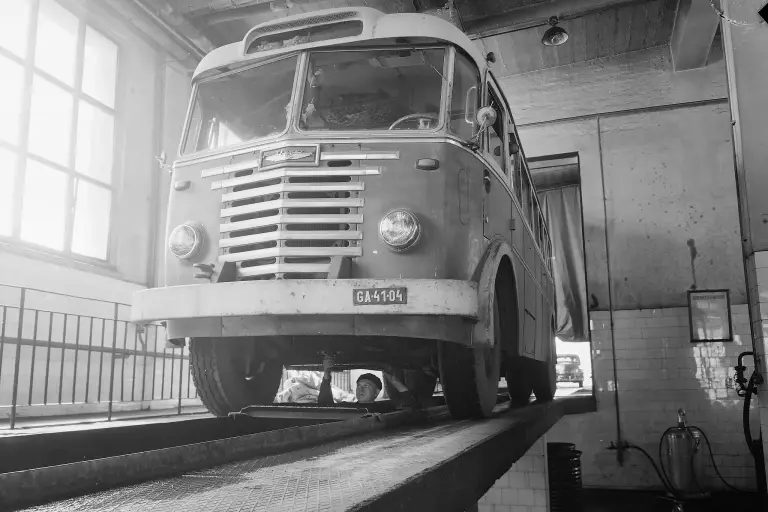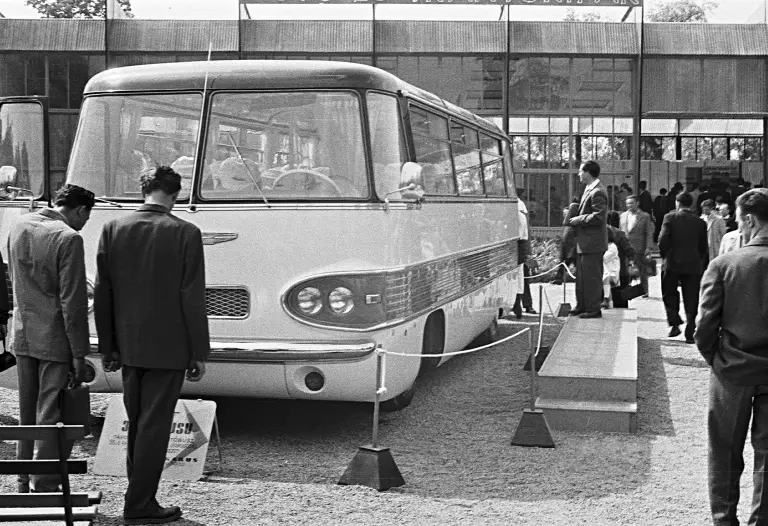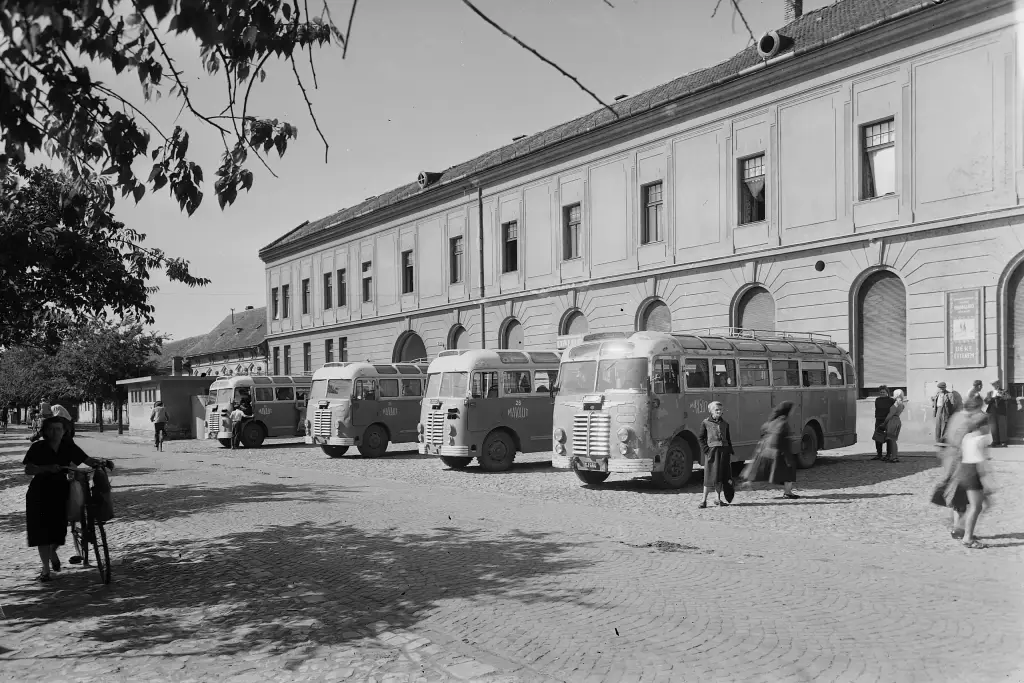
The Ikarus 30 was the first bus the factory sold under the Ikarus name, and the first with a self-supporting body. It left Mátyásföld on 24 February 1951, toured the motor shows of Europe, and became the model that carried the name abroad.
Ikarus 30 at a glance
| Maker | Ikarus, Budapest-Mátyásföld |
|---|---|
| Type | small bus for long-distance and city service |
| First example | 24 February 1951 |
| Body | self-supporting, front-mounted engine |
| Seats | 30+1 in the long-distance version; 19+1 plus 20 standing in the city version |
| Built | 3,175 in seven years |
| East Germany | 662 |
| China | 640 |
| Czechoslovakia | 500 |
| Hungary | about one third of production |
Based on one source: the Hungarian Wikipedia article on the Ikarus 30.
History of the Ikarus 30
Before 1951 the Mátyásföld plant, which had worked under the Ikarus name since 1949, assembled three bus types — the Tr 5, the Tr 3,5 and the M 5 — and they made up only a third of its output, because the factory lived mainly on bodies and special vehicles. Development of a new bus was argued over on both technical and political grounds. The party leadership wanted chassis-based, front-engined buses, the so-called trambuses, while most engineers accepted the need for a self-supporting body but disagreed about where the engine should go. Csepel could not yet build the necessary engine in series. At one point the dispute became so heated that a crash in Buda, in which passengers of a Tr 3,5 died, was blamed on the self-supporting body although the cause was a brake failure.
The outcome was a compromise: Ikarus could build buses with self-supporting bodies, but only with the engine at the front and only in the smaller sizes; larger buses had to keep a chassis, which produced the Ikarus 60. The Ikarus 30 was the result, largely based on the Tr 3,5 that it was meant to replace. The first example left the Mátyásföld works on 24 February 1951; Schmiedt Kázmér and his team were responsible for the design. Capacity grew considerably compared with the Tr 3,5: the long-distance version seated 30 passengers beside the driver, and a city version with 19+1 seats and 20 standing places was built as well, although many had doubted at the drawing board that the bus was big enough for city traffic.
The narrow interior led the designers to add curved windows along the edge of the roof to let in more light. The idea backfired in the heat of summer, when the glass turned the bus into a greenhouse, and the type earned the nickname “nylon bus”. The destination boards sat above the windscreens, with a mechanically directed ventilator above them that never worked well. Demonstration buses toured international exhibitions, including the 1951 Geneva Motor Show, and the type was a considerable success: by 1952 the number built already exceeded all the complete buses the factory had made before. Sixteen entered FAÜ service on 5 June, and although the bus did not prove satisfactory on Budapest routes, about 192 were in service by 1956. In seven years 3,175 were built, only a third of them for Hungary; the largest customers were East Germany with 662, China with 640 and Czechoslovakia with 500. Some were still running in China at the end of the 1990s, and a few with a special interior were built for China as the Ikarus 301. The Ikarus 30s still with the FAÜ in 1960 were stripped of their engines and towed as trailers behind Ikarus 60s until articulated buses arrived.
Design and features
- First Ikarus: the first bus sold under the Ikarus name and the first with a self-supporting body.
- Front-mounted engine: the compromise that the party leadership imposed on the designers.
- Curved roof-edge windows: meant to brighten the small interior, they earned the bus its “nylon bus” nickname.
- Export success: East Germany, China and Czechoslovakia took most of the 3,175 built.
- Second life as a trailer: Budapest buses were stripped and towed behind Ikarus 60s.
Ikarus 30 versions
- Long-distance version: 30+1 seats.
- City version: 19+1 seats and 20 standing places.
- Export versions: the largest batches went to East Germany, China and Czechoslovakia.
- Ikarus 301: a few buses with a special interior built for China.
- Converted trailers: 1960 FAÜ buses stripped of their engines and towed behind Ikarus 60s.
The 30 was followed by the Ikarus 60 and the Ikarus 55. More buses are in the Ikarus collection.
Sources
- Ikarus 30, Hungarian Wikipedia: development, design, production, exports